

You know that feeling when you're standing on the pavement in July, and the heat radiating off the concrete feels just as intense as the sun beating down on your shoulders? That was me last summer, waiting for a bus in downtown Austin, holding a standard black drugstore umbrella.
I was technically "in the shade," but I felt like I was baking in a slow cooker. My sun protection umbrella wasn't protecting me from anything except maybe a light drizzle.
That moment—sweating through my work shirt while thinking "this umbrella isn't working"—is what finally pushed me to dig into the actual physics of sun protection. As someone who's already dealt with a melanoma diagnosis, I couldn't afford to guess anymore. I needed to know why some UV umbrellas keep you cool while others just make you feel like a steamed vegetable, and which colors actually stop the UV rays that matter.
It turns out, the answer isn't as simple as "black vs. white."
TL;DR: Best Sun Protection Umbrella Colors
If you're in a hurry, here's the quick answer:
- Best Overall: Silver exterior + Blue interior (dual-layer) — blocks 99% UV, keeps you 15°F cooler
- Runner Up: Black with UPF 50+ rating — excellent UV blocking but gets hot
- Third Place: White with UPF 50+ coating — cooler but needs special treatment to block UV
- Avoid: Uncoated white or light colors — lets UV rays pass through
- Avoid: Cheap black without UPF rating — absorbs heat, questionable protection
Now let's dig into the science behind why umbrella color matters so much for UV protection.
The "Black Umbrella" Paradox: Great UV Blocking, Terrible Comfort
Here is the thing about black umbrellas that drives people crazy: they are scientifically excellent at blocking UV rays, but they can be miserable to stand under.
Physics tells us that dark colors absorb more UV radiation than light colors. A standard black canopy naturally soaks up about 90% to 95% of those harmful rays. The India Meteorological Department (IMD) has even put out recommendations specifically telling people to use black umbrellas because they create a better "heat sink" effect—absorbing the solar energy so it doesn't hit your skin.
But where does that energy go? It turns into heat. Right there in the fabric.
So yes, you are protected from the burn, but you are also carrying a portable radiator above your head. That 5-10°F temperature spike you feel under a cheap black UV umbrella? That's the fabric radiating absorbed heat back down onto you.
When Black Works Well
Black umbrellas make sense in certain situations:
- Short exposure times — Walking from your car to a building
- Windy conditions — Wind dissipates the heat buildup
- Already using a UPF-rated umbrella — Quality materials handle heat better
- Overcast but UV-present days — Less direct heat but UV still penetrates clouds
The problem is most people use their umbrella for extended periods—beach days, sporting events, outdoor markets—where that heat accumulation becomes unbearable.
Why White Umbrellas Are Tricky for Sun Protection
So I tried a white umbrella next. It reflected the visible light beautifully. I definitely looked more "resort ready," and the fabric didn't turn into a stovetop.
But here is the catch that scared me: white fabric, without specialized coatings, lets a scary amount of UV radiation pass right through. We're talking about 40% to 50% more transmission than black cloth. You stay cooler, but you might still be getting a sunburn.
According to research published in JAMA Dermatology, the weave density and fabric treatment matter more than raw color when it comes to actual UV protection. A loosely woven white fabric is basically transparent to UV rays, even if it looks like solid shade to your eyes.
It felt like a lose-lose choice. Choose black and cook, or choose white and burn.
The White Umbrella Checklist
If you love white UV umbrellas, make sure yours has:
- UPF 50+ certification — Non-negotiable for actual protection
- Tight weave construction — Hold it up to light; you shouldn't see through it
- UV-blocking coating — Often silver or titanium dioxide treatment
- Double-layer canopy — Extra protection layer
Without these features, that white umbrella is just a fashion accessory, not real sun protection.
The Silver Lining (Literally): Why Reflective Coatings Win
Then I discovered the power of silver. Functional? Absolutely. Silver-coated umbrellas are like personal mirrors; they bounce both the UV rays and the heat away before they even touch the fabric.
I measured the temperature difference myself once—it was profound. Standing under a silver UV umbrella felt about 15 degrees cooler than the direct sun.
That cooling effect sold me. But I realized the best designs take it a step further—pairing that reflective silver exterior with a carefully chosen interior color.
The Science of Reflection vs. Absorption
Here's what happens with different umbrella surfaces:
| Surface Type | UV Behavior | Heat Behavior | Net Effect |
|---|---|---|---|
| Black | Absorbs UV | Absorbs heat | Hot underneath, good UV block |
| White | Transmits UV | Reflects heat | Cool underneath, poor UV block |
| Silver coating | Reflects UV | Reflects heat | Cool underneath, excellent UV block |
| Dual-layer | Reflects + absorbs | Reflects + traps | Optimal combo |
The dual-layer approach gives you the best of both worlds—silver reflects the heat away before it can build up, while the interior layer catches any UV that gets through.
The Solution I Finally Settled On: Dual-Layer Sun Protection Umbrellas
After testing nearly a dozen options, I realized the "black vs. white" debate is outdated. The actual solution is what engineers call dual-layer construction.
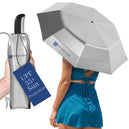
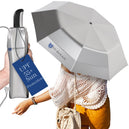
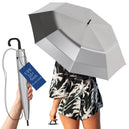
This is what I carry now, and I recommend it to everyone who asks: a sun protection umbrella that is silver on the outside to reflect the heat, but blue on the inside to absorb any stray UV rays that bounce up from the pavement.
It's the cheat code. You get the cooling of the silver reflection and the UV-absorption safety of the blue interior. Plus, looking up at a cool blue canopy is just easier on the eyes than squinting against a bright white underside.

Why Blue Interior Instead of Black?
You might wonder why blue specifically. The engineering reasoning:
- UV absorption — Blue absorbs UV nearly as well as black
- Less heat radiation — Blue radiates less infrared heat downward than black
- Visual comfort — Blue creates a calming visual environment under the canopy
- Reflected light handling — Blue handles reflected UV from sand/water better than black
The technical name for this fabric is often "Solarteck" or similar, and it's specifically engineered for UV umbrella applications.
But What About That Study Saying Umbrellas Don't Work?
You might have seen a headline from a few years back—it was a 2017 JAMA Dermatology study—crying out that "umbrellas don't work!"
I read the actual study. It found that 78% of people using only a beach umbrella got sunburned, compared to 25% using sunscreen.
But here is the detail the headlines missed: they tested standard beach umbrellas. Not high-performance UV gear. If you use a thin piece of canvas with no UV treatment, of course you're going to get burned.
This is why I don't trust any UV umbrella that doesn't have a UPF 50+ rating printed directly on the label. If the manufacturer hasn't tested it, I'm not trusting my skin to it.
What UPF Ratings Actually Mean
When shopping for a UV umbrella, here's the UPF breakdown:
| UPF Rating | UV Blocked | Protection Level |
|---|---|---|
| UPF 15-24 | 93.3-95.9% | Good |
| UPF 25-39 | 96.0-97.4% | Very Good |
| UPF 40-50 | 97.5-98.0% | Excellent |
| UPF 50+ | 98%+ | Maximum |
For serious sun protection, UPF 50+ is the minimum I'd recommend—especially if you have fair skin, a history of skin cancer, or are taking photosensitizing medications.
My Personal Checklist for Choosing a Sun Protection Umbrella
If you are shopping for a sun protection umbrella right now, ignore the color for a second and check these three things first:
1. The UPF 50+ Tag. This is non-negotiable. It's the difference between a "sun shade" and actual safety equipment.
2. The Light Test. Hold the umbrella up to a light bulb. If you can see pinpricks of light coming through the weave, put it back. UV rays are smaller than visible light—if you can see the bulb, the radiation is definitely getting through.

3. Size Matters. On the beach, sand acts like a mirror, reflecting about 25% of UV rays back up at you. A tiny umbrella won't cut it. I use a 7-foot canopy at the beach to make sure my feet aren't sticking out into the "burn zone."
4. Vented Construction. A quality UV umbrella has vents that let wind pass through instead of catching like a sail. This prevents the umbrella from inverting and extends its lifespan significantly.
The Complete Sun Protection Umbrella Color Ranking
If I had to rank them based on my own experience:
First Place: Dual-Layer (Silver exterior, Blue interior). It's the only design that keeps me cool and safe without compromise. The silver reflects the heat, the blue absorbs stray UV, and you get that 15°F temperature drop that makes all the difference.
Second Place: Black (with UPF 50+ rating). You might get a little warm, but you won't get burned. Best for short exposure or windy conditions.
Third Place: White (ONLY if it has a certified UPF 50+ coating). If you love the look, just double-check that label. Without certification, it's just shade, not protection.
Fourth Place: Colored umbrellas (Red, Blue, Green). Performance varies wildly. Some are great, some are useless. Always verify the UPF rating.
Fifth Place: Uncoated white or pastel. These look pretty but provide minimal UV protection. Fine for a brief café lunch, dangerous for beach day.
Common Mistakes People Make with Sun Protection Umbrellas
Based on conversations with dermatologists and my own trial-and-error:
Mistake #1: Assuming All Shade is Equal
The shadow under a tree is different from the shadow under a quality UV umbrella. Trees scatter UV rays; engineered fabrics block them entirely. Don't conflate "being in the shade" with "being protected."
Mistake #2: Forgetting Ground Reflection
Sand reflects 25% of UV. Water reflects up to 100%. Snow reflects 80%. Your umbrella needs to be large enough to block these reflected rays coming from below, not just direct sunlight from above.
Mistake #3: Using Rain Umbrellas for Sun
Rain umbrellas and UV-blocking umbrellas are different products. Rain umbrellas prioritize water resistance; sun umbrellas prioritize UV blocking. The fabric treatments, weave densities, and coatings are completely different.
Mistake #4: Ignoring the Heat Factor
UV protection isn't the only consideration. If your umbrella makes you so hot that you abandon it, you end up with no protection at all. The best umbrella is the one you'll actually use consistently.
The Bottom Line on Sun Protection Umbrella Colors
Don't overthink the fashion aspect. Your skin doesn't care if the umbrella matches your outfit—it cares if it blocks the radiation. Grab a dual-layer umbrella with that silver-outside, blue-inside construction, and enjoy the summer without the stress.
The combination of reflective exterior + absorptive interior + UPF 50+ certification + adequate size is what separates a real UV-blocking umbrella from a fashion accessory that happens to create shade.