Free Shipping on US Orders!
 Dermatologist Approved
 Designed for Maximum Sun Protection


When most people shop for the best umbrella for sun protection, they reach for the biggest canopy they can find. Logical instinct — more fabric means more shade, right?
Not exactly. According to the American Academy of Dermatology, shade quality depends on fabric construction and UV-blocking ability, not size. A 60-inch umbrella with no UV treatment lets significant radiation through. A compact 42-inch umbrella with UPF 50+ coating blocks 98% of it.
The best umbrella for sun protection is the one that blocks UV, fits your daily life, and actually gets used. Here's how to tell the difference between real protection and just a bigger shadow.
Why size isn't the best measure of umbrella sun protection
Oversized umbrellas look protective. But in daily use, size creates problems that reduce how often you actually carry one — which means less protection, not more.
- Wind vulnerability: Larger canopies catch more wind. On breezy sidewalks and parking lots, a big umbrella becomes a liability — inverting, pulling, or snapping ribs
- Carrying fatigue: A heavy, awkward umbrella gets left at home. If it doesn't fit in your bag, it doesn't come with you
- False security: Size alone doesn't block UV. The Skin Cancer Foundation notes that standard fabric without UV treatment provides surprisingly little protection — a basic white cotton canopy might only rate UPF 5–7
A compact umbrella built with reflective UV-blocking fabric outperforms an oversized standard umbrella every time — because fabric quality determines protection, and portability determines usage frequency.
What makes the best umbrella for sun protection
Three factors separate genuine sun protection from marketing labels.
UV-blocking fabric, not just shade
Standard umbrella fabric blocks visible light but allows UV radiation through. You feel cooler in the shadow, but your skin is still absorbing damaging UVA and UVB rays.
The best umbrella for sun protection uses fabric engineered to physically block UV — silver reflective coatings, titanium dioxide treatments, or densely woven specialty fabrics with independently verified UPF ratings.
Reflective technology for heat reduction
Dark fabric absorbs UV, which means it heats up — creating a greenhouse effect under the canopy. Silver or metallic-coated fabrics reflect UV and infrared radiation away, keeping the air underneath measurably cooler.
Independent testing shows reflective UV umbrellas can reduce temperature under the canopy by 10–15°F compared to standard umbrellas. In hot conditions, that difference is the gap between comfort and heat exhaustion.
Portability that ensures daily use
The CDC reports that most skin cancer damage comes from cumulative daily exposure — not occasional beach days. The best umbrella for sun protection is the one you carry every day, not the one that stays in your closet because it's too bulky.
Under 1 pound, compact fold, push-button open — these features determine whether an umbrella becomes a daily habit or an occasional accessory.
UPF rating explained: how sun protection umbrellas are tested
UPF (Ultraviolet Protection Factor) is the industry standard for measuring fabric UV protection. Unlike SPF — which only tracks UVB and varies with application thickness — UPF measures both UVA and UVB blocking consistently.
Here's what the numbers mean:
| UPF Rating | UV Blocked | Protection Category |
|---|---|---|
| UPF 15–24 | 93–96% | Good |
| UPF 25–39 | 96–97% | Very Good |
| UPF 40–50 | 97.5–98% | Excellent |
| UPF 50+ | 98%+ | Maximum rated |
Testing happens in labs using spectrophotometers — no human variability, no application errors. The number on a UPF-rated umbrella is what you actually get, every time you open it.
If an umbrella doesn't list a UPF rating, it hasn't been tested. "UV protection" without a number is a marketing claim, not a measurement. Always check the rating.
Best umbrella sun protection features by activity
The right umbrella depends on how you'll use it. Here's what matters for each scenario.
Daily errands and commuting
- Priority: Compact size, one-hand open, under 1 lb
- Why: You're in and out of stores, cars, and offices. The umbrella needs to deploy fast and disappear into your bag when not needed
- UPF minimum: 50+ (non-negotiable for daily cumulative exposure)
Beach and pool days
- Priority: Maximum canopy size, ground stake, wind resistance
- Why: You're stationary for hours in high-UV conditions with sand and water reflecting UV from below
- UPF minimum: 50+ with reflective coating (sand reflects up to 25% of UV back upward)
Golf and outdoor sports
- Priority: 62–68" arc, cart compatibility, vented canopy
- Why: 4+ hours of stationary exposure on open courses with no shade trees
- UPF minimum: 50+ (professional golfers receive 217× the UV dose needed for sunburn annually)
Medical sun sensitivity (lupus, post-melanoma)
- Priority: Maximum UPF, reflective fabric, broad coverage
- Why: UV avoidance is medically prescribed. Physical barriers don't require reapplication and don't degrade in heat
- UPF minimum: 50+ with Melanoma International Foundation approval
Winter sun protection: why your umbrella still matters
Cold weather creates a false sense of UV safety. According to the EPA, up to 80% of UV radiation penetrates cloud cover. Winter air blocks warmth, not radiation.
Winter makes UV worse in specific ways:
- Snow reflects up to 80% of UV — doubling your effective dose from ground-level reflection
- Glass buildings and icy pavement bounce UV at angles a hat can't cover
- Cold air eliminates the warming sensation that normally alerts you to UV exposure, so burns go unnoticed
A UV umbrella works identically in January as in July. UPF ratings don't change with temperature. Carrying one year-round turns sun protection from a summer project into a daily constant.
Best UV-Blocker umbrellas for sun protection
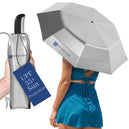
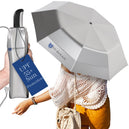
Every UV-Blocker umbrella blocks 99% of UVA/UVB rays with Solarteck™ reflective fabric — keeping temperatures under the canopy up to 15°F cooler. All are dermatologist-recommended.
UV-Blocker Compact Umbrella — best for daily carry
42" arc. Lightest option in the lineup. Push-button auto open/close for one-hand use. Fits backpacks, tote bags, and car door pockets. The umbrella you'll actually carry every day.
UV-Blocker Travel Umbrella — best all-around
44" arc. Slightly more coverage than the Compact while staying portable. Silver reflective exterior bounces UV away; dark interior prevents reflection from below. Ideal for travel, commuting, and general outdoor use.
UV-Blocker Large Folding Umbrella — best for families
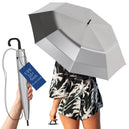
62" arc. Covers 2–3 people under one canopy. Wind-resistant vented design for open environments. When you need more coverage for group outings, markets, or watching kids' outdoor events.
UV-Blocker 68" Golf Umbrella — best for maximum coverage
68" arc (58" diameter). The only golf umbrella approved by the Melanoma International Foundation. Patented Vented Mesh System for wind resistance. When maximum shade area is the priority and portability is secondary.
Browse the full UV umbrella collection to find the right fit.
Frequently asked questions
Does a bigger umbrella always mean better sun protection?
No. A large umbrella without UV-blocking fabric lets significant radiation through. A smaller umbrella with UPF 50+ coating blocks 98%+ of UV. Fabric quality determines protection; size determines coverage area.
What UPF rating should I look for in a sun protection umbrella?
UPF 50+ is the maximum rated category, blocking 98%+ of both UVA and UVB rays. For daily use and cumulative sun exposure, UPF 50+ is the baseline to look for. Avoid umbrellas that don't list a UPF number.
Can I use a regular rain umbrella for sun protection?
A rain umbrella blocks some visible light but doesn't reliably block UV radiation. Standard fabrics may only provide UPF 5–10. For real sun protection, you need fabric specifically engineered and tested for UV blocking.
Is the best umbrella for sun protection different in winter vs. summer?
The same UPF-rated umbrella works year-round — UPF ratings don't change with temperature. Winter UV is still strong (80% penetrates clouds), and snow reflects UV upward. A UV umbrella provides consistent protection regardless of season.
How much cooler is it under a UV umbrella vs. a regular umbrella?
Reflective UV umbrellas (like UV-Blocker's Solarteck™ fabric) keep air underneath up to 15°F cooler than ambient temperature. Standard umbrellas absorb heat rather than reflecting it, creating a warmer microclimate underneath.
Why the Best Umbrella for Sun Protection Isn't Always the Biggest: Frequently Asked Questions
Why is material quality more important than the physical size of the umbrella?
Large, standard umbrellas often use thin polyester that allows up to 10% of UV radiation to leak through the fabric. In contrast, UV-Blocker umbrellas utilize Solarteck® technology to achieve a UPF 50+ rating, which blocks 99% of UVA and UVB rays. This specialized fabric ensures that even a compact model provides clinically superior protection compared to a massive, non-rated beach umbrella.
Does a larger canopy provide better protection against reflected UV rays?
A large size does not stop the 80% of UV rays reflected by sand or 10% reflected by water, which can still cause skin damage under the canopy. UV-Blocker umbrellas are specifically engineered with Solarteck® fabric and recommended by the Melanoma International Foundation to manage these risks. High-quality, lab-tested materials are more effective at reducing overall exposure than simply increasing the diameter of an unrated fabric.
How does the UPF 50+ rating of a smaller specialized umbrella compare to a standard large one?
A standard large umbrella might only offer an estimated SPF 5, whereas a UV-Blocker umbrella provides a certified UPF 50+ rating, the highest possible sun protection grade for fabrics. This means the material allows less than 2% of UV radiation to pass through, whereas unrated large umbrellas can allow significant transmission. The Solarteck® technology ensures that protection is concentrated and effective, regardless of the umbrella's total surface area.
Why is the portability of a smaller UV umbrella considered a safety advantage?
Sun damage is cumulative, and a smaller, portable UV-Blocker umbrella is more likely to be used consistently during the peak UV hours of 10 AM to 4 PM. These umbrellas carry the Melanoma International Foundation seal of approval, signifying they meet rigorous standards for preventing skin cancer. By using high-density Solarteck® fabric, these portable models deliver 99% UV protection in a practical size that ensures you are never without a reliable defense.