

By 2030, one in five Americans will be 65 or older—a demographic shift representing 71.6 million people. This population faces the highest skin cancer rates of any age group, yet data from the Centers for Disease Control and Prevention indicates that less than half of older adults actively protect their skin from the sun.
For seniors, standard rain umbrellas fail to provide adequate solutions. Traditional mechanisms are often painful for arthritic hands to operate, heavy frames strain weakened muscles during walks, and regular canopy fabrics typically block only 50-60% of harmful UV rays.
This guide examines the criteria that define a "senior-friendly" UV umbrella—from strict weight limits and auto-open mechanisms to compatibility with mobility devices—providing actionable advice for seniors and caregivers seeking protection that accommodates aging bodies.
Why Do Seniors Need More UV Protection Than Younger Adults?
Seniors face higher skin cancer risk due to thinner skin, decades of cumulative sun damage, and photosensitizing medications that 20% of older adults take daily.
An estimated 234,680 melanoma cases will be diagnosed in the US in 2026, representing a 46.6% increase over the past decade. The Skin Cancer Foundation notes that the majority of deaths from this disease occur in people over 65. This heightened mortality risk is driven by biological changes; aging skin produces less melanin and possesses thinner protective layers, allowing ultraviolet radiation to penetrate deeper into the dermis than it would in younger skin.
Beyond structural skin changes, pharmaceutical factors play a critical role. Many common prescriptions—including diuretics for blood pressure, statins for cholesterol, and NSAIDs for pain management—carry side effects of photosensitivity. These medications can cause the skin to burn in a fraction of the time normally expected. Research indicates that photosensitivity is responsible for approximately 20% of adverse drug reactions in older adults.
The risk is compounded by cumulative exposure. A lifetime of sun interaction means pre-cancerous cells may already exist within the skin tissue. Each additional exposure acts as a trigger for progression, making current protection strategies more critical than at any previous life stage. Dermatologists consistently recommend physical barriers like UV umbrellas for this demographic because they provide consistent shade without the chemical absorption or reapplication issues associated with sunscreen.
What Makes an Umbrella "Senior-Friendly"?
Senior-friendly umbrellas combine lightweight frames under 1 lb, auto-open buttons requiring minimal force, soft-grip handles for arthritic hands, and UPF 50+ fabric blocking 99% of UV rays.
The physical specifications of an umbrella determine its usability for an older adult. Weight is the primary factor; holding an object at arm's length creates significant torque on the shoulder and wrist. With grip strength declining by 30-50% as part of the natural aging process, a standard 2-pound umbrella becomes unmanageable quickly. A true senior-friendly option must weigh less than 1 lb (16 oz) to allow for comfortable use during walks or outdoor events.
The deployment mechanism is equally important. Manual spring-loaded runners require a grip-and-push motion that can be excruciating for someone with arthritis. An auto-open system, activated by a single button press, removes this physical barrier. Handle design further impacts usability; soft-grip, rubberized handles prevent slipping if a hand is sweaty or weak, while wider handles help distribute pressure across the palm rather than digging into sensitive joints.
Protection levels distinguish UV umbrellas from standard rain gear. While a black rain umbrella provides shade, it allows roughly 40-50% of UV radiation to pass through the weave. A medical-grade UV umbrella requires a UPF 50+ rating, blocking at least 98% of UVA and UVB rays. Finally, wind resistance is a safety feature. A vented canopy that allows wind to pass through prevents the umbrella from inverting or pulling the user off balance—a critical fall prevention measure.
Best Lightweight UV Umbrella for Seniors (Under 1 lb)
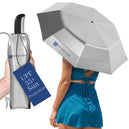
The UV-Blocker Compact weighs just 13 oz with full auto-open/close functionality, making it the lightest medical-grade UV umbrella suitable for purses, walkers, or daily carry.
For a senior with average strength, the difference between a 13-ounce umbrella and a 2-pound alternative is the difference between protection and fatigue. Holding a heavier object for 30 minutes creates muscle strain that can lead to tremors or simply dropping the item.
The UV-Blocker Compact UV Umbrella is engineered specifically for this weight threshold. Weighing only 13 oz, it features a 42-inch arc and 39-inch coverage diameter. It collapses to 11.5 inches, easily fitting into a tote bag, walker basket, or large pocket. The auto-open and auto-close mechanism allows the user to deploy and retract the canopy with one hand, maintaining balance with the other.
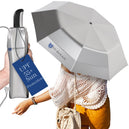
For those requiring more extensive coverage, the UV-Blocker Travel UV Umbrella serves as a strong alternative. At 1 lb 5 oz (21 oz), it remains manageable for most adults but offers a larger 44-inch arc and a deeper dome profile. This shape provides superior protection from angled sun during early morning or late afternoon walks. It includes a shoulder strap for hands-free carrying when closed.
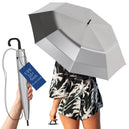
Seniors should avoid "stick" or golf umbrellas, which frequently exceed 2 lbs. While these offer vast coverage, their length and weight make them unwieldy for anyone with balance issues or reduced upper body strength. Beach umbrellas are similarly unsuitable for personal mobility due to their weight and lack of ergonomic handles.
For specific recommendations on portable protection, consult a travel UV umbrella guide to compare size-to-weight ratios further.
How Do Auto-Open Umbrellas Help Seniors with Arthritis?
Auto-open umbrellas use a single button press requiring minimal force, eliminating the painful grip-and-push motion that makes manual umbrellas unusable for arthritic hands.
Manual dexterity issues are prevalent in the aging population. Nearly 50% of adults over 70 experience difficulty with tasks requiring fine motor skills or strong grip, and arthritis affects hand function in approximately 25% of seniors. For these individuals, the standard umbrella mechanism—which requires squeezing a small metal tab while simultaneously pushing a runner up the shaft against spring tension—is mechanically impossible or severely painful.

Auto-open mechanisms replace this compound motion with a simple button press. The force required to depress the button is minimal, accessible even to those with severe joint inflammation. It is important to distinguish between "auto-open" and "auto-open/close." Auto-open umbrellas deploy with a button but require manual closure. Auto-open/close models use the button for both actions, collapsing the canopy instantly. This second feature is particularly valuable for getting into cars or entering buildings quickly.
Handle ergonomics complement the mechanism. Hard plastic or smooth wood handles can be difficult to grasp securely. Rubberized soft-grip coatings increase friction, allowing the user to hold the umbrella with a relaxed grip rather than a tight clench. Wide handles further assist by reducing the pressure points on finger joints.
What Are the Best Umbrella Options for Wheelchairs and Walkers?
Universal umbrella holders clamp to wheelchairs, walkers, and rollators, providing hands-free UV protection without requiring the user to hold anything.
Users of mobility devices face a unique challenge: their hands are occupied with operating the device. A walker user needs both hands for stability; a manual wheelchair user needs hands for propulsion. Holding an umbrella is not just inconvenient; it is a safety hazard.
The solution lies in mounting hardware. Universal Umbrella Holders are adjustable clamps designed to attach to the tubing of wheelchairs, walkers, rollators, and even strollers. These devices typically feature a multi-position joint that allows the umbrella to be angled against the sun's position. Quality holders, such as those compatible with UV-Blocker umbrellas, fit round or square tubing and can be tightened without tools.

Pairing a Compact or Travel umbrella with a holder creates a complete system. The holder takes the weight, meaning the 1 lb limit applies less strictly, though a lighter umbrella puts less leverage on the clamp, ensuring it stays secure. This setup restores independence, allowing the user to remain outdoors comfortably without relying on a caregiver to hold shade over them.
Modern holders are designed with an outdoor gear aesthetic rather than a clinical appearance. This distinction is important for dignity; the equipment looks like an active lifestyle accessory rather than a medical necessity. For detailed mounting options, referencing a wheelchair umbrella guide can help verify compatibility with specific chair models. Further specifications on stability can be found in resources discussing wheelchair umbrella features.
Which Medications Make Seniors More Sensitive to Sun?
Common senior medications including diuretics, statins, NSAIDs like ibuprofen, and certain antibiotics significantly increase sun sensitivity, causing burns in minutes rather than hours.
Photosensitivity is a chemically induced change in how skin reacts to ultraviolet radiation. When a senior takes a photosensitizing drug, the medication absorbs UV energy and releases it into the skin, causing cell damage that manifests as exaggerated sunburn, rashes, or blistering.
Several widely prescribed drug classes are known offenders:
| Drug Class | Purpose | Common Examples |
|---|---|---|
| Diuretics | High Blood Pressure | Hydrochlorothiazide |
| Statins | Cholesterol Management | Atorvastatin, Simvastatin |
| NSAIDs | Pain Relief | Ibuprofen, Naproxen |
| ACE Inhibitors | Blood Pressure | (Prescribed formulations) |
| Antibiotics | Infection Treatment | Doxycycline, Ciprofloxacin |
Polypharmacy—the use of multiple medications concurrently—is common in geriatrics, with many seniors taking five or more prescriptions daily. This combination can compound sensitivity risks. For these individuals, sunscreen alone is often insufficient because the chemical reaction occurs from within the skin tissue. Physical barriers provide the only reliable defense. A lupus sun protection guide offers parallel insights, as lupus patients face similar extreme sensitivity challenges requiring absolute UV avoidance.
Gift Guide: UV Umbrellas for Elderly Parents Who Refuse Sunscreen
UV umbrellas bypass sunscreen resistance by providing passive protection—seniors don't need to apply, reapply, or remember anything once the umbrella is open.
Caregivers often struggle with aging parents who refuse to wear sunscreen. The resistance stems from valid complaints: lotions can feel greasy, application is physically difficult for stiff shoulders and hands, and cognitive changes can make the complex routine of application and reapplication hard to track. Many seniors also hold the belief that they "never needed it before," ignoring the biological changes in their skin.
A UV umbrella solves these friction points through passive protection. There is no routine to memorize and no sensory discomfort. The protection is binary: if the umbrella is open, they are safe.
When presenting a UV umbrella as a gift, framing is crucial. Rather than emphasizing "safety" or "cancer prevention"—which can feel nagging—focus on immediate comfort. Describe it as a "cooling umbrella" that lowers the temperature by 15 degrees. This benefit is immediately tangible. To ensure the gift is used, pair a Compact umbrella with a walker holder or a car visor clip. Making the item instantly accessible removes the final barrier to use.
Frequently Asked Questions About UV Umbrellas for Seniors
Q: How heavy is too heavy for a senior's umbrella? Under 1 lb (16 oz) is ideal for most seniors; over 1.5 lbs causes arm fatigue during extended use, especially for those with reduced grip strength. The UV-Blocker Compact at 13 oz and Travel at 1 lb 5 oz both fall within the comfortable range. Stick/golf umbrellas typically weigh 2+ lbs and are better suited for stationary use.
Q: Will arthritis prevent someone from using a UV umbrella? Auto-open umbrellas with soft-grip handles are specifically designed for arthritic hands, requiring only a gentle button press rather than grip-and-push force. Look for "auto-open" (not manual) mechanisms and rubberized handles. Avoid umbrellas with small, hard plastic handles or manual spring mechanisms.
Q: Are bigger umbrellas better for sun protection? Larger coverage helps, but weight matters more for handheld use—a 42" umbrella at 13 oz provides adequate shade without arm strain. Golf-size umbrellas (62"+) offer maximum coverage but weigh 2+ lbs. For seated use with a holder, larger is fine; for walking, prioritize lighter weight.
Q: Can a UV umbrella be used on a walker or rollator? Yes, with a universal holder that clamps to the frame, providing hands-free protection while maintaining walker stability and mobility. The Universal Umbrella Holder fits most standard walkers, rollators, and wheelchairs. Pair with a Compact or Travel umbrella for the best combination.
Q: Does Medicare cover UV umbrellas? Standard Medicare does not cover UV umbrellas as durable medical equipment, but HSA/FSA accounts can be used to purchase sun protection products. Check with your HSA/FSA administrator—UV-Blocker products are eligible for many health spending accounts as preventive care items.
Q: What's the difference between UPF and SPF ratings? UPF measures fabric protection (clothing/umbrellas), while SPF measures sunscreen protection—both should be 50+ for adequate defense against UV rays. A UPF 50+ umbrella blocks 99% of UV rays. For comparison, regular dark umbrellas without UV treatment only block 50-60%.
Conclusion: Choosing the Right UV Umbrella
Selecting appropriate sun protection for seniors requires balancing medical necessity with physical capability. The data is clear: older adults face the highest risks from UV exposure due to thinning skin, cumulative damage, and medication side effects. Yet, standard solutions often fail to accommodate the realities of aging, such as reduced grip strength and mobility challenges.
A truly senior-friendly umbrella must meet specific criteria: a weight under 1 lb to prevent fatigue, an auto-open mechanism to bypass dexterity issues, soft-grip handles for comfort, and UPF 50+ fabric for verified protection. For those using walkers or wheelchairs, the addition of a Universal Holder transforms a handheld accessory into a hands-free safety system.
| Need | Best Choice | Why |
|---|---|---|
| Lightest option | UV-Blocker Compact (13 oz) | Auto-open/close, fits in purse |
| More coverage | UV-Blocker Travel (1 lb 5 oz) | Deeper dome, shoulder strap |
| Walker/wheelchair use | Compact + Universal Holder | Hands-free, adjustable angle |
| Gift for resistant parent | Compact + "cooling" framing | Passive protection, no routine |
Immediate Action: Measure the heaviest item your parent or you currently carry comfortably. If it is under 1 lb, the Compact will feel effortless. If weight is less of a concern, the Travel's extra coverage provides broader shade. Explore UV-Blocker's senior-friendly options to find medical-grade protection approved by the Melanoma International Foundation.