Free Shipping on US Orders!
 Dermatologist Approved
 Designed for Maximum Sun Protection


TL;DR
- Insert umbrella pole 18-24 inches deep (CPSC recommends 2 feet minimum)
- Tilt into the wind so wind pushes umbrella down, not up
- Use secondary anchoring (sand bags, screw anchors) for extra security
- Check anchor every 1-2 hours as wind conditions change
- Know when to close: Take down at sustained winds over 25-30 mph
- Yearly reality: Over 3,000 ER visits from umbrella injuries—proper anchoring prevents most

A beach umbrella provides essential shade and UV protection. A poorly anchored beach umbrella becomes a dangerous projectile.
The Consumer Product Safety Commission reports that approximately 3,000 people visit emergency rooms annually due to umbrella-related injuries. Most of these injuries happen when umbrellas are lifted by wind and strike bystanders—a completely preventable scenario with proper anchoring.
Learning how to anchor your beach umbrella isn't complicated. It requires five minutes of setup, some basic physics awareness, and occasional monitoring. Here's the complete guide.

Why Beach Umbrella Anchoring Matters
The physics are straightforward: a beach umbrella is a large surface area attached to a lightweight pole. Even moderate wind creates significant upward force on the canopy. If that force exceeds the resistance from your anchoring, the umbrella launches.
A typical beach umbrella weighs 5-10 pounds. In a 20 mph wind gust, that umbrella can generate enough lift to pull free from shallow sand and travel at dangerous speeds. The pointed end of the pole becomes a spear.
The ASTM F3681-24 Beach Umbrella Safety Standard now requires that beach umbrellas provide 75 pounds of resistance at the base to withstand winds up to 30 mph. But that standard only applies if you anchor the umbrella correctly.
The real risk: Most beach umbrella injuries don't happen to the owner—they happen to bystanders. Your poorly anchored umbrella could seriously injure someone else's child. Proper anchoring isn't just about your convenience; it's about everyone's safety.
How to Anchor Beach Umbrella: The 5-Step Method
Step 1: Choose the Right Location
Where you plant your umbrella determines half of its stability.
Wet sand vs. dry sand: Wet, compact sand provides 2-3x better grip than dry, loose sand. Set up closer to the water line (while still above high tide) rather than in the soft, dry sand near the dunes.
Natural windbreaks: Position near dunes, beach structures, or vegetation that can reduce direct wind exposure. Even a partial windbreak significantly reduces the force your anchor must resist.
Fall zone clearance: Assume your umbrella might fall. Is there clear space for it to land without hitting anyone? Don't set up immediately adjacent to other beach-goers' areas.
Observe wind direction: Before you start digging, stand still for a moment and note wind direction. This determines your tilt angle in Step 3.
Step 2: Dig Deep (18-24 Inches Minimum)
This is where most people fail. Insufficient depth is the primary cause of umbrella blowouts.
The CPSC recommendation: Two feet of depth. That's 24 inches—significantly deeper than most people think to dig.
Practical measurement: Most umbrella poles have 30-36 inches of pole below the canopy attachment point. You want roughly half to two-thirds of that pole in the sand.
Why depth matters: It's basic lever physics. The longer the lever arm in the sand, the more resistance to rotation. A pole 6 inches in the sand will pivot out easily. A pole 24 inches in the sand requires exponentially more force to dislodge.
Technique: Dig the hole first, then insert. Don't try to twist the umbrella pole into packed sand—you'll bend the pole. Create the hole, drop the pole in, and pack sand firmly around it.
Step 3: Tilt Into the Wind
This counterintuitive step is the difference between a stable umbrella and a flying one.
The principle: When you tilt the umbrella into the wind, the wind pushes the canopy down into the anchor point instead of lifting it up. The wind becomes your ally, not your enemy.
How to do it: Open the umbrella, then tilt the top of the pole toward the wind direction at approximately 15-20 degrees from vertical. The wind should hit the top of the canopy first, pushing down.
Test it: Stand under the umbrella. The shade should fall slightly behind you (downwind), not in front of you.
A common mistake: People intuitively tilt the umbrella away from the wind, thinking they're "sheltering" it. This creates an airfoil effect that generates lift—exactly what you don't want.

Step 4: Add Secondary Anchoring
Even with proper depth and angle, secondary anchoring provides crucial backup security—especially on windy days.
Sand bag weights: Fill mesh bags or purpose-built umbrella weights with sand (approximately 10-20 pounds each) and attach to the pole base or lower spokes. These add downward force that resists lifting.
Screw-in anchors: Spiral or corkscrew-style anchors twist into sand, creating significant resistance. The spiraling motion compacts surrounding sand, multiplying holding power with each turn. These typically cost $15-25 and work well for regular beach-goers.
The BeachBUB system: For serious beach users, this integrated system includes a sand gopher, sandbag tarp, and anchor system designed to meet ASTM safety standards. It's more expensive ($80+) but provides professional-grade security.
DIY solutions: In a pinch, pile sand on the base, hook the pole to your cooler, or use your beach bag as additional weight. Any extra downward force helps.
Step 5: Monitor and Adjust
Wind doesn't stay constant. Conditions that were safe at 10 AM might be dangerous at 2 PM.
Check every 1-2 hours: Give your anchor a gentle test pull. Inspect that sand hasn't loosened around the base. Verify your tilt angle still matches the (potentially changed) wind direction.
Watch for gusts: Steady 15 mph wind is manageable. Sudden gusts to 30 mph are dangerous. If you notice increasing gustiness, consider closing your umbrella temporarily.
Know when to quit: When sustained winds exceed 25-30 mph, no amount of anchoring makes a beach umbrella safe. Close it, lay it flat, or take it to your car. Pride isn't worth an injury.

Beach Umbrella Anchor Options Compared
| Anchor Type | Ease of Use | Wind Resistance | Price | Best For |
|---|---|---|---|---|
| Built-in spike | Easy | Moderate | Included | Light wind, casual use |
| Screw anchor | Moderate | Good | $15-25 | Regular beach trips |
| Sand bags | Easy | Good | $20-40 | Families, extra security |
| BeachBUB system | Complex | Excellent | $80+ | Frequent beach users |
The trade-off: More effective anchoring systems generally require more setup time and cost more. For occasional beach trips in calm conditions, the built-in spike on your umbrella is adequate. For regular beach days or windier locations, invest in a proper screw anchor or sand bag system.
Common Anchoring Mistakes to Avoid
Not going deep enough: The most common failure. If you can see more than 12 inches of pole above the sand, you haven't gone deep enough. Most beach umbrella blowouts happen because people dug 6-8 inches instead of 18-24.
Tilting away from wind: Instincts tell us to shelter from wind by tilting away. Physics says tilt into wind. Trust the physics.
Ignoring changing conditions: Morning setup doesn't guarantee afternoon safety. Conditions change. Monitor throughout your beach day.
Using cheap, bendy poles: Budget umbrellas often have thin aluminum poles that flex or bend. A flexing pole reduces the effectiveness of your anchor. Look for fiberglass or thick aluminum construction.
Leaving unattended during gusts: Even a well-anchored umbrella can lift during sudden strong gusts. If you're going in the water, have someone stay near the umbrella or close it temporarily.
How to Choose an Umbrella That Anchors Better
Not all beach umbrellas are created equal. Some designs inherently anchor better than others.
Pole diameter and material: Thicker poles (1.5" or more) resist bending and provide more surface area for sand to grip. Fiberglass poles don't corrode and maintain stiffness over years of use.
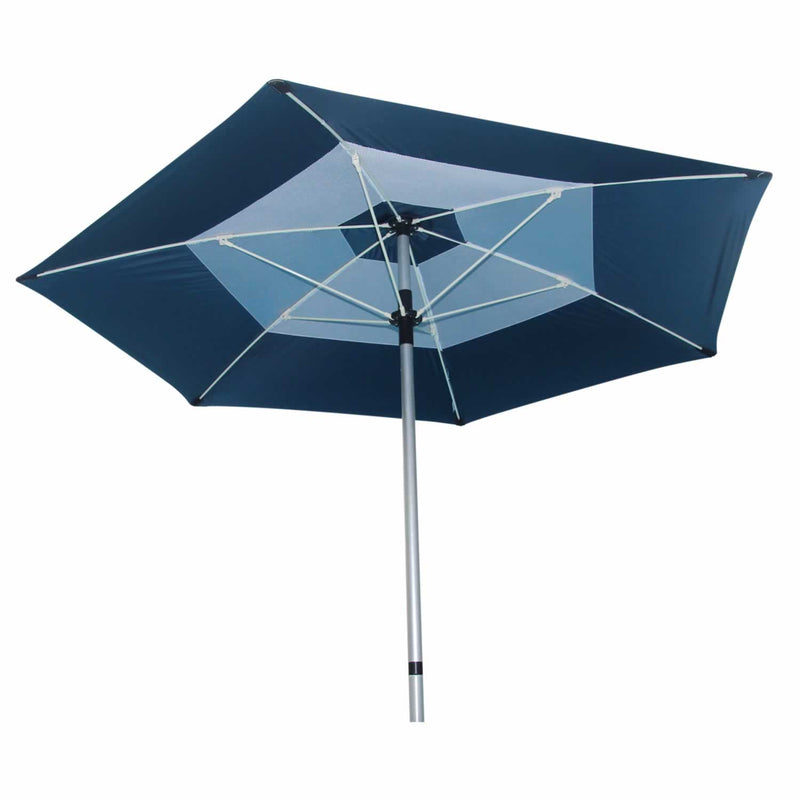
Built-in anchor design: Some umbrellas come with integrated sand spikes—pointed ends designed to grip sand. The UV-Blocker Large Beach Umbrella features an integrated anchor system designed for secure planting.
Vented canopy: Vented or double-canopy designs allow wind to pass through rather than building up lift force underneath. This significantly reduces the load on your anchor.
UV protection AND stability: The best beach umbrella provides both solid anchoring and genuine UV protection. Look for UPF 50+ rated canopies that also feature wind-resistant design elements. The UV-Blocker Personal Beach Umbrella combines UPF 50+ protection with stability features.

What to Do If Your Umbrella Starts to Lift
Despite best efforts, you might feel your umbrella beginning to lift. Quick action prevents injury.
Grab the pole immediately: Don't wait to see if it stabilizes. Get your hands on the pole before it gains momentum.
Close the canopy first: A closed umbrella has dramatically less wind resistance than an open one. Close it, then deal with re-anchoring or removal.
Re-anchor or remove: Either dig deeper and add weight, or admit defeat and pack up. A temporarily umbrella-less beach visit beats an ER visit.
Never chase a flying umbrella: If it's already airborne, let it go. Yell a warning to bystanders, but don't run after a wind-propelled pole. Your safety comes first.
Frequently Asked Questions
How deep should a beach umbrella go in sand?
The CPSC recommends at least 2 feet (24 inches) of depth. This provides sufficient leverage resistance to prevent the umbrella from rotating out of the ground in typical beach winds. At minimum, bury 18 inches. More is better.
Can I anchor an umbrella in windy conditions?
In moderate winds (10-20 mph), yes—with proper technique: 24" depth, tilted into wind, secondary anchoring. In sustained winds over 25-30 mph, no amount of anchoring makes a beach umbrella safe. The force simply exceeds what sand can resist.
What's the safest beach umbrella design?
Look for: thick fiberglass or aluminum poles, vented double-canopy design, integrated sand spike anchor, and UPF-rated fabric. The safest umbrellas combine stability features with genuine UV protection. Cheap umbrellas with thin poles and solid canopies are the most dangerous.
Do I need a separate sand anchor?
For casual use in light wind: probably not, if you dig deep enough. For regular beach trips, windy locations, or family safety: yes. A $15-25 screw anchor dramatically improves security and provides peace of mind.
How do I know when to take my umbrella down?
When sustained winds exceed 25 mph, when gusts are frequent and strong, when you can feel the umbrella pulling despite deep anchoring, or when other beachgoers are closing their umbrellas. Trust your instincts—if it feels unsafe, it probably is.
The Bottom Line
Learning how to anchor your beach umbrella properly takes five minutes but prevents serious injuries. The formula is simple: dig deep (24 inches), tilt into wind, add secondary anchoring when conditions warrant, and monitor throughout your beach day.
Over 3,000 people visit emergency rooms each year because of beach umbrellas. Most of those injuries are completely preventable with basic anchoring knowledge. The few minutes you spend securing your umbrella protects you, your family, and the people around you.
A properly anchored, high-quality beach umbrella provides hours of safe shade and UV protection. A poorly anchored umbrella is a lawsuit waiting to happen.
Shop UV-Blocker Beach Umbrellas
How to Anchor Beach Umbrella: Frequently Asked Questions
How deep should a beach umbrella anchor be buried to withstand typical coastal wind speeds?
For optimal stability, a sand anchor should be screwed at least 12 to 15 inches into the ground to resist gusts up to 25 mph. Properly securing your UV-Blocker umbrella ensures the UPF 50+ fabric remains positioned to block 98% of harmful UVA and UVB rays throughout the day. This specific depth provides the necessary leverage to prevent the umbrella from becoming a hazardous projectile in shifting coastal conditions.
How often should I check the stability of my anchored umbrella during a full day of sun exposure?
It is recommended to inspect the anchor every 2 hours or whenever wind speeds increase by 5 mph, as shifting tides and dry sand can loosen the grip. UV-Blocker models featuring Solarteck® technology provide the best protection when the canopy is level, as a loose or tilted umbrella can reduce effective shade coverage by as much as 40%. Maintaining a vertical pole ensures you receive the full clinical protection recommended by the Melanoma International Foundation.
Do specific sand types require different anchoring techniques for high-UPF umbrellas?
Sand anchors with wide-thread spirals are approximately 30% more effective in soft, dry sand, whereas heavy-duty augers are necessary for the high-density packed sand near the shoreline. UV-Blocker recommends using a high-torque sand anchor to ensure the Solarteck® fabric stays taut, preventing the 'sail effect' that can dislodge standard umbrellas. This stability is crucial for maintaining a consistent UPF 50+ barrier against the 80% of UV rays that can penetrate through light cloud cover.
Does the angle of the anchored pole affect the actual UV protection levels for the user?
Tilting an anchored umbrella more than 30 degrees can allow reflected UV radiation from the sand—which accounts for up to 15% of total exposure—to bypass the canopy. By vertically anchoring a UV-Blocker umbrella, you optimize the Solarteck® reflective coating to bounce away direct radiation while maintaining the shade density required for Melanoma International Foundation approval. This configuration ensures that at least 99% of direct DNA-damaging radiation is filtered out before reaching your skin.