

TLDR:
- Dog owners average 265+ hours per year of outdoor UV exposure from daily walks — more than most golfers, tennis players, or gardeners
- UV damage from dog walking accumulates year-round, with peak risk from April through September and meaningful exposure even in winter months
- Traditional methods fail because both hands are busy with leash and bags, making sunscreen reapplication and hat-wearing impractical
- A compact UV umbrella with one-hand auto-open/close provides instant UPF 50+ protection without disrupting the daily routine
Sun protection dog walking isn't something most owners think about. Yet the average American dog owner logs over 265 hours per year walking their dog outdoors — exceeding the cumulative sun exposure most recreational golfers or weekend gardeners rack up annually. Unprotected daily walks contribute directly to premature skin aging and elevated skin cancer risk.
Unlike beach trips or golf outings, dog walks rarely register as formal outdoor recreation. Most owners skip sun protection dog walking routines without a second thought. This guide breaks down why dog walking is a UV blind spot, why UV exposure varies dramatically by season and time of day, why traditional methods fail mid-walk, and how to protect your skin without changing the daily routine.
How Much UV Exposure Do Dog Owners Actually Get?
The average dog owner walks their dog 9 times per week for 34 minutes each, totaling over 265 hours of outdoor UV exposure per year.
Americans own approximately 65 million dogs, according to the APPA 2024–2025 National Pet Owners Survey. Those dogs require daily outdoor exercise regardless of weather. Nine walks per week at 34 minutes per session equals 5.1 hours per week outdoors. Multiplied across 52 weeks, that's 265 hours of annual UV exposure from dog walking alone.
Wondering how long does a sunburn last? The acute pain fades in days. The cellular damage from 265 hours of cumulative exposure builds over decades.

| Outdoor Activity | Avg. Sessions/Week | Avg. Duration | Annual Hours |
|---|---|---|---|
| Dog walking | 9 | 34 min | 265+ |
| Recreational golf | 1–2 | 4 hrs | 208–416 |
| Tennis | 2–3 | 1.5 hrs | 156–234 |
| Gardening | 2–3 | 1 hr | 104–156 |
| Weekend hiking | 1 | 2–3 hrs | 104–156 |
For millions of Americans, dog walking serves as their single biggest UV exposure source. Nearly 60% of dog owners who walk regularly meet federal physical activity guidelines from dog walking alone. That makes the neighborhood route their primary athletic environment — and their primary UV exposure window.
What makes the 265-hour figure particularly significant is that it doesn't come from one long outdoor event. It accumulates in 34-minute increments across 468 individual walks per year. Each walk alone feels inconsequential. Together, they represent one of the most sustained UV exposure patterns in modern life — one that operates on autopilot, year after year, without protective gear or any deliberate planning.
UV Exposure by Season and Time of Day for Dog Walkers
Dog walking UV risk peaks in summer midday walks but remains meaningful in spring and fall mornings — and even winter walks in sun-belt states contribute to cumulative annual exposure.
Most owners think of sun protection as a summer-only concern. UV science tells a different story. The UV Index varies dramatically by season, time of day, latitude, and weather conditions — and dog walkers encounter nearly every combination of these variables across a full year of daily outings.
UV Index by Season for Typical Morning Dog Walks (7–9 AM)
| Season | Typical UV Index (7–9 AM) | Protection Needed? | Notes |
|---|---|---|---|
| Summer (Jun–Aug) | 3–6 | Yes — always | UV rises rapidly after 8 AM; can reach 6 by 9 AM in southern states |
| Spring (Mar–May) | 2–5 | Yes — from March onward | UV climbs steeply as days lengthen; April mornings in the South reach UVI 4 |
| Fall (Sep–Nov) | 1–4 | Yes — through October | September can still reach UVI 5+ in lower latitudes; November drops to minimal |
| Winter (Dec–Feb) | 0–2 | Minimal in northern US | Southern states (FL, TX, AZ) regularly hit UVI 3–4 even in December |
The EPA defines a UV Index of 3 as the threshold for active sun protection. In practice, this means dog walkers in states below 37°N latitude — including California, Virginia, and most of the South — should use sun protection for morning walks from March through October. That's 8 months of the year, not 3.
UV Exposure by Walk Time: A Practical Guide
The time of day a dog owner chooses to walk has the single largest impact on acute UV exposure during any individual outing. The table below reflects summer conditions at a mid-latitude US location:
| Walk Start Time | Typical Summer UV Index | Minutes to Minimal Erythemal Dose (Fair Skin) | Risk Assessment |
|---|---|---|---|
| 6:00 AM | 0–1 | N/A | Negligible |
| 7:30 AM | 2–3 | 60–90 min | Low but present; no burn in a 34-min walk |
| 9:00 AM | 4–6 | 25–40 min | Moderate; burn possible in a long walk |
| 11:00 AM | 7–9 | 12–20 min | High; burn likely in a 34-min unprotected walk |
| 1:00 PM | 9–11 | 8–12 min | Very high; significant burn in under 15 minutes |
| 4:00 PM | 5–7 | 20–35 min | Moderate-high; protection still warranted |
| 6:00 PM | 2–3 | 60+ min | Low; occasional protection useful in summer |
A common mistake: owners believe that walking before 10 AM fully eliminates UV risk. A 9 AM walk in summer with a UV Index of 5 or higher still presents real cumulative damage potential, especially for owners who repeat that exposure 468 times per year. When 9 AM UV exposure meets a dark or reflective surface — light concrete, sandy paths, or standing water — ambient radiation increases by another 10 to 25%.
Cloud Cover and UV: The Invisible Danger
Cloud cover offers minimal defense against UV radiation. Up to 80% of UV radiation penetrates through clouds, according to the WHO. Many dog owners discover this firsthand — finding out you can get sunburn on a cloudy day during a mild spring afternoon. Thin overcast conditions actually scatter UV more broadly across the sky, producing diffuse radiation that reaches exposed skin from multiple angles rather than one direct overhead source.
This is why sun protection dog walking habits need to be unconditional, not weather-dependent. Overcast walks in April may carry more effective UV exposure than clear walks in February.
Why Is Dog Walking a UV Blind Spot?
Dog walks feel like errands rather than outdoor recreation, so most owners never think to apply sunscreen or carry shade protection.
People categorize taking the dog out as a household chore. They grab the leash, check their pockets for waste bags, and step out the door. Nobody pauses to consider UV indexes or sun angles for a quick spin around the block. Contrast that with a scheduled golf match, where packing sunscreen, hats, and protective gear is part of the preparation ritual.
Even early morning and late evening walks carry real UV risk. The UV Index routinely reaches levels between 3 and 5 during the "safe" hours of 7 to 9 AM and 5 to 7 PM from April through September, especially at latitudes below 37°N. The EPA notes that a UV Index of 3 or higher warrants active sun protection.
Dog walks also involve extended stationary time with zero shade. Owners wait at crosswalks for traffic to clear. They stand still watching the dog explore every fire hydrant and fire plug. They spend 30 minutes posted up in open dog parks. This stationary outdoor time creates maximum UV accumulation on exposed skin because there's no movement to create airflow or opportunity to step into shade.
Three factors make dog walking a particularly severe UV blind spot compared to other routine outdoor activities:
- No defined "season." Golf, tennis, and gardening are seasonal. Dog walking happens 365 days a year regardless of temperature, cloud cover, or weather conditions. There is no off-season, no natural break in exposure.
- No physical sensation of risk. A brisk breeze on a mild morning makes outdoor air feel cool, masking the UV radiation building on unprotected skin. Unlike beach sun, morning walks don't produce heat or perspiration that signal exposure to the brain.
- Cumulative damage is invisible. A single 34-minute walk rarely produces visible sunburn. The cellular damage — DNA mutations in keratinocytes and melanocytes — accumulates silently over years before manifesting as aging, sunspots, or skin cancer.
Why Does Traditional Sun Protection Fail for Dog Walkers?
Dog walkers' hands are occupied with leash, bags, and treats, making sunscreen reapplication impractical and sun hats unstable during bending and movement.

Both hands stay busy during a standard dog walk. One grips the leash. The other manages poop bags, water bottles, or training treats. Dermatologists recommend reapplying sunscreen every two hours, but that's impractical when your hands are dirty from handling waste or loaded with gear. Sweat also runs sunscreen into the eyes during warm-weather walks — and there's no free hand to wipe it away.
Sun Hats Fall Short on Dog Walks
Wide brims blow off when an owner bends down to pick up after the dog. Those same brims limit the peripheral vision needed to monitor leash tension, watch for approaching dogs, and scan cross-traffic at intersections. Hats also provide zero protection for the neck, arms, and hands holding the leash.
Structured sun hats can also generate significant heat on warm mornings. A hat that feels comfortable at 68°F becomes oppressive at 82°F — and many owners choose comfort over protection when temperatures climb, defeating the purpose entirely. Narrow-brim baseball caps offer even less protection for the ears and neck, which take concentrated UV during the forward-lean of bending down to manage the dog.
UPF Clothing Gaps
UPF clothing offers solid torso coverage but falls short where dog walkers need it most. UPF shirts leave the face, neck, ears, and hands exposed — the exact areas taking direct sunlight on every walk. Long sleeves and heavy UPF fabrics also become uncomfortably hot during summer, right when UV risk peaks.
The hand and forearm situation is particularly underappreciated. The hands holding the leash rest at hip height, angled slightly upward — directly toward reflected UV from light pavement or concrete sidewalks. The skin on the back of the hands is among the thinnest on the body and heals poorly after UV damage. Yet it's the area most dog walkers never think to protect.
That's what makes sun protection dog walking so challenging — both hands are occupied, shade is scarce on sidewalks and paths, and protection needs to be instant with zero prep time.
How Does a Compact UV Umbrella Solve the Dog Walker's Problem?
A compact UV umbrella with one-hand auto-open provides instant 99% UV protection while the other hand holds the leash, solving the hands-busy problem.
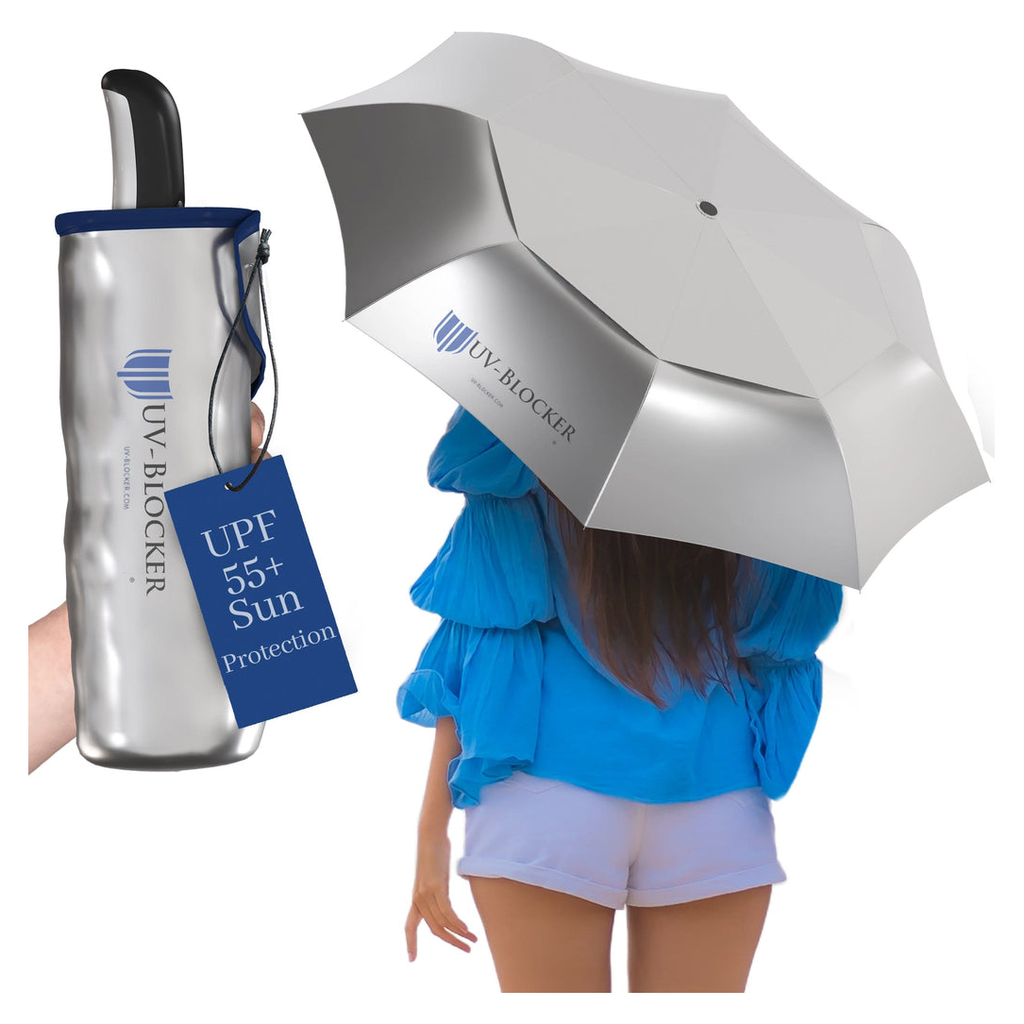
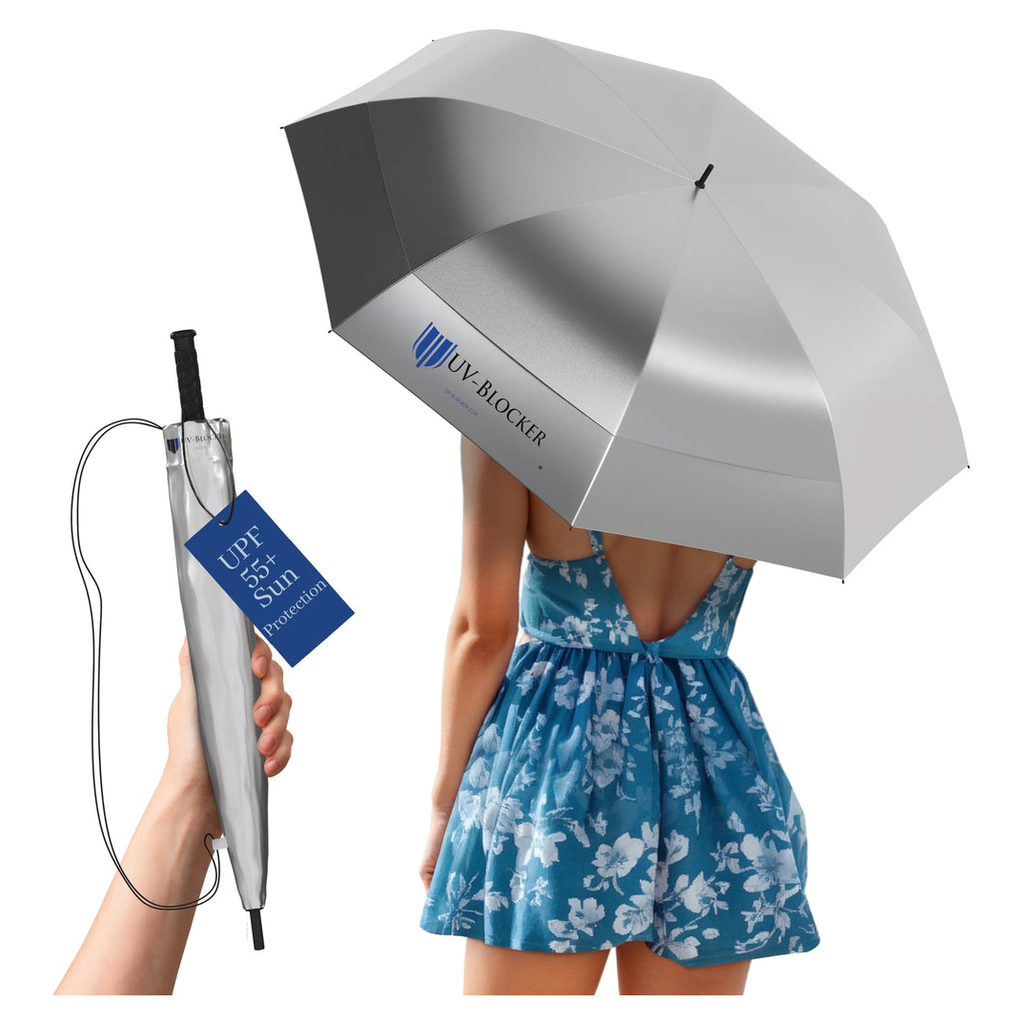
Portability dictates whether a dog walker will actually carry a piece of gear every day. UV-Blocker's Compact UV Umbrella features a 42-inch arc but folds down to just 11.5 inches and weighs 13 ounces. That's small enough to slip into a canvas tote bag, a dedicated leash bag, or a deep jacket pocket.
One-hand auto-open/auto-close is the feature that makes this work for dog walkers. Press the button on the handle while holding the leash with the other hand. The canopy deploys instantly. No fumbling with metal latches, no setting the leash down, no dropping the water bottle or losing control of the dog.
The patented Solarteck® fabric blocks 99% of UV rays with a UPF 50+ rating, tested to AATCC TM183-2020 standards. It casts a solid, dark shadow over the face, neck, and shoulders — medical-grade protection, not just light filtering. This is a meaningful difference: a standard rain umbrella blocks 77 to 90% of UV. The remaining 10 to 23% that passes through represents a significant dose over hundreds of walks.
The reflective outer layer and dark inner lining create an environment 15°F cooler underneath the canopy. This cooling effect helps the owner stay comfortable during a brisk walk and doubles as instant portable shade for the dog at rest stops on hot pavement. On days where pavement temperature reaches 130°F or more, the cooling canopy provides relief for both owner and pet during critical pauses at crosswalks and rest areas.
The Melanoma International Foundation has approved UV-Blocker umbrellas, and dermatologists recommend them as practical barriers for daily, unavoidable exposure. For dog walkers specifically, the value proposition is simple: the umbrella stays packed in the leash bag. No decision, no preparation, no extra step. It deploys in under two seconds when needed.
How the UV Umbrella Compares to Other Dog-Walk Protection Methods
| Protection Method | UV Blocked | Hands-Free? | Covers Face/Neck? | Practical for Daily Walk? |
|---|---|---|---|---|
| SPF 50 sunscreen | 98% (when applied) | Yes | Yes (if applied) | Reapplication hard mid-walk |
| Wide-brim hat | Partial face/scalp | Yes | Partial | Blows off, limits vision |
| UPF 50+ shirt | 98% (torso only) | Yes | No | Yes, but leaves face/neck exposed |
| Rain umbrella | 77–90% | No (one hand) | Yes | Heavy, no UV rating |
| Compact UV umbrella (UPF 50+) | 99%+ | Partial (one hand) | Yes — face, neck, shoulders | Yes — 11.5" folded, 13 oz |
What Are the Best Sun Safety Tips for Dog Walkers?
Time walks before 10 AM or after 4 PM, carry a compact UV umbrella, choose shaded routes, and apply mineral sunscreen to exposed hands and forearms.
Building consistent sun protection dog walking habits requires practical steps that fit the reality of owning an energetic dog. Here's the daily protocol:
- Time walks before 10 AM or after 4 PM when possible. UV rays still exist outside peak hours, so don't skip protection just because the sun sits lower. In spring and summer, the 9 AM UV Index often reaches 4–5 — high enough to warrant protection on a 34-minute walk.
- Carry a compact UV umbrella on every outing. It provides instant shade at long traffic lights, during neighborhood chats, and across open parks. Store it in the leash bag permanently so the decision requires zero thought.
- Choose shaded routes. Walking down tree-lined streets and forested park paths reduces ambient UV exposure by 50 to 75%. Plan two or three rotating routes — at least one of which prioritizes tree canopy coverage — and default to the shaded option during peak UV months.
- Apply mineral sunscreen to exposed skin before the walk. Cover hands, forearms, and the face. Don't rely on sunscreen alone since mid-walk reapplication isn't happening. Choose a water-resistant mineral formula rated SPF 30 or higher for the hands, which take the most UV from both above and reflected pavement.
- Watch the pavement. Place your bare hand flat on the asphalt — if it's too hot to touch after 7 seconds, it'll burn your dog's paws. Reflected UV from light concrete also increases the owner's ambient exposure by 10 to 12%.
- Check the daily UV Index. The EPA's UV Index forecast is available by ZIP code at weather.gov and most smartphone weather apps. Make it a habit to check the UV Index the same way you check temperature. Any reading of 3 or higher warrants active protection.
- Hydrate for both of you. Carry enough water for yourself and your dog, especially on routes without public fountains. Dehydration elevates core temperature and reduces the body's ability to manage heat stress from UV radiation.
Quick Tip: Build the UV Umbrella Into Your Leash Routine
Keep the UV umbrella in the same hook or basket where the leash hangs. Grabbing both at the same time requires zero decision-making and eliminates the most common reason walkers skip protection: forgetting it at home.
Dog Park Shade Strategy
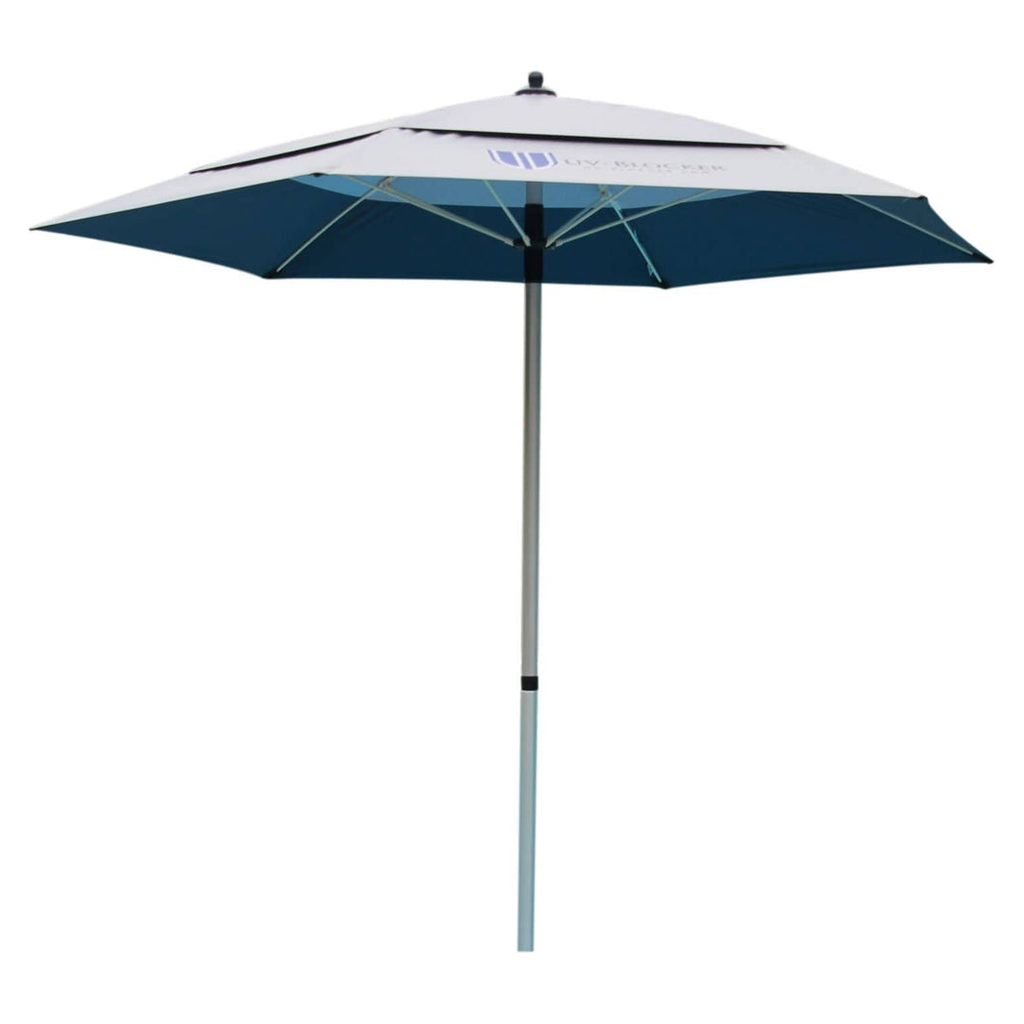
Dog parks function as UV traps — wide open municipal fields with minimal trees and scattered metal benches. Owners spend 30 to 60 minutes standing in direct sunlight while their dogs play. A UV umbrella generates instant personal shade anywhere in an open field.
Most dog park visits involve long stationary periods near fence lines or on open benches — exactly the scenario where cumulative exposure builds fastest. Stationary exposure compounds quickly: standing in direct midday sun for 45 minutes at UV Index 8 is equivalent to spending 2 hours in moderate sun. A UV umbrella converts this high-exposure situation into a protected one without limiting mobility or social interaction.
The Travel UV Umbrella includes a shoulder strap case that allows hands-free transport from the car to the park gates. Once inside, it deploys instantly and can be held in one hand while the other manages the dog.
Beach Walks With Dogs
Beach walks present the highest UV exposure scenario for dog owners. Water reflects 10 to 25% of UV radiation back upward into the face. Sand reflects another 15 to 25%. A beach dog walk combines the most intense natural UV environments with extended outdoor time. Total reflected UV at the beach can effectively double the dose received compared to an equivalent walk on a shaded neighborhood sidewalk.
Men dealing with hair loss face distinct challenges during these walks. Sun protection for bald head strategies become essential, as the scalp absorbs direct overhead radiation without any natural defense. Beach walking with a dog is one of the highest-risk UV scenarios for bald or thinning scalps.
Sun Protection by Walk Environment: Sidewalk, Park, and Beach
The type of surface and environment a dog walker traverses significantly affects UV exposure from reflected radiation in addition to direct overhead sun. Here's how to adapt protection strategy by environment:
Urban Sidewalk Walks
Light concrete sidewalks reflect 8 to 12% of UV radiation upward, adding measurable ambient exposure below the direct UV from the sky. Dark asphalt reflects less — approximately 4 to 7% — but absorbs and radiates far more heat. Urban canyon environments (narrow streets between tall buildings) can both reduce direct sun exposure significantly while creating complex scattered UV patterns from reflective glass facades. The key protective tool is the UV umbrella — it shields from both above and, to a meaningful extent, reflected UV from the sides and pavement.
Suburban Park Walks
Open municipal parks and recreational fields offer moderate shade from scattered trees but generally leave most walking paths exposed to direct sun. Studies on UV distribution in urban parks find that tree-lined park paths reduce UV exposure by 50 to 75% compared to open grass areas. Choosing paths along tree lines rather than cutting across open lawn makes a measurable difference. For time spent on open grass while the dog plays, a UV umbrella is the most practical solution — it creates shade wherever you stand.
Beach Dog Walks
The beach represents the most aggressive UV environment for dog walkers. Direct UV from overhead combines with reflection from water (10–25%) and sand (15–25%), creating an environment where effective UV exposure can be 1.5 to 2x higher than the overhead UV Index alone would suggest. Beach walkers should:
- Apply broad-spectrum mineral sunscreen SPF 50+ to all exposed skin 20 minutes before walking
- Carry a UV umbrella for use during rest stops and when stationary
- Walk early morning (before 9 AM) or late afternoon (after 5 PM) when possible
- Protect the scalp — either with a UPF-rated hat or UV umbrella — as overhead radiation is maximum at the beach
- Reapply sunscreen after any ocean wading, even if the formula is water-resistant
Forest Trail Dog Walks
Forest and wooded trail walks offer the best natural UV protection. Dense tree canopy can reduce UV exposure by 50 to 90% depending on leaf density and canopy coverage. However, forest gaps — clearings, fire roads, open meadows — expose walkers to full sun suddenly. Transitioning in and out of these open areas without protection allows brief but intense UV hits. Carrying a UV umbrella and deploying it in open sections is the practical solution for trail walks that alternate between shaded and exposed terrain.
Frequently Asked Questions About Sun Protection Dog Walking
Sun protection dog walking questions come up often — from UV risk thresholds to sunscreen timing to whether dogs need protection too. Here are answers to the most common ones.
How long can I walk my dog in the sun safely?
There is no universally safe duration — UV damage is cumulative, so even 20-minute walks add up over weeks and months.
The UV Index determines risk far more than time alone. At a UV Index of 6 or higher, unprotected skin can burn in under 20 minutes for fair-skinned individuals. Check the EPA's daily UV Index forecast before morning walks from April through September. A 34-minute walk at UV Index 3 accumulates considerably less damage than the same walk at UV Index 8 — but neither should be treated as a zero-risk event over a year of 468 repetitions.
Do I need sunscreen for a 30-minute dog walk?
Yes — dermatologists recommend sun protection for any outdoor exposure lasting 15 minutes or more, regardless of the activity.
A 30-minute walk repeated daily adds up to 182 hours per year. Applying mineral sunscreen to the face and hands before walking establishes a baseline. Shade protection via a UV umbrella covers more skin with less daily effort and doesn't require reapplication mid-walk. Use both for comprehensive coverage.
Can my dog get sunburned too?
Yes, dogs with thin fur, light skin, or pink noses are vulnerable to sunburn, especially on the belly, ears, and nose.
Breeds like Dalmatians, Pit Bulls, Boxers, and Whippets carry the highest risk due to shorter coat density and lighter pigmentation. Hairless breeds — Chinese Crested, Xoloitzcuintli — are among the most vulnerable and should have pet-safe sunscreen applied to exposed skin before any extended outdoor time. A UV umbrella provides shared shade during rest stops on hot days. Consult a veterinarian about pet-safe sunscreen formulas that are free of zinc oxide and para-aminobenzoic acid (PABA), both of which are toxic to dogs.
What is the best portable shade for daily dog walks?
A compact UV umbrella with one-hand operation is the most practical portable shade for dog walkers who need one hand free for the leash.
Look for UPF 50+ rated fabric — not regular rain umbrellas. Make sure it has an auto-open/close mechanism and weighs under one pound for daily carry. UV-Blocker's Compact UV Umbrella weighs 13 ounces and folds to 11.5 inches. It deploys in under 2 seconds and can be operated with one hand while maintaining full leash control.
Does a regular umbrella protect from UV rays?
Standard rain umbrellas block some UV but typically only filter 77 to 90% of rays, compared to 99%+ for UPF-rated UV umbrellas.
Fabric density, color, and coating all affect performance. Dark-colored rain umbrellas offer more UV protection than light or clear ones, but none match the 99% UV block and 15°F cooling of Solarteck® fabric. Browse purpose-built options in the UV protection sun umbrellas collection.
Should I walk my dog in the morning or evening to avoid UV?
Morning walks before 9 AM or evening walks after 6 PM offer the lowest UV exposure, but sun protection is still recommended from March through October even during these hours in southern US states.
A 7 AM walk in July in Florida may have a UV Index of 2–3 — low enough that one walk alone presents minimal risk, but repeated 468 times per year across years, cumulative damage accrues. The best approach is to time walks in low-UV windows AND carry a UV umbrella for use during any long pauses at dog parks, crosswalks, or rest stops, regardless of the time.
How do I protect my hands during dog walks?
Apply broad-spectrum mineral sunscreen SPF 30+ to the backs of both hands before each walk, and consider lightweight UV-protective gloves for extended walks at midday.
The backs of the hands receive concentrated UV reflected from pavement while holding the leash at hip height. Over hundreds of walks annually, this area accumulates significant UV damage that accelerates visible skin aging — age spots, loss of skin elasticity, and visible veins from fat layer thinning. A UV umbrella also provides overhead shade that covers the hands while they hold the leash handle.
Conclusion
The numbers tell a clear story: sun protection dog walking deserves the same attention as any outdoor sport.
- Dog walking generates 265+ hours per year of cumulative UV exposure — treat it as a primary outdoor activity, not a minor chore
- UV risk varies significantly by season and time of day, with meaningful exposure from March through October even during morning and evening walks
- Traditional sun protection fails for dog walkers because both hands are occupied and mid-walk reapplication is impractical
- A compact UV umbrella with one-hand operation solves the portability, coverage, and convenience problems at once
- Pavement type, walk environment, and cloud cover all affect total UV dose — adapting protection strategy to the specific route improves outcomes
Check the UV Index before heading out for tomorrow's walk. If the number sits at 3 or higher, carry a UV umbrella. Find the right protective gear for your daily route by exploring the UV protection sun umbrellas collection.