

A 2024 Drexel University study found that 59.5% of umbrella brands make UPF claims online, yet none of the tested products had independently validated UV protection data.
For health-conscious travelers and anyone with sun sensitivity, that gap matters. UV exposure accumulates with every outdoor hour, regardless of what the umbrella label says. This article covers how UV blocking technology works, the science behind the cooling effect, who benefits most, and exactly what to look for when choosing UV protection travel umbrellas.
TLDR:
- Most "UV resistant" umbrella labels describe dye durability, not skin protection
- Certified UPF 50+ umbrellas block up to 99% of UV rays; standard ones block only 77%
- Silver reflective coatings reduce perceived temperature by up to 15°F through infrared reflection
- People on photosensitizing medications, melanoma survivors, and lupus patients benefit most
- Look for AATCC TM183-2020 test certification, 44"+ arc, and vented wind-resistant ribs
What Makes UV Protection Travel Umbrellas Different from Regular Ones?
UV protection travel umbrellas use certified UV-blocking fabric tested to UPF 50+, blocking 99% of UVA and UVB rays. Standard umbrellas block only about 77%.
The distinction starts with the label. When an umbrella is marketed as "UV resistant," that phrase describes the colorfastness of the dye. It means the canopy color won't fade in sunlight. It has nothing to do with how much UV radiation passes through the fabric and reaches a person's skin.
A JAMA Dermatology study found that UV-blocking umbrellas reduced UVB exposure by up to 99%, while standard umbrellas blocked only 77%. That 22-point gap represents meaningful exposure over a full day outdoors, and the difference comes entirely from fabric technology, not canopy size or frame construction.
UPF 50+ means the fabric has been independently tested using the AATCC TM183-2020 standard, a lab protocol that measures actual UV transmission through the fabric. UPF 50 means only 1/50th of UV radiation passes through. A brand that names its test standard has third-party data to back the claim. A brand that says "UV resistant" almost certainly does not.
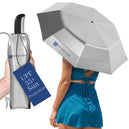
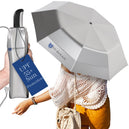
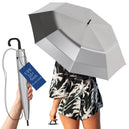
The UV-Blocker Travel UV Umbrella uses patented Solarteck® fabric, a silver reflective outer canopy tested to AATCC TM183-2020 with 100% UV-B block and 99.97% UV-A block at UPF 50+. The 44-inch arc and deep dome profile add side-angle protection against low-angle sun exposure that flat-canopy designs miss entirely.
How Does UV Blocking Technology Work in Travel Umbrellas?

UV blocking technology in quality travel umbrellas uses silver reflective coatings to bounce UV radiation away, preventing it from penetrating the fabric to reach skin.
Most people assume any opaque fabric blocks UV. In reality, standard woven nylon transmits a meaningful percentage of UV rays through the weave, even when the canopy looks fully solid to visible light. UV wavelengths pass through microscopic gaps that block visible light, which is why a regular umbrella providing deep shade still lets a significant amount of UV through.
UV-Blocker's Solarteck® fabric uses three layers working together:
- Silver reflective outer coating bounces UV and infrared radiation outward before it contacts the weave
- Tightly woven nylon substrate blocks transmission of any UV the outer coating doesn't reflect
- "Cool Blue" inner layer absorbs residual UV scatter so none reaches the person underneath
This three-layer approach is why the AATCC TM183-2020 test shows 100% UV-B block and 99.97% UV-A block. No single layer achieves that on its own; all three work in sequence. For a detailed breakdown of how UPF ratings are calculated and what the test standard measures, see UPF 50 UV Umbrella: What Certified Protection Actually Means.
Independent validation supports the claim further. The UV-Blocker Travel Umbrella carries Melanoma International Foundation (MIF) approval and dermatologist recommendations, signals that medical reviewers have evaluated the protection evidence.
The fabric is made from RPET (recycled plastic bottles), certified to the Global Recycled Standard. For environmentally conscious travelers, protection and sustainability travel together.
Why Do UV Protection Travel Umbrellas Keep You Cooler Than Shade?

Silver reflective coatings bounce infrared heat away from the body. This reduces perceived temperature by up to 15°F, while standard dark canopies absorb heat and radiate it back downward.
This is basic physics applied to sun protection. Dark fabric absorbs infrared radiation across the full solar spectrum and re-radiates it as heat, directing it toward the person standing underneath. A standard black or dark umbrella creates shade from visible light while functioning as a heat collector above a person's head.
Silver reflective technology reverses that. The Solarteck® coating bounces infrared energy outward before it becomes thermal load on the canopy. Less absorbed radiation means less re-radiated heat, and a measurably cooler zone below.
The data supports this. A study by the Seoul Institute found that parasols with reflective coatings can lower perceived temperature by as much as 10°C (18°F). A 2026 Auburn University study confirmed that a UV-protection umbrella kept the area beneath it 4.89°F cooler than direct sun exposure and 1.79°F cooler than a standard umbrella in the same conditions.
UV-Blocker's founder Ron Walker's uncle once called it "the air-conditioned umbrella." That nickname captures the mechanism: the silver outer surface sheds heat before it builds, producing cooling rather than just shade.
For travelers, this dual effect delivers practical benefits. Reduced heat load means less fatigue, lower hydration demand, and reduced heat exhaustion risk, all while the UV protection layer handles the health dimension simultaneously.
Who Benefits Most from UV Protection Travel Umbrellas?
Melanoma survivors, lupus patients, and travelers on photosensitizing medications benefit most from certified UV protection travel umbrellas.
Medical Necessity
For melanoma survivors and lupus patients, UV protection is a health requirement. Sun exposure can trigger lupus flares and raises recurrence risk for melanoma patients. Certified coverage that doesn't depend on reapplication is one of the most reliable management tools available outdoors.
Unlike sunscreen, a UPF 50+ umbrella provides consistent protection regardless of sweat, water, or time elapsed. It doesn't need reapplying every 90 minutes. For people managing real medical conditions, that reliability changes how they experience outdoor travel.
Medication-Induced Sensitivity
A range of common medications increase UV sensitivity significantly, including antibiotics, retinol, birth control pills, and certain blood pressure medications. Travelers on these medications face amplified UV risk during outdoor excursions, often without realizing it.
Retinol users often don't know that their skin becomes substantially more UV-reactive during use. Many common antibiotics cause phototoxic reactions that turn ordinary sun exposure into a skin damage event. The CDC notes that UV levels peak between 10 a.m. and 4 p.m., precisely the hours when most travel itineraries are active outdoors.
Active Outdoor Travelers
Beach destinations, cruise excursions, theme parks, and sports spectating all involve extended outdoor exposure where consistent sunscreen application isn't realistic. For a deeper look at managing UV risk on the water, Sun Protection on a Cruise covers the specific considerations for ship excursions.
Parents with Infants
Children under six months cannot safely use sunscreen. A certified UV umbrella provides consistent coverage without any topical application, making it one of the only evidence-backed options for infants in outdoor environments.
What to Look for When Choosing UV Protection Travel Umbrellas
Look for AATCC TM183-2020 tested UPF 50+ certification, a silver reflective outer canopy, vented wind-resistant ribs, and a deep dome profile for side-angle coverage.
Certification First
UPF 50+ is the minimum threshold. The test standard must be named, not implied. AATCC TM183-2020 is the relevant protocol. If a brand won't specify the test standard, the rating is unverifiable. The 2024 Drexel study found that 59.5% of brands claiming UPF online had no validated data, making this step essential before trusting any product with health-level protection.
Arc Size and Dome Geometry
A 44-inch arc with a deep dome covers the head, shoulders, and upper body for one person. Shallow domes allow UV entry at low sun angles. In early morning and late afternoon, when the sun sits lower on the horizon, a flatter canopy leaves the face and neck exposed. Travelers near the equator or at altitude face stronger oblique UV, making dome depth more consequential.
Wind Resistance
Standard umbrella canopies invert in wind because they trap air pressure beneath the fabric. A patented vented mesh system addresses this by allowing wind to pass through the canopy rather than build pressure against it. For beach use, waterfront promenades, and open-air venues, wind resistance determines whether the umbrella stays functional or becomes a problem.
Portability Specs
Travel-specific UV umbrellas fold to approximately 17.5 inches and weigh around 1 lb 5 oz. Those dimensions fit in checked luggage side pockets, carry-on bags, or day-pack sleeves without dominating packing space.
| Feature | Why It Matters | UV-Blocker Travel Umbrella |
|---|---|---|
| UPF Rating | Certified UV block level | UPF 50+ (AATCC TM183-2020 tested) |
| UV-B Block | Sunburn-causing radiation | 100% |
| UV-A Block | Aging and cancer radiation | 99.97% |
| Arc Size | Coverage area | 44 inches |
| Canopy Profile | Side-angle UV protection | Deep dome |
| Cooling Technology | Heat reduction mechanism | Solarteck® silver reflective |
| Wind Resistance | Durability in outdoor conditions | Patented vented mesh system |
| Folded Length | Travel portability | 17.5 inches |
| Weight | Ease of carry | 1 lb 5 oz |
| Certifications | Third-party validation | MIF Approved, Dermatologist Recommended |
| Price | Accessibility | $59.95 |
The UV-Blocker Travel UV Umbrella meets all of these criteria, independently tested and purpose-built for extended outdoor use in travel conditions.
Frequently Asked Questions About UV Protection Travel Umbrellas
UV protection travel umbrellas raise practical questions about effectiveness, certifications, and use. Here are the most common answers.
Can a UV protection umbrella replace sunscreen?
A UV protection umbrella significantly reduces UV exposure but doesn't cover every exposed area. Sunscreen on the face, hands, and legs remains valuable as a complement.
For people who cannot use sunscreen (infants under six months, those with topical allergies, or individuals with skin conditions), a UPF 50+ umbrella provides the primary protection layer. For everyone else, combining both delivers the most complete defense.
What does UPF 50+ actually mean for skin protection?
UPF 50+ means only 1/50th (2%) of UV radiation passes through the fabric, providing 98%+ UV block equivalent to dermatologist-grade sun barrier protection.
The AATCC TM183-2020 test measures real UV transmission through physical fabric samples under standardized lab conditions. A product that names this standard and provides specific percentage results (100% UV-B, 99.97% UV-A) has completed the full verification process.
Do travel umbrellas actually reduce heat, or just block light?
Quality UV travel umbrellas with silver reflective coatings reduce both UV radiation and heat, lowering perceived temperature by up to 15°F through active infrared reflection.
Standard dark canopies absorb infrared radiation from sunlight and re-radiate it downward, making the shade beneath them warmer than necessary. Silver reflective technology prevents that absorption, so the thermal load never accumulates.
Will a travel UV umbrella hold up in wind at outdoor destinations?
UV travel umbrellas with patented vented mesh canopies resist wind inversion by releasing airflow through the canopy rather than trapping pressure against it.
Standard canopies catch wind by creating a sealed pressure pocket beneath the fabric. Venting releases that pressure while maintaining full UV coverage. For beach, waterfront, and open-air use, this design difference is the gap between a durable tool and a discarded one.
Is a UV protection travel umbrella worth the investment for occasional use?
For anyone with sun sensitivity, photosensitizing medications, or outdoor-heavy travel plans, a certified UV umbrella delivers consistent 99% UV block on every outdoor use without the recurring cost of sunscreen.
A $59.95 UV-certified umbrella used across multiple trips compares favorably to sunscreen expenditures and provides protection sunscreen alone cannot match: consistent coverage without reapplication, regardless of sweat or water exposure.
Conclusion
The gap between a "UV resistant" label and a certified UPF 50+ product is significant. It's the difference between a dye durability claim and independently verified skin protection. For travelers who need genuine UV defense, that distinction is worth understanding before choosing gear.
Key takeaways:
- "UV resistant" describes dye durability, not skin protection. Most travel umbrellas carry this label without independent UV testing
- UPF 50+ with AATCC TM183-2020 certification is the standard for verified protection
- Silver reflective Solarteck® technology blocks UV and reduces heat by up to 15°F
- Melanoma survivors, lupus patients, and travelers on photosensitizing medications benefit most from consistent certified coverage
- The UV-Blocker Travel Umbrella delivers certified protection in a 17.5-inch folded format built for travel
For travelers who take sun safety seriously, the UV-Blocker Travel UV Umbrella provides certified UV protection backed by independently tested results, the kind of coverage a label alone cannot guarantee.
UV Index by Top Travel Destination: Where a Travel Umbrella Is Non-Negotiable
UV intensity varies dramatically by destination — and travel changes your exposure baseline in ways that catch even experienced sun-protectors off guard. Here's what to expect in the world's most popular sun destinations:
UV Index Comparison: Popular Travel Destinations
| Destination | Peak UV Index | Season of Highest Risk | UV vs. US Avg |
|---|---|---|---|
| Bali, Indonesia | 13–14 | Year-round | +45% |
| Cancún, Mexico | 11–12 | May–September | +20% |
| Queensland, Australia | 14–15 | October–February | +60% |
| Hawaii (Maui) | 12–13 | Year-round | +35% |
| Greece / Mediterranean | 10–11 | June–August | +15% |
| New York City (baseline) | 7–8 | June–July | — |
Why Travelers Are Uniquely Vulnerable
Travelers accumulate UV exposure across activities that individually seem short — a poolside lunch, a beach walk, open-air touring — but can add up to 4–6 hours of UV exposure daily. The UV-Blocker compact travel umbrella folds to 11 inches and weighs under 12 oz, fitting in carry-on bags while providing the same certified UPF 50+ protection as full-size models. It's the only travel umbrella approved by the Melanoma International Foundation that collapses to true carry-on size.