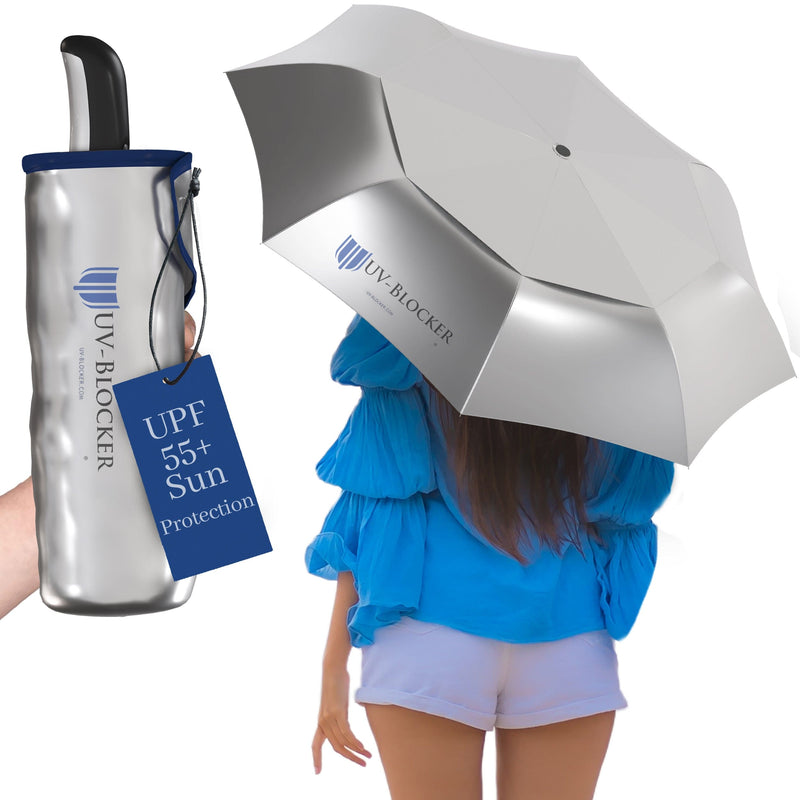

TLDR: The Science in 60 Seconds
- UV umbrella effectiveness varies dramatically—from blocking 77% to 99% of UV radiation based on fabric quality (JAMA Dermatology, 2013)
- Standard beach umbrellas caused sunburn in 78% of users in controlled studies (JAMA Dermatology, 2017)
- UPF 50+ fabrics block 98%+ of UV; UV-Blocker's UPF 50+ blocks 99%
- Three mechanisms create protection: reflection (silver exterior), scattering (dense weave), and absorption (dark interior)
- Weave density determines how much UV slips through microscopic "pinholes"
- Solarteck™ fabric combines all three mechanisms for maximum protection + 15°F cooling effect
Why Some Umbrellas Protect You (And Others Don't)
Here's a finding that should concern anyone who's ever trusted an umbrella for sun protection: in a 2017 clinical trial published in JAMA Dermatology, 78% of participants who relied solely on a standard beach umbrella got sunburned.
That's not a misprint. Four out of five people under a beach umbrella still suffered UV damage.
The problem? Most umbrellas weren't designed for sun protection. Rain umbrellas are engineered to shed water—fabric technology optimized for completely different physics. When you repurpose a rain umbrella for sun protection, you're trusting your skin to fabric that's never been tested for UV blocking.
Purpose-built UV umbrellas are fundamentally different. They use fabric specifically engineered to block ultraviolet radiation through three distinct mechanisms. Understanding these mechanisms helps you distinguish between marketing claims and actual protection.

The Three Mechanisms of UV Blocking
Every UV-blocking fabric works through some combination of three physical processes: reflection, scattering, and absorption. Premium fabrics like Solarteck™ employ all three simultaneously for maximum protection.
Mechanism 1: Reflection
Reflective coatings—typically silver or metallic finishes—bounce UV rays away before they ever penetrate the fabric. Think of it like a mirror for ultraviolet light.
The physics are straightforward: metallic coatings reflect electromagnetic radiation rather than absorbing it. This prevents UV from reaching the fabric's interior layers and provides a significant secondary benefit: heat reflection. Because the fabric reflects rather than absorbs solar energy, the area underneath stays dramatically cooler—up to 15°F cooler than direct sunlight.
This is why premium UV umbrellas have silver or metallic exteriors. It's not aesthetic—it's functional physics.
Mechanism 2: Scattering
Dense fabric disperses UV radiation in multiple directions, reducing the concentrated dose that reaches your skin. This is a function of weave density—how tightly the fabric fibers are packed together.
In loose weaves, UV can pass straight through gaps between fibers. In tight weaves, UV strikes fiber surfaces and scatters in multiple directions. Some exits upward, some exits sideways, and only a fraction continues downward toward your skin.
Combined with reflection, scattering can block the vast majority of incoming UV before it even reaches the fabric's inner layer.
Mechanism 3: Absorption
Dark inner layers serve a critical but often overlooked purpose: they capture UV rays that bounce up from the ground, water, or sand.
When you're at the beach, on concrete, or near water, UV doesn't just come from above. It reflects off surfaces and hits you from below and the sides. This "ground-reflected" UV is why you can get sunburned even in the shade.
A dark inner fabric layer absorbs these reflected rays before they reach your face. The UV energy converts to harmless heat rather than bombarding your skin. This is why premium UV umbrellas are dark blue or black on the inside, even when they're silver on the outside.

Fabric Weave Density: The Pinhole Problem
Beyond coatings, the physical structure of the fabric itself determines UV protection. The key variable is weave density—how tightly the fibers are packed together.
Loose weaves create pinholes. When you hold a loosely woven fabric to bright light, you can see individual points of light shining through. Each of those points is a gap where UV radiation passes straight through without being blocked.
Tight weaves eliminate pinholes. Dense fabrics present an unbroken barrier to UV. There are no gaps, no shortcuts. UV must interact with the fabric—being reflected, scattered, or absorbed—rather than passing through unchanged.
You can test any fabric with what dermatologists call the "light test": hold the material up to a bright light source. If you see points of light coming through the weave, UV is getting through too. If the fabric blocks all visible light, it's likely blocking UV effectively.
The 2013 McMichael study in JAMA Dermatology measured this directly. Loosely woven umbrellas blocked only 77% of UV—better than nothing, but still allowing 23% through. Tightly woven umbrellas with proper coatings blocked up to 99%.
Material Matters
Not all fabrics are created equal for UV protection:
| Material | UV Blocking Capability | Notes |
|---|---|---|
| Polyester | Excellent | Naturally UV-resistant, tight weave possible |
| Nylon | Very Good | Good when densely woven |
| Acrylic | Excellent | Used in premium sun fabrics |
| Cotton | Fair | Loose natural weave allows UV through |
| Canvas | Good | Heavier, but can trap heat |
Polyester and nylon dominate UV umbrella construction because they can be woven extremely tightly while remaining lightweight. Natural fibers like cotton tend to have looser weaves and absorb water, which can actually reduce their UV protection when wet.
Coating Science: Silver Outside, Dark Inside
If you've looked at a premium UV umbrella, you've noticed the two-tone design: silver or metallic exterior, dark blue or black interior. This isn't styling—it's engineered physics solving two different problems simultaneously.
Exterior Coatings: The Reflection Layer
Silver exterior coatings serve two functions:
- UV Reflection: Metallic coatings bounce UV rays away from the umbrella entirely
- Heat Rejection: By reflecting rather than absorbing solar energy, the fabric doesn't heat up
Traditional black umbrellas absorb all incoming light energy, including heat. Stand under a solid black umbrella on a hot day and you'll feel that heat radiating down toward you. The umbrella becomes a heat trap.
Silver exterior coatings flip this equation. Heat-carrying wavelengths bounce away before being absorbed. The result: up to 15°F cooler underneath compared to direct sunlight.
Interior Coatings: The Absorption Layer
Dark interior coatings handle a different problem: ground-reflected UV.
When you're at the beach, near water, or on concrete, UV bounces off these surfaces and hits you from below. This reflected UV bypasses overhead shade entirely—it comes from the side and below, hitting your face, neck, and any exposed skin.
A dark interior layer absorbs these upward-traveling UV rays. Instead of bouncing around under the canopy and eventually reaching your skin, the reflected UV is captured by the dark fabric and converted to harmless heat.
This is why the interior color matters even though you rarely look at it. Black or dark blue interiors are functional UV traps, not aesthetic choices.
For a deeper dive into color physics, see our complete analysis: Black vs Silver: The Hidden Physics.
Debunking the "Black Absorbs Heat" Myth
You've probably heard the advice: avoid black umbrellas in hot weather because they absorb heat. This is true for solid black umbrellas—but completely false for dual-layer designs with silver exteriors.
The myth applies to: Solid black umbrellas where the black fabric faces the sun. These absorb solar energy and radiate heat downward toward you.
The myth does NOT apply to: Silver-outside, dark-inside designs. The silver exterior reflects heat away before it ever reaches the dark layer. The dark interior only faces downward, where it absorbs ground-reflected UV—not sun-directed heat.
UV-Blocker's Solarteck™ fabric uses exactly this dual-layer approach:
- Silver exterior reflects UV and heat away
- Dark blue interior absorbs ground-reflected UV
- Result: Maximum UV protection AND 15°F cooler than direct sunlight
Don't let outdated advice steer you toward inferior protection.
UPF vs SPF: What the Ratings Actually Mean
UPF and SPF both measure UV protection, but they're fundamentally different systems for different products.
SPF (Sun Protection Factor)
- Applies to: Sunscreens and lotions
- Measures: Primarily UVB protection
- How it works: Time-based. SPF 30 means you can stay in the sun 30x longer before burning
- Limitations: Must be reapplied every 2 hours (or after swimming/sweating)
UPF (Ultraviolet Protection Factor)
- Applies to: Fabrics (clothing, umbrellas, hats)
- Measures: Both UVA AND UVB protection
- How it works: Percentage-based. UPF 50 means only 1/50th (2%) of UV passes through
- Advantage: Doesn't wear off, doesn't need reapplication
| UPF Rating | Protection Category | UV Blocked |
|---|---|---|
| 15-24 | Good | 93.3-95.9% |
| 25-39 | Very Good | 96-97.4% |
| 40-49 | Excellent | 97.5-98% |
| 50+ | Maximum (Standard) | 98%+ |
| 55+ (UV-Blocker) | Exceeds Standard | 99% |
The key insight: UPF 50+ is the baseline for "excellent" protection. UV-Blocker umbrellas are rated UPF 50+—exceeding the standard by blocking an additional 1% of UV. That might sound small, but it represents a 50% reduction in the UV that does penetrate.
For complete UPF details, see: UPF 50+ Explained: What the Rating Means.
How Solarteck™ Fabric Puts It All Together
Solarteck™ is UV-Blocker's proprietary fabric technology. It's not a marketing term—it's an engineered solution combining every UV-blocking mechanism into a single material:
Dual-Layer Construction
- Outer layer: Reflective silver surface bounces UV and heat away
- Inner layer: Dark blue absorption layer captures reflected UV from ground/water
Tight Weave
- High-density weave eliminates pinholes
- Passes the "light test"—no visible light penetration means no UV penetration
UPF 50+ Tested Rating
- Independently tested to exceed UPF 50+ standard
- Blocks 99% of UVA and UVB radiation
Water-Resistant
- Maintains full UV protection even when damp
- No degradation of protection after exposure to moisture
Cooling Effect
- 15°F cooler than standing in direct sunlight
- Reflects heat rather than absorbing and radiating it
Certifications
- Melanoma International Foundation approved
- Dermatologist recommended for sun-sensitive patients
- Independent laboratory tested
The difference between Solarteck™ and competitor fabrics: we explain exactly how and why it works. Compare that to vague claims like "UV protective" or "sun shelter" that offer no measurable guarantee.
FAQ — Your UV Science Questions Answered
How do I know if my current umbrella blocks UV?
Check for a UPF rating on the label. If there isn't one, the fabric hasn't been tested for UV protection. You can also do the "light test"—hold it up to bright light. If you see pinholes or light spots, UV is getting through.
Is a regular rain umbrella enough for sun protection?
Not reliably. Rain umbrellas are designed to shed water, not block UV. Studies show non-UV umbrellas can let 20-50% of UV radiation through. That's enough to cause sunburn and long-term skin damage.
Why is the umbrella silver on the outside and dark on the inside?
Each color serves a different function. Silver reflects UV and heat away from you, preventing the umbrella from becoming a heat trap. Dark interior absorbs UV that bounces up from ground, water, or sand—radiation that would otherwise hit your face from below.
Does wet fabric lose UV protection?
Some fabrics lose protection when wet or stretched. Solarteck™ is water-resistant and maintains its UPF 50+ rating in damp conditions. Always check whether your specific umbrella is rated for wet conditions.
What's the difference between UPF and SPF?
SPF applies to sunscreens and primarily measures UVB protection. UPF applies to fabrics and measures both UVA and UVB. UPF 50+ means 98%+ of all UV is blocked. Unlike sunscreen, UPF protection doesn't wear off with time or sweat.
How long does UV protection last?
Unlike sunscreen, quality UPF-rated fabric maintains its protection for years. The coating and weave don't degrade with normal use. Your UV umbrella will protect you the same way in year five as it did on day one.
The Science, Applied
Now you understand the physics behind UV protection: reflection, scattering, and absorption working together to block harmful radiation. You know why weave density matters, why dual-layer designs outperform solid colors, and why UPF rating is the only reliable measure of fabric protection.
Every UV-Blocker umbrella uses Solarteck™ fabric—engineered to maximize all three blocking mechanisms while maintaining the cooling effect that makes extended outdoor time comfortable.
Ready to choose your protection? See our complete guide: UV Umbrella Buying Guide: How to Choose.