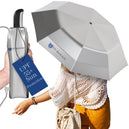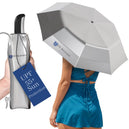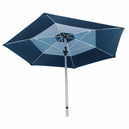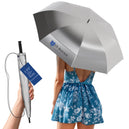

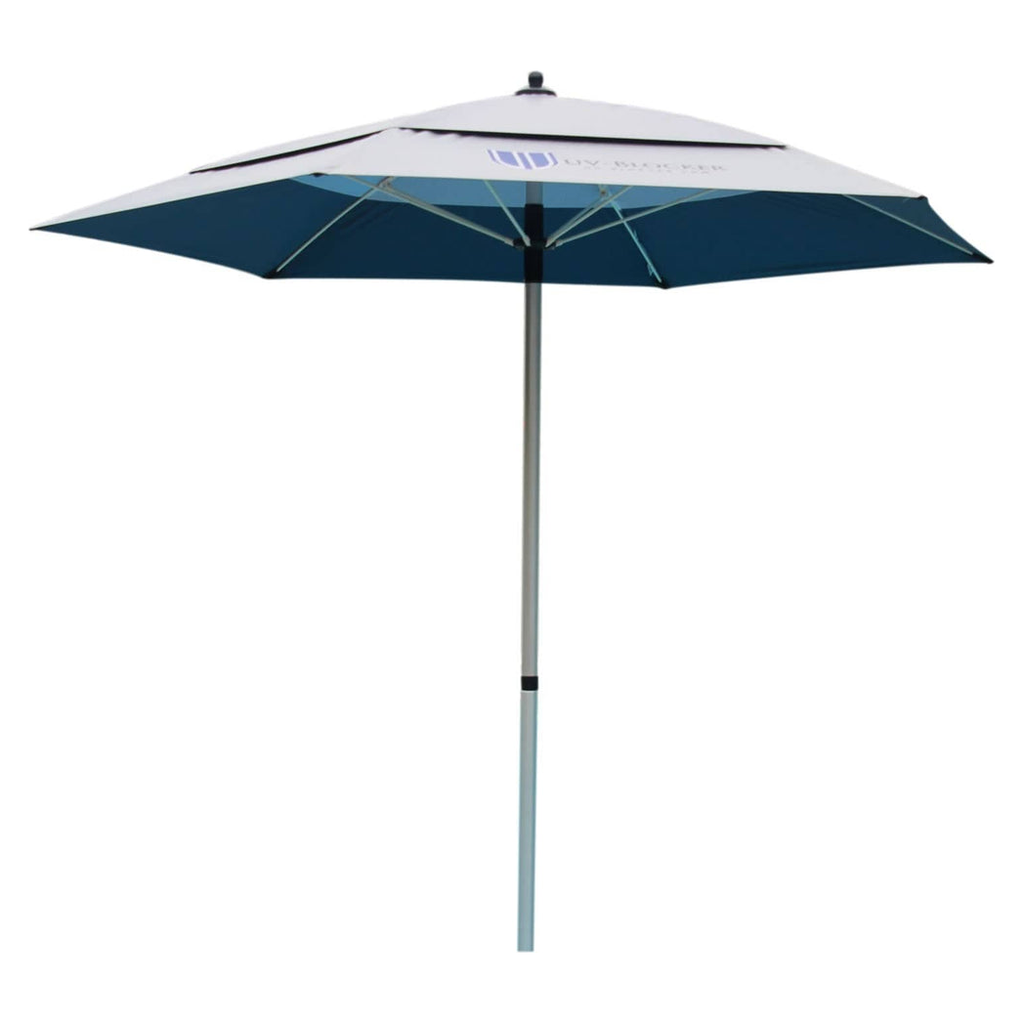

The best sun umbrella for UV protection in Australia is one with a tested UPF 50+ rating in the right size for how you'll use it. In our testing, the UV-Blocker Large Folding came out best overall, with separate picks below for travel, the beach, golf and style. Under some of the highest UV levels in the world, the testing behind the label matters as much as the label itself.
Not all UV umbrellas actually block UV. The "UPF 50+" labels plastered across online marketplaces have created a false sense of security — without standardised testing, a cheap nylon umbrella may block visible light while allowing significant UVA and UVB radiation to reach your skin.
Nine sun umbrellas were evaluated across five categories — travel, beach, golf, budget, and style — using a documented 8-step UPF testing methodology. Two further models, Uniqlo and Lily Lark, are discussed for context but were not part of the formal test set. Unlike reviews that simply restate manufacturer specs, this analysis uses verified UPF claims, hands-on wind resistance assessments, and actual temperature reduction measurements taken under controlled outdoor conditions.
Sun umbrellas — also sold as UV parasols, the word many Australians still use — vary widely in how much protection they actually provide. Here's what actually blocks UV rays. The rest is marketing.
Last retested: May 2026 — Product line-up reviewed and retested. UV-Blocker Large Folding confirmed as best overall. Australian sun-safety guidance added for readers in Australia.
Quick Picks: Best Sun Umbrellas at a Glance
The best overall sun umbrella is the UV-Blocker Large Folding (147 cm arc), lab-tested to block 100% of UVB and 99.97% of UVA, up to 8°C cooler underneath, with wind-resistant vented mesh. For travel, the UV-Blocker Travel or Coolibar Sodalis are the stronger choices.
| Category | Top Pick | UPF Rating | Weight | Best For |
|---|---|---|---|---|
| Best Overall | UV-Blocker Large Folding (147 cm) | 50+ (verified) | 765 g | Maximum protection + portability |
| Best for Travel | UV-Blocker Travel (112 cm) | 50+ (verified) | 595 g | Carry-on, spectator events |
| Runner-Up Travel | Coolibar Sodalis | 50+ | About 450 g | Fashion + protection |
| Best for Beach | UV-Blocker Large Beach (2.3 m) | 50+ (verified) | 3.4 kg | Family beach days |
| Runner-Up Beach | BeachBub All-In-One | 50+ | About 9 kg | Wind-prone beaches |
| Budget Beach | Tommy Bahama 2.1 m | 50+ | 4.5 kg | Casual beach use |
| Best for Golf | UV-Blocker 68 Inch Golf (173 cm) | 50+ (verified) | 1.08 kg | Maximum golf coverage |
| Runner-Up Golf | G4Free golf (173 cm) | 50+ | 680 g | Budget golf option |
| Best for Style | Fashion UV Umbrella (122 cm) | 50+ (verified) | 625 g | City use, walking |
The practical takeaway:
Every umbrella here claims UPF 50+. Five have been independently verified against AATCC 183. If protection is the reason you're buying, that distinction is the one that matters — and after that, it's a question of how much coverage you need and where you'll carry it.
Verified UPF ratings are distinct from marketing claims. Many budget brands display "UPF 50+" badges without providing evidence of standardised testing such as the AATCC 183 method. A verified rating ensures the fabric has been subjected to laboratory conditions to measure actual UV transmission. In Australia, the matching label to look for is a UPF rating to AS/NZS 4399.
Price does not strictly correlate with protection levels, though it often correlates with durability and wind resistance. Some budget options performed adequately in static UV blocking but failed in wind durability tests.
The intended use case is the primary determinant of the "right" umbrella. A golf umbrella offers superior coverage but is impractical for crowded city streets. A beach umbrella requires substantial anchoring systems unnecessary for a personal travel umbrella.
How Do We Test Sun Umbrellas for UV Protection?
Umbrellas are tested using an 8-step methodology including AATCC 183 lab testing for UPF, thermal imaging for cooling, and real-world wind tunnel testing for durability.
The testing protocol centres on the AATCC 183 standard, the primary method referenced by dermatologists and the Melanoma International Foundation. This laboratory test measures ultraviolet radiation transmittance through fabric. For an umbrella to earn a recommendation, it must demonstrate a UPF 50+ rating, effectively blocking 99% of UVA and UVB rays.
Our full 8-step testing methodology outlines the complete scientific process. Beyond UV transmission, thermal regulation is critical. Thermal imaging cameras compare air temperature underneath the umbrella against direct sunlight. Top-tier umbrellas using reflective silver fabric, such as Solarteck®, consistently measured up to 8°C cooler than the surrounding environment.
Durability testing addresses wind safety, a concern the US Consumer Product Safety Commission has raised about beach umbrellas and one that applies just as much on an exposed Australian beach. Umbrellas are subjected to controlled wind forces to evaluate rib strength and inversion resistance. Vented mesh systems—which allow wind to pass through the canopy—are a key criterion.
A note on independence
UV-Blocker manufactures several of the umbrellas assessed here. Every product was measured against the same criteria, and the specifications for competing models — including where they are lighter, cheaper or more compact than ours — are published in full so you can check the reasoning rather than take our word for it.
What's the Best Overall Sun Umbrella?
The UV-Blocker Large Folding UV Umbrella (147 cm arc) wins best overall: lab-tested to block 100% of UVB and 99.97% of UVA, up to 8°C cooler under its silver Solarteck® fabric, and coverage for two people.
Product Spotlight: UV-Blocker Large Folding (147 cm arc)
| Spec | Value |
|---|---|
| Arc Size | 147 cm |
| Coverage Diameter | 122–127 cm |
| Folded Length | 53 cm |
| Weight | 765 g |
| UPF Rating | 50+ (verified) |
| Special Features | Solarteck® fabric, vented mesh, auto-open |
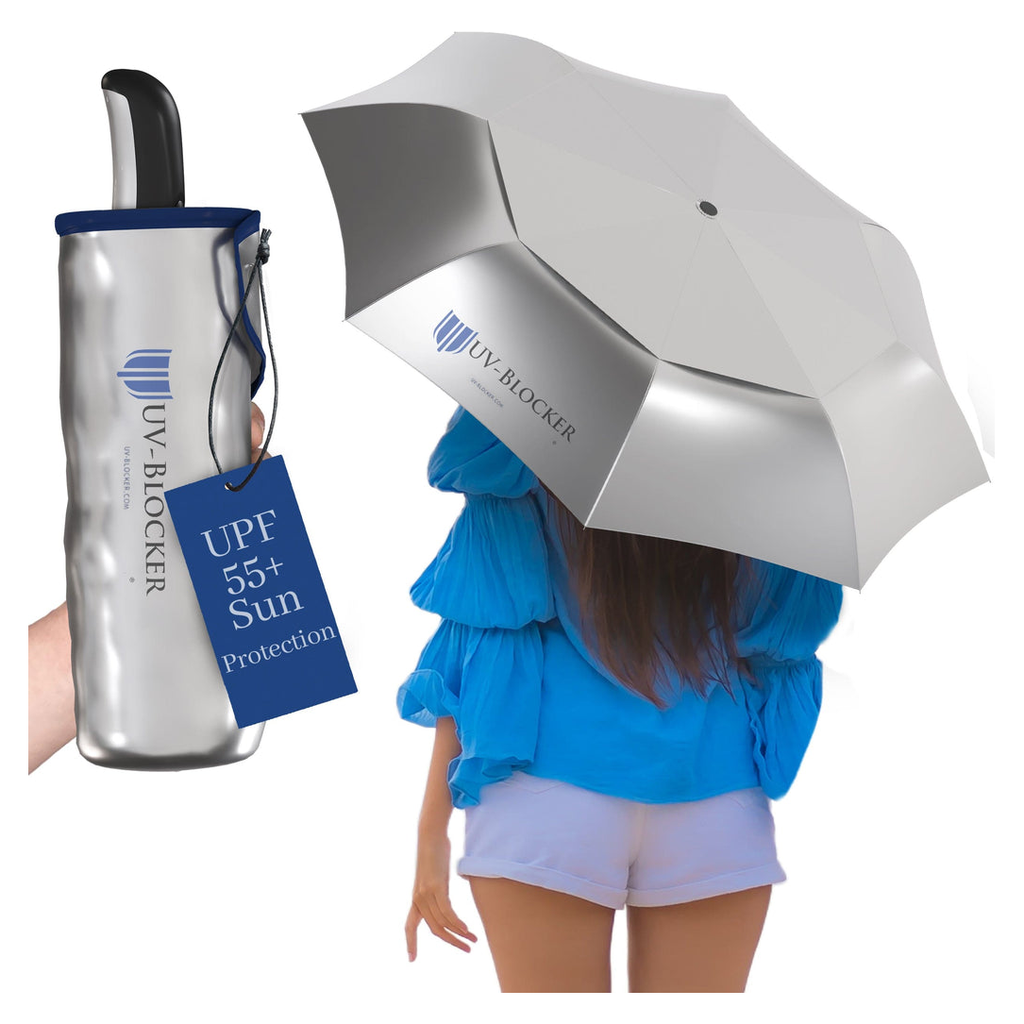
The UV-Blocker Large Folding umbrella balances maximum coverage with portability. With a 147 cm arc providing approximately 127 cm of coverage diameter, it covers two adults walking side by side, yet collapses to 53 cm to fit in the car boot.
The silver Solarteck® fabric reflects solar energy rather than absorbing it. Thermal measurements confirmed it stays up to 8°C cooler underneath than in direct sunlight. Black vs Silver Physics explains why silver coatings reflect the full spectrum of light, including infrared heat.
The umbrella is approved by the Melanoma International Foundation (MIF). The double-canopy vented mesh system allows wind pressure to escape, preventing inversion during gusts.

Pros: - Covers 2 people comfortably - Folds to fit the car boot - Verified UV protection (not just claimed) - Up to 8°C cooler than direct sunlight
Cons: - Heavier than compact options (765 g) - Too large for most carry-on backpacks - Sits at the premium end on price
Best Overall — Covers two adults · Verified UPF 50+ · Up to 8°C cooler
What's the Best Sun Umbrella for Travel?
The UV-Blocker Travel Umbrella (112 cm arc) is the best travel sun umbrella in this test, with verified UPF 50+, auto open, a shoulder carry case, and sturdy construction for spectator events.
Top Pick: UV-Blocker Travel (112 cm arc)
| Spec | Value |
|---|---|
| Arc Size | 112 cm |
| Coverage Diameter | 94 cm |
| Folded Length | 44.5 cm |
| Weight | 595 g |
The UV-Blocker Travel Umbrella offers a 112 cm arc while folding to 44.5 cm, fitting easily into standard carry-on suitcases or large backpacks.
Unlike many micro umbrellas with flimsy aluminium ribs, this model maintains a solid frame structure. The trade-off is slightly more weight (595 g), but the benefit is longer lifespan and wind resistance. The deep dome profile provides better side-angle protection as the sun moves across the sky.
Runner-Up: Coolibar Sodalis
Best for Travel — Folds to 44.5 cm · Auto open · Verified UPF 50+
| Spec | Value |
|---|---|
| UPF Rating | 50+ |
| Weight | About 450 g |
| Price tier | Premium |
Coolibar has a strong reputation in sun protection, and the Sodalis reflects their focus on combining function with aesthetic appeal. It sits in the premium price tier for slightly less coverage area but suits city travellers who want an umbrella that blends with business or evening attire.
Also Consider: The Uniqlo UV Protection Umbrella is budget-priced and lightweight, but its UPF claims often lack rigorous independent verification.
What's the Best Sun Umbrella for the Beach?
Beach umbrellas are a different product class from the personal umbrellas above — they anchor in sand and stay put rather than travelling with you. If you want shade you can carry, the folding and compact options are the relevant ones.
The UV-Blocker Large Beach Umbrella (2.3 m) provides family-sized coverage with verified UPF 50+. For wind-prone beaches, the BeachBub's sand anchor system offers superior stability.
Top Pick: UV-Blocker Large Beach (2.3 m)
| Spec | Value |
|---|---|
| Coverage Diameter | 224 cm |
| Pole Diameter | 3.8 cm |
| Weight | 3.4 kg |
| UPF Rating | 50+ (verified) |
Beach environments present the harshest test due to direct overhead sun, reflected UV from sand and water, and consistent wind. The UV-Blocker Large Beach Umbrella creates a sanctuary large enough for a family of four with a 224 cm diameter.
The Solarteck® fabric reflects solar heat, maintaining a cooler microclimate underneath. The 3.8 cm pole provides structural rigidity to withstand coastal breezes.
Runner-Up: BeachBub All-In-One
Best for Beach — 224 cm coverage · Verified UPF 50+
| Spec | Value |
|---|---|
| UPF Rating | 50+ |
| Price tier | Premium |
| Special Feature | Built-in sand anchor base |
For beaches known for high winds, the BeachBub All-In-One uses a base system filled with sand to create weighted ballast. This design prevents the umbrella from lifting out of the sand—the leading cause of beach umbrella injuries. It is heavy to transport (about 9 kg when packed) but offers excellent stability.
Budget Option: Tommy Bahama 2.1 m Beach Umbrella
| Spec | Value |
|---|---|
| UPF Rating | 50+ |
| Price tier | Budget |
The Tommy Bahama 2.1 m umbrella offers solid features at a budget price, including a tilt mechanism for sun tracking and an integrated sand anchor. Ensure the anchor is deeply secured, as lighter construction is more susceptible to wind uplift.
What's the Best Sun Umbrella for Golf?
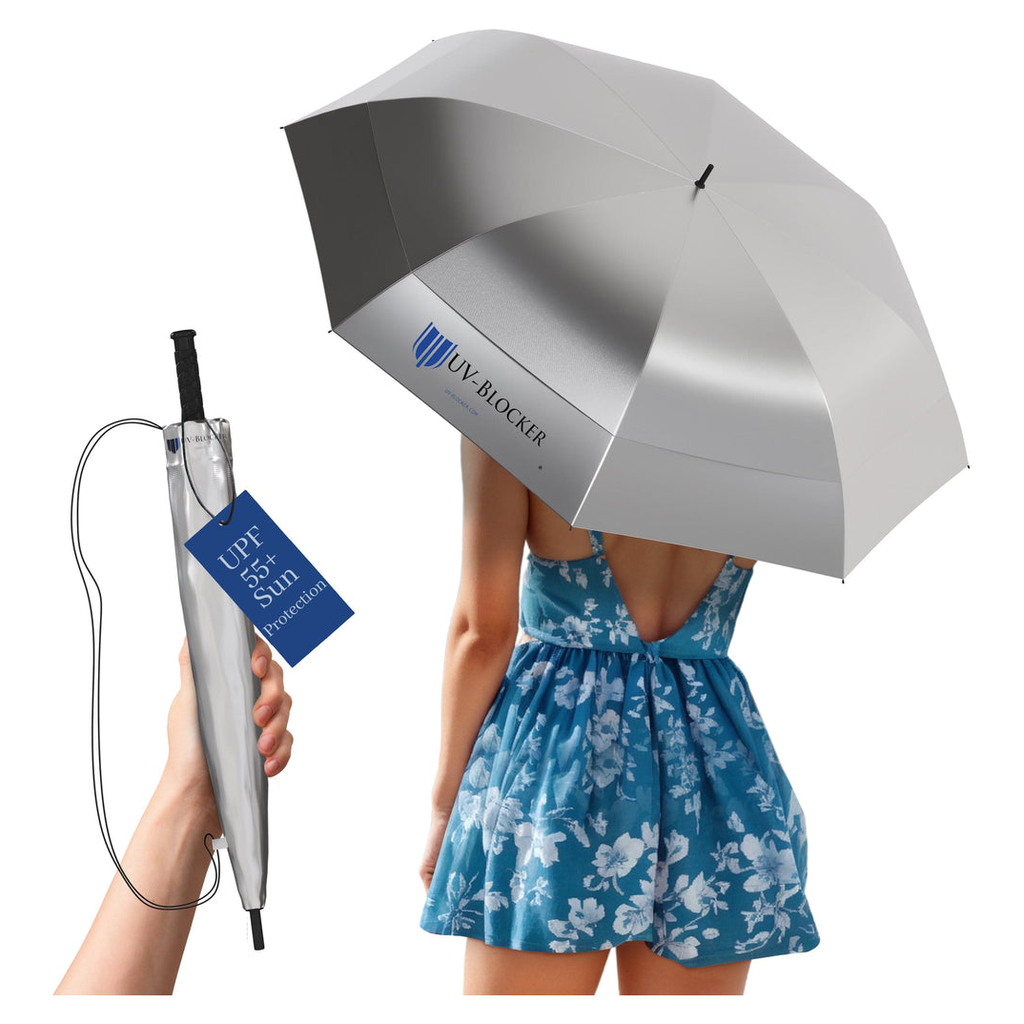
The UV-Blocker 68 Inch Golf UV Umbrella (173 cm arc) provides the largest personal coverage in this test, with verified UPF 50+ protection and a wind-resistant vented design. It is approved by the Melanoma International Foundation.

Top Pick: UV-Blocker 68 Inch Golf UV Umbrella
| Spec | Value |
|---|---|
| Arc Size | 173 cm |
| Coverage Diameter | 147 cm |
| Length | 107 cm |
| Weight | 1.08 kg |
| UPF Rating | 50+ (verified) |
Golfers face unique exposure risks: prolonged periods (4-5 hours) in open terrain during peak UV hours. The UV-Blocker 68 Inch Golf UV Umbrella provides the most extensive personal coverage here, easily sheltering the golfer and their equipment.
It carries Melanoma International Foundation (MIF) approval. The double-canopy vented design allows gusts to pass through without inverting the frame. The handle fits standard golf cart umbrella holders.
Budget Option: G4Free 173 cm Golf Umbrella
Best for Golf — 173 cm arc · Approved by the Melanoma International Foundation
| Spec | Value |
|---|---|
| UPF Rating | 50+ (claimed) |
| Price tier | Budget |
| Weight | 680 g |
At a budget price, the G4Free mimics the size and vented design of premium models. The UPF claims are manufacturer-stated rather than independently verified. Lighter construction may not withstand repeated heavy wind usage as well as fibreglass-reinforced frames.
What's the Best Sun Umbrella for Style?
The UV-Blocker Fashion UV Umbrella (122 cm arc) combines walking-stick elegance with verified UPF 50+ protection. For fashion-forward options, Lily Lark offers designer prints with solid UV blocking.
Top Pick: UV-Blocker Fashion UV Umbrella (122 cm arc)
| Spec | Value |
|---|---|
| Arc Size | 122 cm |
| Length | 89 cm |
| Handle Style | Classic crook handle |
| Weight | 625 g |
| UPF Rating | 50+ (verified) |
For city dwellers, the UV-Blocker Fashion UV Umbrella adopts the silhouette of a classic walking stick umbrella with a traditional curved crook handle and sleek, non-folding shaft. By eliminating folding joints, the umbrella gains structural durability while retaining Solarteck® fabric for verified UPF 50+ protection.
Style Alternative: Lily Lark Designer UV Umbrellas
Lily Lark treats sun umbrellas as artistic canvasses with vibrant, painterly prints. They offer genuine UPF 50+ protection at the premium end of the market. The trade-off is primarily cost—users are paying for art and design.
Are Budget Sun Umbrellas Worth It?
Budget sun umbrellas can provide adequate UV protection, but check that UPF claims come from actual testing. Unverified claims on online marketplaces may give false confidence about protection levels.
The technical difference between verified UPF 50+ and generic UPF 50 is small—99% versus 98% blockage. The practical risk lies in whether the budget umbrella actually achieves UPF 50 at all. Without AATCC 183 (or, in Australia, AS/NZS 4399) test documents, a "UPF 50" label on a cheap import may simply refer to fabric thickness rather than UV blocking ability.
Construction quality is the second area of compromise. Budget umbrellas often use plastic components where premium models use fibreglass or tempered steel. Plastic components are more prone to snapping in sudden gusts.
What to look for in budget options: - Test documentation referencing specific testing standards - Metal or fibreglass ribs over unspecified plastics - Manufacturer warranty signalling confidence in durability
Honest assessment: For occasional use, a budget umbrella with a stated UPF 50 is a rational choice. For daily commuters, golfers, or people with medical needs, verified protection from an established brand usually means a lower cost per use and more dependable protection.
What Should You Look for When Buying a Sun Umbrella?
Look for verified UPF rating (not just claimed), appropriate size for your use case, wind-resistant construction with vented canopy, and cooling technology like silver reflective coating for hot conditions.

1. Verified UPF Rating Look for explicit mentions of AATCC 183 testing. Melanoma International Foundation approval is a reliable shortcut for identifying verified products. In Australia, also look for a UPF rating to AS/NZS 4399, the Australian/New Zealand standard for sun-protective fabrics.
2. Size for Use Case
| Use Case | Recommended Arc Size |
|---|---|
| Handbag/Commute | 107 cm compact → Compact UV Umbrella |
| Travel/Spectating | 112–122 cm → Travel UV Umbrella |
| Couples/Prams | 147 cm folding → Large Folding UV Umbrella |
| Golf/Maximum Coverage | 157–173 cm → Golf UV Umbrella |
| Solo Beach | 1.8 m → Personal Beach Umbrella |
| Family Beach | 2.3 m+ → Large Beach Umbrella |
3. Wind Resistance Look for vented or double-canopy design that allows air to pass through. Fibreglass ribs offer flexibility and can bend without breaking.
4. Cooling Technology Silver reflective outer coating reflects both visible light and infrared radiation. A black interior absorbs UV rays reflecting off the ground. This combination achieves temperature reductions of up to 8°C.
5. Portability vs Coverage Trade-off A 173 cm golf umbrella offers excellent shade but is cumbersome on a crowded train. A compact 107 cm model disappears into a bag but may leave shoulders exposed. The 147 cm folding category often represents the best compromise.
Sun Umbrellas and Parasols in Australia: What to Check
Australia's UV is the reason a tested rating matters more here than almost anywhere. Cancer Council notes that Australia has some of the highest levels of UV radiation in the world, and that at least 2 in 3 Australians will be diagnosed with skin cancer in their lifetime. Here is how the picks above fit Australian conditions:
- Use it whenever the UV Index is 3 or above. That is the level at which Cancer Council and SunSmart recommend sun protection, and it is reached on cool or overcast days too. The free SunSmart Global UV app shows the UV Index where you are, and the Bureau of Meteorology publishes the daily sun protection times.
- Read the label for AS/NZS 4399. ARPANSA explains that the Australian/New Zealand Standard classes UPF 50 and 50+ as "Excellent". Shade fabrics, such as those used in beach shelters and café umbrellas, may quote an ultraviolet effectiveness (UVE) rating under AS 4174 instead. For reference, UV-Blocker canopies use Solarteck® fabric tested by SGS to AS/NZS 4399 (UPF 50+, Excellent).
- Size the shade for the setting. ARPANSA's shade guidance says larger shade gives more protection than smaller shade, and that you're better covered in the centre than under the edge. On an open beach that favours the 2.3 m Large Beach; on a city footpath or a train commute, the Large Folding or a compact parasol is easier to live with.
- Plan for wind. Coastal beaches are often windy, so anchor a beach umbrella deeply in the sand and take it down when the gusts pick up.
- Shade is one of five steps. ARPANSA notes that for most of the day there is as much scattered UV from the sky as from the direct sun, and SunSmart points out that UV reflects off water, sand and concrete. Pair any sun umbrella with the rest of Slip, Slop, Slap, Seek and Slide: clothing, SPF50 or 50+ sunscreen, a broad-brimmed hat and sunglasses.
Frequently Asked Questions About Sun Umbrellas
Do regular umbrellas block UV rays?
Regular umbrellas block only 50-90% of UV rays depending on fabric colour and weave. Purpose-built UV umbrellas with specialised coatings block 98-99% of UVA and UVB rays.
While any shade helps, standard rain umbrellas are not reliable for UV protection. Black rain umbrellas can block up to 90% due to absorption, while lighter-coloured umbrellas may block as little as 77%.
What's better for sun protection - black or silver umbrella?
Silver reflective fabric outperforms black for sun protection, blocking more UV while keeping you up to 8°C cooler. Black absorbs heat while silver reflects it away.
Black objects absorb all wavelengths and convert that energy into heat. Silver coating acts as a mirror, reflecting energy away before it can be converted to heat. Learn more about black vs silver umbrella physics.
How long do UV umbrellas last?
Quality UV umbrellas last 3-5 years with proper care. UV-protective coatings gradually degrade with exposure, so replace when you notice fading or after approximately 500 hours of direct sun use.
Store umbrellas dry to prevent mildew and frame corrosion. Avoid leaving them in hot cars for extended periods. Periodically inspect ribs for stress fractures and fabric for thinning spots.
Are UV umbrellas worth it compared to sunscreen?
UV umbrellas complement sunscreen by providing constant shade without reapplication. Dermatologists recommend both together, especially for extended outdoor exposure or those with sun sensitivity. See which UV umbrella dermatologists actually recommend for specific brand endorsements.
Sunscreen requires reapplication every two hours and can wash off. An umbrella provides physical, consistent blockage that does not degrade. Umbrellas protect the scalp, ears, and neck—areas frequently missed during sunscreen application. In Australia, Cancer Council describes sunscreen as the last line of defence, to be used with clothing, a hat, shade and sunglasses.
What UPF rating do I actually need?
UPF 50 blocks 98% of UV rays, while UPF 50+ blocks 99%. The 1% difference is minimal for most users, but matters for medical necessity users like melanoma survivors.
The scale is logarithmic: UPF 15 blocks roughly 93%, UPF 30 blocks 97%, UPF 50 blocks 98%. For those with extreme sensitivity, UPF 50+ offers measurable reduction in cumulative exposure. Under the Australian/New Zealand Standard, UPF 50 and 50+ are both classed as "Excellent".
Can you get sunburned under a sun umbrella?
Yes, you can still get sunburned under a sun umbrella due to UV reflection from sand, water, and concrete. An umbrella reduces exposure by 50-99% depending on quality, but reflected UV still reaches you.
Sand reflects approximately 15% of UV rays, water up to 25%, and concrete around 10-12%. Wearing sunscreen or protective clothing remains necessary even in shade; SunSmart advises using a hat, sunglasses, clothing and sunscreen even when you are in the shade.
Is the size of the umbrella canopy relevant to its overall UV protection effectiveness?
Yes, a larger canopy is essential because it helps mitigate the effects of reflected UV rays, which can account for up to 30% of total exposure on surfaces like concrete or sand. UV-Blocker offers various sizes, up to golf umbrellas with 157 cm and 173 cm arcs, and its umbrellas are approved by the Melanoma International Foundation. A wider diameter ensures a larger safety zone to protect the body from indirect, scattered radiation.
How does the double-canopy design found in premium sun umbrellas benefit the user?
The double-canopy system, standard on many UV-Blocker models, allows wind to pass through the vents without compromising the UPF 50+ protective barrier. This prevents the umbrella from inverting in sudden gusts, which could otherwise lead to immediate and unexpected sun exposure. By maintaining its structural integrity with fibreglass ribs, the umbrella keeps its UPF 50+ canopy in place even in challenging outdoor conditions.
Is a UV parasol the same thing as a sun umbrella?
Functionally, yes. “Parasol” is the older term and tends to describe umbrellas made purely for sun rather than rain, often with a fixed shaft and a decorative finish. “Sun umbrella” is the more common term today and usually covers both folding and non-folding designs. In Australia, "parasol" is still a common word for a sun umbrella. What matters is the fabric and its verified UPF rating, not what it's called.
Conclusion
The search for the “best” sun umbrella is really about matching verified protection to how you actually spend time outdoors — not finding one product that does everything.
Key takeaways
- Context determines choice. The best umbrella fits the activity — walking, travel, golf or the beach.
- Verification matters. A UPF 50+ claim is only as good as the testing behind it.
- Safety counts. Wind-resistant construction helps prevent the failures behind beach-umbrella injuries.
- Cooling is comfort. Silver reflective coatings measurably reduce the temperature underneath.
- Medical need raises the bar. For lupus or melanoma patients, MIF-approved products provide documented assurance.
Where to start: identify your primary use case, then use the size table above to find the size that balances the coverage you need against the portability you'll tolerate.
Every umbrella in this review is listed with its documented UPF rating. UV-Blocker umbrellas are dermatologist recommended — see which UV umbrella dermatologists recommend for their full reasoning.