

FDA's consumer sun-safety page names atorvastatin as a photosensitizing drug. Atorvastatin's own FDA prescribing label, checked across 43 versions on DailyMed, does not mention photosensitivity at all.
That gap matters. An estimated 29.7 million Americans fill atorvastatin prescriptions each year, making it the single most prescribed drug in the country. Patients who search for statin sun sensitivity find the FDA page and understandably worry. But the consumer page and the prescribing label tell different stories, and no competing guide breaks down what each statin's label actually says.
This guide to statin sun sensitivity walks through which drugs list photosensitivity, how strong the pharmacovigilance signal really is, the statin and skin cancer question, and what sun protection makes practical sense. For a broader look at medications that cause sun sensitivity, start with the full drug-class guide.
TLDR:
- Four of seven statins list photosensitivity in postmarketing data. Three, including atorvastatin (the most prescribed), do not list it at all.
- The FAERS pharmacovigilance signal for statins is among the weakest of any drug class studied.
- Roughly a dozen case reports describe statin photosensitivity across all seven drugs, spanning five decades.
- The real sun-sensitivity risk for most statin users comes from companion medications, not the statin itself.
- Randomized trials show no statin and skin cancer association. Observational signals are modest and contested.
- Statin users skew older, and age alone raises UV vulnerability. Layered sun protection is a practical baseline.
Does Your Statin List Photosensitivity on Its FDA Label?
Four of seven statins list photosensitivity in their postmarketing adverse reaction sections. Three, including atorvastatin, rosuvastatin, and pitavastatin, do not mention it anywhere on the label.

Every photosensitivity mention in a statin label appears in narrative adverse-reaction lists, never in numbered incidence tables. That distinction is important: no statin has a measurable photosensitivity rate because the reaction is too rare to quantify even in large clinical trials.
| Statin | Brand | US Patients (2024) | On FDA Label? | Where Listed | Evidence Level |
|---|---|---|---|---|---|
| Atorvastatin | Lipitor | 29.7 million | No | N/A | No label mention, FAERS borderline |
| Rosuvastatin | Crestor | 14.4 million | No | N/A | No label mention, FAERS low-signal |
| Simvastatin | Zocor | 5.7 million | Yes | Postmarketing, Skin Disorders | No incidence rate |
| Pravastatin | Generic (Pravachol discontinued) | 3.0 million | Yes | Postmarketing, Hypersensitivity | No incidence rate |
| Lovastatin | Generic (Mevacor discontinued) | 850,000 | Yes (caveat) | Class-effect disclaimer list | Not drug-specific |
| Pitavastatin | Livalo | Not in 2024 dataset | No | N/A | No label mention |
| Fluvastatin | Generic (Lescol brand largely discontinued) | Not in 2024 dataset | Yes | Postmarketing, Hypersensitivity | No incidence rate |
Patient counts come from ClinCalc DrugStats 2024 (MEPS survey data). Pitavastatin had roughly 240,000 US patients as recently as 2018 but does not appear in the 2024 survey dataset. Fluvastatin has never appeared in any ClinCalc survey year.
One nuance: lovastatin's photosensitivity mention sits inside a class-effect disclaimer paragraph that states "Not all the effects listed below have necessarily been associated with lovastatin therapy." That is weaker evidence than simvastatin's or pravastatin's drug-specific postmarketing sections.
The FDA consumer sun-safety page (current as of May 2024) names exactly four statins: simvastatin, atorvastatin, lovastatin, and pravastatin. Fluvastatin, which does carry the warning on its label, is not mentioned. Atorvastatin, which does not carry the warning, is.
How Strong Is the FAERS Photosensitivity Signal for Statins?
Statin photosensitivity reports account for the smallest share of any drug class analyzed in a 2025 FAERS study, with 186 cases (1.92 percent) out of 20,236 total reports from 2004 to 2023.
Ge L et al. (2025) analyzed FDA Adverse Event Reporting System data across 17.4 million reports. Among the 33 drugs with a positive photosensitivity signal, rosuvastatin ranked 27th with a reporting odds ratio (ROR) of 1.62 based on 78 cases. Atorvastatin ranked last at 33rd with an ROR of 1.20 based on 108 cases. Rankings follow the lower bound of the 95% confidence interval, not the ROR itself.
The atorvastatin signal is even weaker than that ranking suggests. It fails two of the study's three standard detection criteria: its IC025 value is negative at -0.02 (the threshold requires zero or above), and its chi-squared value is 3.47 (the threshold requires 4 or above). By these measures, atorvastatin does not qualify as a statistically supported photosensitivity signal at all.
For context, lamotrigine (an epilepsy drug) topped the list with an ROR of 360.8, and vemurafenib (a melanoma treatment) followed at 68.6. The statin signals run more than 50 times lower.
One important caution: ROR is a signal-detection metric, not an incidence rate or a risk ratio. FAERS relies on spontaneous reporting, which captures only a fraction of actual adverse events. These numbers tell us that statins generate very few photosensitivity reports relative to their enormous prescribing volume, but they cannot tell us the true percentage of users affected.
What Do Published Case Reports Say About Statin Photosensitivity?
Roughly a dozen published case reports describe statin photosensitivity across all seven drugs combined, spanning five decades from 1995 to the present.
The case literature is sparse but real. Representative reports include:
- Rodriguez-Pazos et al. (2010): two patients developed photoinduced erythema multiforme while taking simvastatin and pravastatin
- Thabouti et al. (2022): one patient on rosuvastatin developed photolocalized purpura
- Granados et al. (1998): one case of chronic actinic dermatitis attributed to simvastatin
- Chacko et al. (2024): three cases of erythema multiforme linked to atorvastatin
The clinical presentations vary. Some patients develop phototoxic-pattern reactions (erythema confined to sun-exposed skin), others show photoallergic-pattern responses (photodistributed erythema multiforme), and at least one case involved chronic actinic dermatitis. Different statins appear to produce different reaction patterns, which is consistent with their varying molecular structures.
The mechanism is partially understood for atorvastatin specifically. Montanaro et al. (2009) demonstrated that atorvastatin itself does not generate singlet oxygen, but a phenanthrene-like photoproduct does. The study's own conclusion: "the role of the parent drug as singlet oxygen photosensitizer can be discarded." This work was done in solution-phase chemistry, not in living skin cells, and the photocyclization pathway is specific to atorvastatin's molecular structure. It does not generalize to other statins.
Why Does Your Full Medication List Matter More Than Any Single Drug?
Most statin users take multiple medications, and the photosensitivity risk almost always comes from something else on the list, especially diuretics, antibiotics, or NSAIDs.
The typical statin patient is 55 or older and often takes three to five medications. According to NCHS Data Brief 177 (the most recent available), 27.9% of adults aged 40 and over were using a prescription cholesterol-lowering medication as of 2011-2012, and that rate rose with age: 43.3% among adults 60-74 and 47.6% among those 75 and older. (Those age-specific figures cover all cholesterol-lowering medications, not statins alone.)
Hydrochlorothiazide (HCTZ) is one of the most well-documented photosensitizing drugs and appears frequently alongside statins in cardiovascular regimens. Fluoroquinolone antibiotics, NSAIDs, and certain antifungals also carry photosensitivity risks that are orders of magnitude higher than any statin.
Readers taking a statin alongside other cardiovascular drugs may want to review these individual guides:
- Hydrochlorothiazide sun sensitivity (thiazide diuretic)
- Amlodipine sun sensitivity (calcium channel blocker)
- Lisinopril sun sensitivity (ACE inhibitor)
- Losartan sun sensitivity (ARB)
- Metoprolol sun sensitivity (beta-blocker)
- Furosemide sun sensitivity (loop diuretic)
The medications that cause sun sensitivity hub page grades statins as LOW risk, and statin sun sensitivity evidence across FAERS, case reports, and label data is consistent with that grading. If a statin user notices unusual sunburn or a rash on sun-exposed skin, the first step is reviewing the full medication list with a pharmacist, not stopping the statin.
Do Statins Increase Skin Cancer Risk?
Randomized trials show no association between statins and skin cancer. Observational studies show modest, inconsistent signals that their own authors largely attribute to residual confounding.
This question deserves a direct answer because statin users search for it, and the published evidence is more nuanced than most summaries acknowledge.
Randomized trials
Yang K et al. (2017) pooled 14 randomized controlled trials covering 63,157 participants and found a relative risk of 1.09 (0.85-1.39) for non-melanoma skin cancer. No significant association.
Observational data
The same Yang 2017 analysis included an observational arm: 4 studies, 1.5 million participants, RR 1.11 (1.02-1.22). The Women's Health Initiative found an odds ratio of 1.21 (1.07-1.35) but concluded: "The lack of duration–effect relationship points to possible residual confounding."
Arnspang et al. (2015) reported BCC odds ratio 1.09 (1.06-1.13) and SCC 1.01 (0.91-1.11), concluding: "Residual confounding plausibly explains the marginally increased risk of BCC."
The 2023 lipophilic statin finding
A 2023 meta-analysis by Wang D et al. distinguished lipophilic statins (including atorvastatin and simvastatin) from hydrophilic ones and found a small but statistically significant melanoma signal for the lipophilic group: OR 1.13 (p=0.009). The same analysis found BCC OR 1.05 (p=0.036) and SCC OR 1.13 (p=0.026). This is the newest large-scale synthesis and should be weighed alongside the trial data.
Genetic evidence
Studies using Mendelian randomization, which simulates lifelong statin exposure through genetic variants, find no increase in skin cancer risk. Miao L et al. (2024) found no significant association between genetically proxied HMGCR inhibition (the statin target) and cutaneous melanoma. Carter P et al. (2020) found HMGCR-proxied LDL lowering associated with a 24% reduction in overall cancer risk (OR 0.76, 0.65-0.88).
The bottom line
The evidence does not support stopping a statin over skin cancer concern. Randomized trials and genetic studies run counter to the observational signals. Patients with a history of skin cancer should raise the question with their dermatologist, but the current data does not warrant changing statin therapy based on skin cancer risk alone.
What Sun Protection Makes Sense for Statin Users?
Managing statin sun sensitivity starts with standard AAD sun protection, not because statins are dangerous in the sun, but because the population taking them skews older and more UV-vulnerable.
The American Academy of Dermatology recommends layered protection for all adults:
- SPF 30+ broad-spectrum sunscreen, reapplied every two hours when outdoors
- Sun-protective clothing, including UPF-rated fabrics when available
- Shade during peak hours (10 AM to 2 PM), especially for extended outdoor time
- Wide-brimmed hat and UV-blocking sunglasses
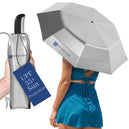
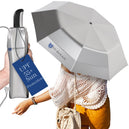
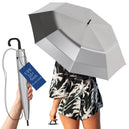
Shade is the only layer that does not need reapplication. A UPF 50+ umbrella blocks 99% of UVA and UVB rays and can drop the temperature underneath by up to 15 degrees Fahrenheit, which matters for anyone spending extended time outdoors. The UV-Blocker Travel Umbrella ($59.95) uses Solarteck RPET fabric and fits in a bag or golf cart.
If a statin user develops unusual sunburn, a rash, or hives after sun exposure, the first step is a full medication review with a pharmacist. The reaction is far more likely to trace back to a diuretic or antibiotic than to the statin.
Frequently Asked Questions About Statin Sun Sensitivity
These are the questions statin users ask most often about sun exposure and their cholesterol medication.
Does atorvastatin (Lipitor) cause sun sensitivity?
Atorvastatin does not list photosensitivity on its FDA prescribing label. The FDA consumer sun-safety page names it, but across 43 label versions on DailyMed, photosensitivity does not appear. The FAERS pharmacovigilance signal for atorvastatin is the weakest among all 33 drugs studied and fails two of three detection criteria.
Does simvastatin (Zocor) cause sun sensitivity?
Simvastatin lists photosensitivity in its postmarketing adverse reactions section, but no incidence rate exists. The reaction is too rare to quantify in clinical trials, and only a handful of published case reports describe it.
Is rosuvastatin (Crestor) safe in the sun?
Rosuvastatin does not list photosensitivity on its FDA label. A low-level FAERS signal exists (ROR 1.62, ranked 27th of 33), but it is one of the weakest signals among all reported photosensitizers in the database.
Do statins increase skin cancer risk?
Randomized trials and genetic studies find no association. Some observational studies show modest signals, including a 2023 meta-analysis linking lipophilic statins to a small melanoma increase (OR 1.13). Researchers have attributed the observational findings primarily to residual confounding.
Should I wear sunscreen while taking a statin?
Yes, but not specifically because of the statin. Statin users tend to be older adults, and the AAD recommends layered sun protection for everyone, especially those over 50. The sun protection is for age-related UV vulnerability, not for the drug.
Can I take my statin before going to the beach?
Yes. Statin photosensitivity is documented but uncommon, and no published study shows that timing the dose relative to sun exposure changes the risk. Patients should continue taking their statin as prescribed.
Conclusion
Statin sun sensitivity is documented but uncommon, and the evidence splits unevenly across the seven drugs. Four statins carry a postmarketing photosensitivity mention on their labels. Three, including the most prescribed drug in America, do not.
The FAERS pharmacovigilance data places statin photosensitivity reports at the smallest share of any drug class analyzed. The published case literature spans roughly a dozen reports over five decades. And the largest randomized trial data shows no link between statins and skin cancer, even as some observational studies continue to raise modest questions.
For most statin users, the practical risk comes from companion medications, not the cholesterol drug itself. Hydrochlorothiazide, fluoroquinolones, and NSAIDs carry photosensitivity risks that overshadow any statin signal. A pharmacist review of the full medication list is the single most useful step a patient can take.
Sun protection still matters for statin sun sensitivity and for general UV vulnerability alike, because the population taking these drugs tends to be older. SPF 30+ sunscreen, UPF 50+ shade, and common-sense timing are the reliable foundation.
Small price to pay. Isn't your health worth it? UV Protection Travel Umbrella, $59.95.