
Black blocks sun. White doesn't. That's what I thought anyway.
My dermatologist set me straight after I showed up with a mild burn on my cheeks. I'd been sitting under my buddy's black patio umbrella for maybe two hours, checking work emails. Thought I was being smart about it. The shadow was solid. You couldn't even see the sun through the fabric.
And yet. Pink face.
"Was it a cheap umbrella?" she asked. I had no idea. It was just... an umbrella? Black?
She laughed. Not in a mean way. More like she's had this conversation a hundred times before. "Color's only part of it. Probably less than a third of what makes an umbrella actually protective."
That threw me. I'd always figured darker meant better for blocking light. Turns out umbrella UV protection is this whole rabbit hole I never expected to go down. Most of what's sold as "UV protection" is pretty much marketing speak.
Anyway. Here's what I learned digging into this stuff.
TL;DR
- Black absorbs more UV than white (90% vs 77%), but color is only 30% of the equation
- Tiny gaps between threads let UV hit your skin at full power regardless of color
- Coatings like titanium dioxide boost UV blocking by 15x
- Best design: silver outside (reflects heat and UV), black inside (catches UV bouncing up from ground)
- Regular umbrellas block 50-77% of UV; good UV umbrellas hit 95%+
- Look for third-party UPF certification, not marketing claims
What Are the 3 Factors of Umbrella UV Protection?
Umbrella UV protection depends on three factors: color absorption (30%), fabric weave density (40%), and chemical coatings (30%), with coatings providing up to 15x improvement in blocking ability.
Here's how they compare:
| Factor | Impact | What It Does | Key Stat |
|---|---|---|---|
| Color | ~30% | Absorbs UV radiation | Black blocks 90%+, white blocks 77% |
| Weave Density | ~40% | Blocks UV through physical barrier | 33% denser = 60% better protection |
| Coatings | ~30% | Multiplies protection chemically | TiO2 coating improves UPF by 15x |
Standard umbrellas block 50-77% of UV. Good sun umbrellas with all three factors hit 95% or more. Marketing UPF claims are often meaningless, so look for third-party certification.
Does Black Really Block More UV Than White?
Black umbrellas block 90-95% of UV radiation while white umbrellas block only 77%, according to Emory University research testing handheld umbrellas against UV transmission.
Makes sense if you think about it. Dark stuff absorbs radiation. Light stuff reflects visible light but lets UV sneak through more easily.
Cool. Buy black. Problem solved? Nope.
This 2024 paper from Drexel kinda ruined that simple answer. The researchers looked at how umbrella companies market their stuff. Direct quote: UPF claims are often "more of a promotional tactic than a reliable indicator of the UV protection provided."
Brutal.
Here's the thing nobody tells you. A white umbrella with tight weave and proper coatings can beat a loosely-woven black one. Color shows you how much UV the fabric itself absorbs. Doesn't say anything about UV sneaking through the gaps. Or UV bouncing around under there.
My dermatologist put it this way: color is one leg of a three-legged stool. Stand on one leg and you fall over. The other two legs matter more.

What Is the "Hole Effect" in Umbrella Fabric?
The hole effect means UV radiation passes through microscopic gaps between fabric threads at 100% intensity, regardless of color, making weave density more important than umbrella color for UV protection.
Grab a magnifying glass and look at any fabric. Even the tight stuff has tiny spaces between threads. Microscopic little holes everywhere. Those holes are why my face got pink.
UV that slips through those gaps hits skin at full dose. Completely unfiltered. Picture window blinds made of solid steel. Sounds protective right? But if there's a quarter inch gap between each slat, sunlight pours through. The steel's doing its job perfectly. The gaps don't care.
Some textile researchers put numbers on this. Making fabric 33% denser improved UV blocking by 60%. Wild right? That's not linear math. You're just closing the holes that were letting raw UV sneak by.
Different weave styles make a difference too. Scientists testing various fabric types found this ranking:
| Weave Type | Tightness Needed | Protection Quality |
|---|---|---|
| Satin | 60% | Good |
| Twill | 70% | Good |
| Plain | 90%+ | Still poor |
Makes you wonder about rain umbrellas. They're built to stop water drops. Those are huge compared to UV wavelengths. Your rain umbrella might keep you bone dry while UV streams through gaps you can't see with your eyes.
The US government actually makes fabric go through simulated wear before testing it. 40 wash cycles. Stretch it. Sun exposure. If the weave loosens and protection drops, it fails.

How Do UV Coatings Improve Umbrella Protection?
UV coatings like titanium dioxide can improve fabric UV protection by 15x, taking fabric from UPF 3.67 to UPF 55.82, making coatings the biggest differentiator between cheap and effective sun umbrellas.
This is where cheap umbrellas and expensive ones actually separate. Fabric coatings are chemical layers that add protection beyond what the base material does. Three main flavors.
Absorption coatings have these tiny particles (think titanium dioxide, zinc oxide) that grab UV before it passes through. They're see-through for regular light but absorb UV wavelengths like crazy.
The numbers are honestly ridiculous. This study tested workwear before and after TiO2 treatment. Untreated fabric had UPF 3.67. Useless basically. Same fabric after titanium dioxide coating? UPF 55.82. Fifteen times better. From one coating application.
Reflective coatings flip the approach. Silver and aluminum particles bounce UV away instead of absorbing it. Bonus: they bounce heat too. You actually stay cooler underneath. Black fabric absorbs UV great but also absorbs heat. Someone online called black umbrellas "portable radiators over your head." Protected from burn but sweating buckets.
Hybrid coatings combine both. Reflective layer outside bouncing stuff away. Absorptive particles in the fabric catching whatever makes it through.
The good news: proper TiO2 applications stick around for 30-50 washes. It bonds into the fabric rather than sitting on top where it'll rub off.

Why Is Silver Outside and Black Inside Best for Umbrella UV Protection?
Silver exterior reflects UV and heat before they hit the fabric (keeping you 15 degrees cooler), while black interior absorbs UV bouncing up from sand, water, and pavement that would otherwise hit your face.
Put the three factors together and the "best design" stops being confusing. What you actually want:
- Silver or shiny exterior bouncing UV and heat before it even touches the fabric
- Black interior catching UV that's bouncing up from below
- Dense coated weave blocking whatever's left
Number two threw me at first. UV from below?
Think about the beach. UV doesn't just fall from the sky. Skin Cancer Foundation says sand bounces 15-25% of UV back upward. Water bounces 10-30%. Even sidewalks and grass reflect some.
That warm glow under your beach umbrella? Part of that is UV smacking your face from below. White interior just bounces it right back at you. Black interior absorbs it.
Temperature tests back this up. Shiny exterior umbrellas keep the space underneath 15 degrees cooler than plain black ones. You get dark-color absorption without the portable radiator situation.
Research published in JAMA Dermatology found standard umbrellas block somewhere between 50-77% of UV. Purpose-built sun umbrellas with real coatings? 95%+. Gap between 77% and 95% doesn't sound massive. Over a few beach hours it's the difference between some shade and genuine protection.
How Does UV-Blocker Solarteck Fabric Work?
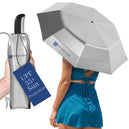
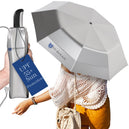
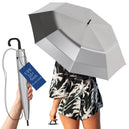
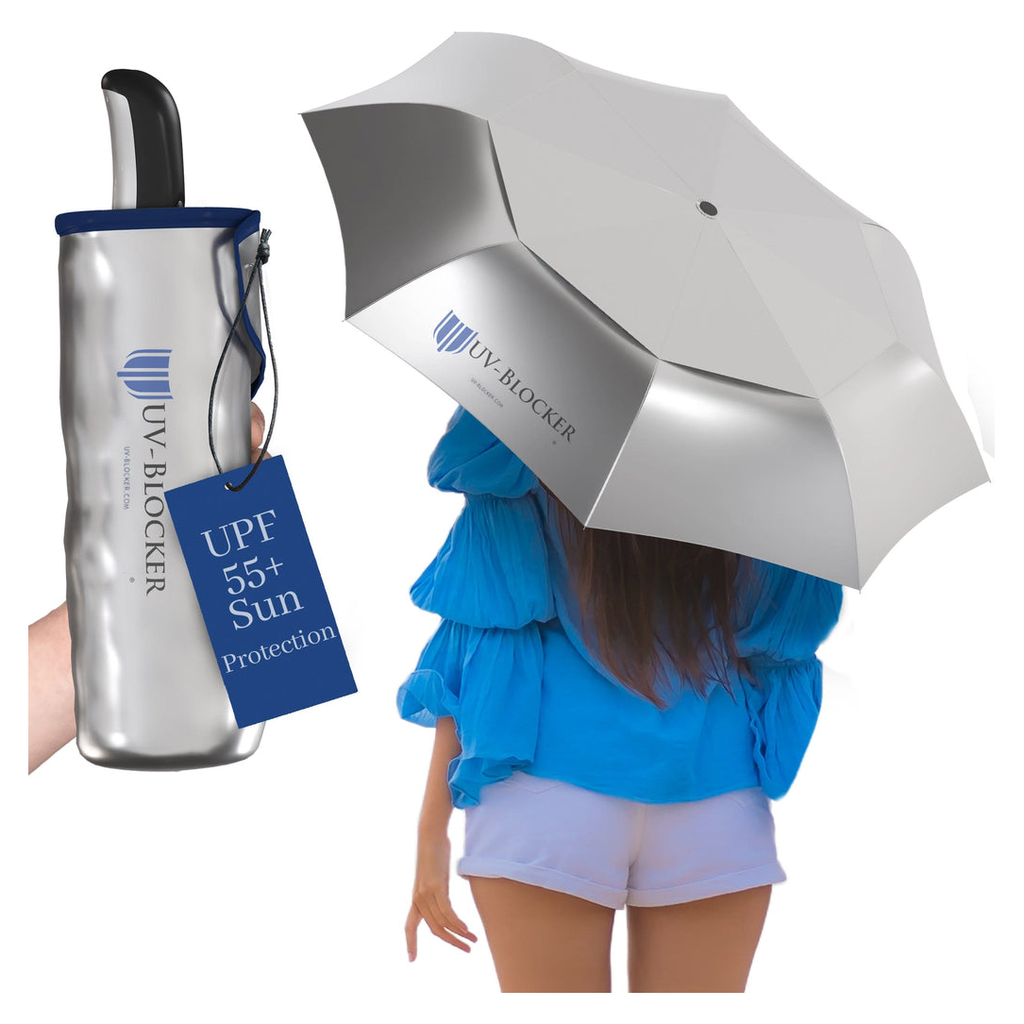
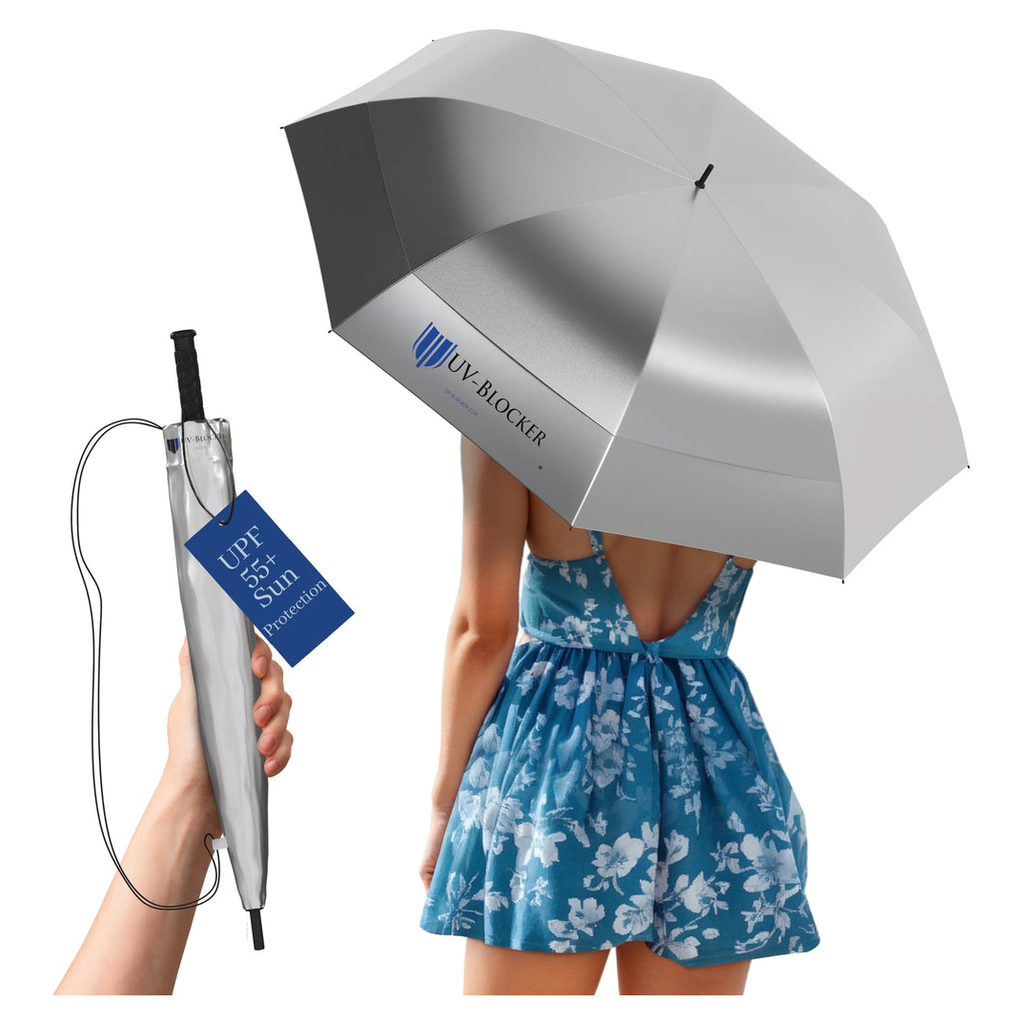
Solarteck fabric combines silver reflective outer layer, black absorptive inner layer, and dense RPET weave with UV treatment to achieve UPF 50+ protection and 15 degrees cooler temperature underneath.
I'll use UV-Blocker's Solarteck stuff as an example since I actually dug into their specs. Their setup covers all three areas:
- Silver reflective outer layer (bounces UV and heat before reaching the canopy)
- Black inner layer (absorbs UV bouncing up from sand, pavement, water)
- Dense RPET weave with UV treatment (that's recycled polyethylene terephthalate, dense enough to minimize gaps)
UPF 50+ meaning 99% of UVA and UVB blocked. Unlike the brands that Drexel study called out, this isn't a number they made up. The Melanoma International Foundation certified it. Actual medical organization.
Their temperature testing showed 15°F cooler under the umbrella versus direct sun. The shiny exterior doing what it's supposed to. Learn more about the science of how umbrella fabrics block UV.
How Can You Tell If Umbrella UV Claims Are Real?
Legitimate umbrella UV protection requires third-party certification from medical organizations like Melanoma International Foundation, specific fabric and coating details, and dual-layer construction with black interior.
Here's what I look at now:
Where's the UPF rating from? Did some medical org verify it or did the company just write a number on the box? Melanoma International Foundation, dermatologist endorsements, stuff like that matters. Self-assigned ratings are meaningless.
What's the fabric? Real UV umbrella makers tell you weave type, material, construction details. "UV fabric" with zero specifics is a red flag.
Coating info? If they're using titanium dioxide, silver, zinc oxide coatings, they'll mention it. No coating details probably means no coating.
Two colors? Black inside with reflective outside means they actually thought about it. Same color everywhere? Probably cheaper construction.
Medical backing? Derm organizations don't just certify random products. Someone who actually understands UV protection had to review it.
The flashlight trick. Hold the canopy up against bright light. See through it? Looks kinda translucent? UV's getting through those same spots. Real UV umbrellas look basically solid when you backlight them.
Stuff I skip now: - "UV protection" claims with no actual UPF number - Single layer, one color all over - Zero fabric or coating details - Price that seems too low for claimed protection

What UPF Rating Should You Look For?
UPF 50+ blocks 98% or more of UV radiation and represents excellent protection, while UPF 30 offers very good protection at 96.7%, and anything below UPF 15 provides minimal meaningful protection.
| UPF Rating | UV Blocked | Protection Level |
|---|---|---|
| UPF 50+ | 98%+ | Excellent |
| UPF 40-49 | 97.5-98% | Excellent |
| UPF 30-39 | 96.7-97.4% | Very Good |
| UPF 15-29 | 93-96% | Good |
| Below UPF 15 | <93% | Minimal |
Yeah color matters but not as much as everyone thinks. Black absorbs maybe 90%+ of UV, white gets about 77%. But weave and coatings matter more. Coated white umbrella can beat uncoated black one.
Below UPF 15 you're basically getting marketing nonsense, not real protection.
Can a Regular Rain Umbrella Protect From UV?
Regular rain umbrellas block 50-77% of UV radiation depending on construction, while purpose-built UV umbrellas with proper coatings and dense weave achieve 95% or higher protection.
Kinda. Standard umbrellas block somewhere between 50-77% depending on construction. Real UV umbrellas with proper coatings hit 95%+. If you've got skin concerns, get an actual sun umbrella.
Silver bounces UV and heat before hitting the fabric. Keeps you cooler. Black inside catches UV that reflects up from ground, sand, water. Otherwise that UV hits your face from below. The combo handles both directions.
Third-party medical certification matters. Melanoma International Foundation, dermatologist endorsements. That 2024 Drexel paper found most self-assigned UPF numbers are basically just marketing.
Research shows titanium dioxide coating is legit. One study got 15x improvement—fabric went from UPF 3.67 to 55.82 after TiO2 treatment. Good applications last 30-50 washes.
What Did I Learn About Umbrella UV Protection?
True umbrella UV protection requires all three factors working together: dark interior for absorption, reflective exterior for heat and UV reflection, and dense coated weave to close microscopic gaps that let raw UV through.
The usual advice isn't wrong exactly. Just incomplete.
Dark colors absorb more UV than light ones. True. But that absorption only kicks in after UV reaches the fabric. It says nothing about UV sneaking through gaps in the weave. Or UV bouncing around the space between umbrella and your face.
Real umbrella UV protection needs all three legs of the stool:
- Color (absorption): Dark insides catch UV, including the UV bouncing up from ground
- Coatings (reflection): Silver and metal outsides bounce UV and heat away before contact
- Weave density (blocking): Tight construction closes the microscopic gaps that let raw UV through
Silver outside, black inside, dense coated fabric. That setup addresses every angle UV can attack from. Not the only option but covers the bases.
$15 black umbrella and $60 UV umbrella look similar from across the beach. The fabric engineering is completely different. One's shade. The other's actually a shield.
Use a checklist. Look for real certification. When you're unsure, hold it up to light.
Want an umbrella with verified UV protection? Browse our UV-blocking umbrella collection using Solarteck fabric.
From the UV-Blocker Sun Protection Team. We work with dermatologists and the Melanoma International Foundation building medically-validated UV protection. Ron Walker founded UV-Blocker after Stage 1 melanoma diagnosis in 2003.
Frequently Asked Questions About Umbrella UV Protection
Does a regular umbrella protect from UV rays?
A standard rain or fashion umbrella provides partial UV protection — typically blocking 50 to 77% of UV radiation. That means 23 to 50% passes straight through to your skin. Under a UV index of 8 or higher, that level of transmission is enough to cause damage over one to two hours of stationary use. A UV-rated umbrella with independent UPF 50+ certification (like UV-Blocker's Solartek® fabric) blocks 98%+ of UV — a meaningful difference for extended outdoor exposure.
What is the best color for a UV-blocking umbrella?
Color is only about 30% of UV protection performance. Black absorbs slightly more UV than lighter colors, but fabric weave density (40% of performance) and UV-reflective or UV-absorbing coatings (30%) matter more. The most effective design — used by UV-Blocker — is a silver reflective outer layer (reflects UV and heat) combined with a dark inner layer (absorbs any transmitted UV before it reaches the person below).
How do I know if an umbrella genuinely blocks UV?
Look for independent third-party testing to AATCC TM183-2020 (the UV-protective textile standard used for medical clothing) and a UPF 50+ rating. Marketing language like "UV protection" or "sun blocking" without a certified UPF rating is not sufficient. Hold the fabric up to bright light — a visible amount of light passing through indicates inadequate UV protection, though this test is imprecise. Third-party certification is the definitive check.
How long does UV protection in an umbrella last?
UV-protective coatings and treatments on umbrella fabric can degrade over time with heavy use, washing, and UV exposure itself. High-quality UV umbrellas like UV-Blocker's use durable Solartek® silver-coated fabric designed for multi-year use. Inspect the fabric periodically for wear — any holes, thinning, or mechanical damage reduces UV protection at those points.
Is an umbrella or sunscreen better for UV protection?
A properly certified UV umbrella outperforms sunscreen for stationary outdoor use. Sunscreen degrades with UV exposure, washes off with sweat, and is typically applied at 25 to 50% of the dose required to achieve its labeled SPF. A UPF 50+ umbrella's performance doesn't degrade during use, doesn't require reapplication, and can't be missed in application. For active outdoor use where carrying an umbrella isn't practical, sunscreen plus UPF clothing is the correct approach. The most effective strategy combines both.