

A rubber playground surface can reach over 170 degrees on a summer afternoon. That temperature causes second-degree burns in seconds.
Yet 97% of playgrounds across the United States have no full shade during peak UV hours. Three problems converge on every unshaded playground: scorching surface temperatures, a massive shade deficit, and school policies that restrict children from carrying sunscreen. This guide on sun protection for playgrounds covers what the actual risks are, why they persist, and what parents and schools can do about each one starting today.
TLDR:
- Rubber playground surfaces exceed 170 degrees in direct sun, well above the 131-degree threshold for second-degree burns
- Only 3% of US public playgrounds have full shade during peak UV hours (10 a.m. to 2 p.m.)
- The FDA classifies sunscreen as an over-the-counter drug, and 21 states still require a doctor's note for children to use it at school
- The 7-second hand test is the fastest way to check if a surface is too hot for a child's skin
- Schools can apply for American Academy of Dermatology shade grants of up to $8,000
- Moving recess outside the 10 a.m. to 2 p.m. window is a zero-cost UV reduction strategy
How Hot Do Playground Surfaces Actually Get?
Playground rubber surfaces can exceed 170 degrees in direct sunlight, and plastic slides reach 160 degrees on an 80-degree day. Both sit well above the 131-degree threshold for second-degree burns.
Most parents instinctively test a metal slide with a quick touch before letting kids climb. Fewer think to check the rubber safety surface underneath their children's feet. That poured rubber absorbs solar radiation all morning and retains heat deep into the afternoon. On a 95-degree day with direct sun, the rubber underfoot can be 75 degrees hotter than the air temperature.
Dark-colored synthetic turf performs even worse. Artificial grass with dark infill has been recorded above 180 degrees during peak afternoon hours, making it the hottest common playground material.
Surface Temperature Comparison by Material

The table below compares peak surface temperatures measured in direct sunlight against established burn-risk thresholds. These readings come from peer-reviewed research on playground thermal hazards.
| Surface Material | Peak Temperature (Direct Sun) | Burn Risk Level |
|---|---|---|
| Synthetic turf (dark) | 180°F+ (82°C+) | SEVERE |
| Rubber pour-in-place | 170°F+ (77°C+) | SEVERE |
| Plastic slides | 150-160°F (66-71°C) | HIGH |
| Metal slides and rails | 140-160°F (60-71°C) | HIGH |
| Wood decking | 120-130°F (49-54°C) | MODERATE |
| Sand (natural) | 110-120°F (43-49°C) | LOW-MODERATE |
| Pea gravel | 100-110°F (38-43°C) | LOW |
First-degree burns begin at approximately 118 degrees. Second-degree burns with blistering start at 131 degrees. Children's skin is thinner than adult skin, which lowers the effective burn threshold and shortens the time to tissue damage. A toddler's foot on 170-degree rubber experiences a more severe injury than an adult hand on the same surface.
The Shade Difference
Shaded surfaces stay 20 to 30 degrees cooler than identical materials in direct sun and never reach burn-threshold temperatures, according to research published in Building and Environment. The same rubber that hits 170 degrees in full sun stays below 140 degrees under a shade canopy. Shade does not just reduce the burn hazard. It eliminates it.
That finding makes the next question unavoidable: how much shade do playgrounds actually have?
Why Do 97% of US Playgrounds Lack Full Shade?
Only 3% of US public playgrounds have full shade during peak UV hours, between 10 a.m. and 2 p.m. Two-thirds have zero shade of any kind.
The breakdown from the National Program for Playground Safety is stark. Three percent of playgrounds have full shade coverage. Thirty percent have partial shade, meaning some equipment is covered but large sections of the play area remain exposed. The remaining 67% sit in complete, unobstructed sunlight through the most intense UV period of the day.
A child playing at noon on a cloudless June day is standing on surfaces hot enough to burn bare skin while absorbing the day's highest UV dose. The playground sun safety gap is not an edge case. It describes the default condition at two out of every three public play areas.
Why This Matters for Long-Term Health
Between 40% and 50% of a person's lifetime UV exposure accumulates before age 20, according to the Skin Cancer Foundation. Children log the bulk of their cumulative UV dose at the exact locations, playgrounds and schoolyards, where shade infrastructure is least present.
Each sunburn during childhood raises lifetime melanoma risk. The American Academy of Dermatology estimates that five or more blistering sunburns between ages 15 and 20 increase melanoma risk by 80%. School-age children spend an estimated 2.5 to 4 hours outdoors on school days, with 30 to 60 minutes of that during peak recess times.
The Cost Barrier
Permanent shade structures cost $5,000 to $25,000 or more per installation, depending on coverage area and structural design. For school districts already stretched on deferred maintenance backlogs, that price tag stalls projects indefinitely. The result is a growing gap between documented risk and built infrastructure that children absorb with every recess period.
There is one zero-cost alternative. Moving outdoor play to before 10 a.m. or after 3 p.m. reduces UV intensity by 60% to 80%. No construction budget required. But that still leaves a compounding problem: the single most recommended personal sun protection may not be allowed through the school door.
Why Can't Kids Bring Sunscreen to School?
The FDA classifies sunscreen as an over-the-counter drug, so many school districts prohibit students from carrying or applying it without a doctor's note.
This classification places sunscreen in the same regulatory category as aspirin and cough medicine, catching most parents off guard. The American Academy of Dermatology, the Skin Cancer Foundation, and every major pediatric health organization recommend daily sunscreen use for children exposed to UV radiation. Yet the legal framework treats a bottle of SPF 50 the same way it treats a tube of hydrocortisone cream. School nurses often lack the staffing to apply sunscreen to dozens of children before each recess period, so the practical effect is that children go outside unprotected.
Where Legislation Stands in 2026
Progress on this issue is real but far from complete. As of January 2026, 29 states and the District of Columbia have passed SUNucate or similar legislation allowing students to possess and self-apply sunscreen at school, according to the Skin Cancer Foundation. California, Arizona, Florida, Utah, and Washington were among the earliest states to pass these laws.
In the remaining 21 states, students still need a physician's note on file to use sunscreen during school hours. States including Colorado, Georgia, Idaho, Iowa, Kansas, Kentucky, Mississippi, and Wyoming maintain the restriction.
The Compounding Hazard
The combined effect is hard to overstate: no shade on the playground plus no sunscreen in the backpack equals children doubly exposed during outdoor time. Parents in the 21 restricted states have one immediate fix. A pediatrician's note authorizing daily sunscreen use resolves the policy barrier. It takes five minutes at the next well-child visit and covers the remainder of the school year.
With the three core problems now identified, the question shifts to what parents can do right now without waiting for policy changes or capital budgets.
What Can Parents Do Today Without Waiting for Infrastructure?
Five immediate steps reduce playground UV risk: the hand test, timing, UPF clothing, portable shade, and a doctor's note for sunscreen.

None of these require a school board vote, a construction permit, or a budget line item. Every item on this playground sun safety checklist works this week.
1. The 7-Second Hand Test
Press the back of your hand flat against any playground surface and hold for seven seconds. If the heat feels uncomfortable on adult skin, the surface is too hot for a child. This test works on slides, rubber surfacing, metal rails, and synthetic turf alike. Teach children to do it themselves before touching any sun-exposed equipment. It costs nothing and takes seconds.
2. Time-of-Day Awareness
Push outdoor play to before 10 a.m. or after 3 p.m. whenever scheduling allows. UV intensity drops 60% to 80% outside the peak midday window, and surface temperatures can be 30 to 50 degrees lower in the early morning compared to early afternoon.
Parents cannot always control when school recess happens. But weekend playground visits, after-school play dates, and summer outings are fully within family scheduling control. Choosing the 8 a.m. or 5 p.m. playground window instead of the noon slot is one of the highest-impact free decisions available.
3. UPF 50+ Clothing and Hats
Rated sun-protective clothing blocks 98% or more of UV radiation without reapplication, sweat-off, or expiration. A UPF 50+ shirt and wide-brim hat provide consistent, reliable coverage that sunscreen alone cannot match over a full day of active play. UPF-rated fabrics maintain their protection through washing and do not need reapplication every two hours.
4. Portable UV Umbrella for Sideline Shade
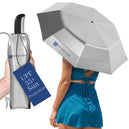
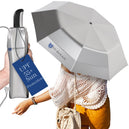
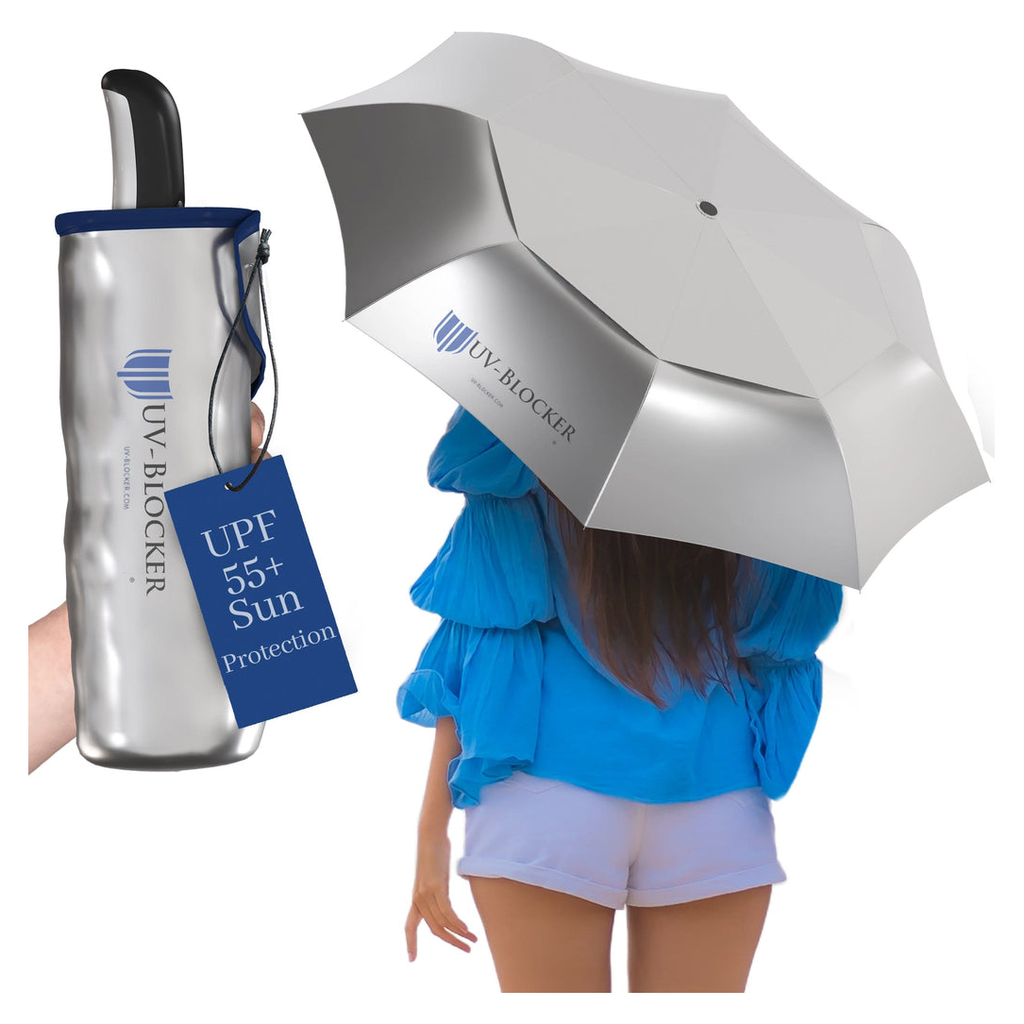
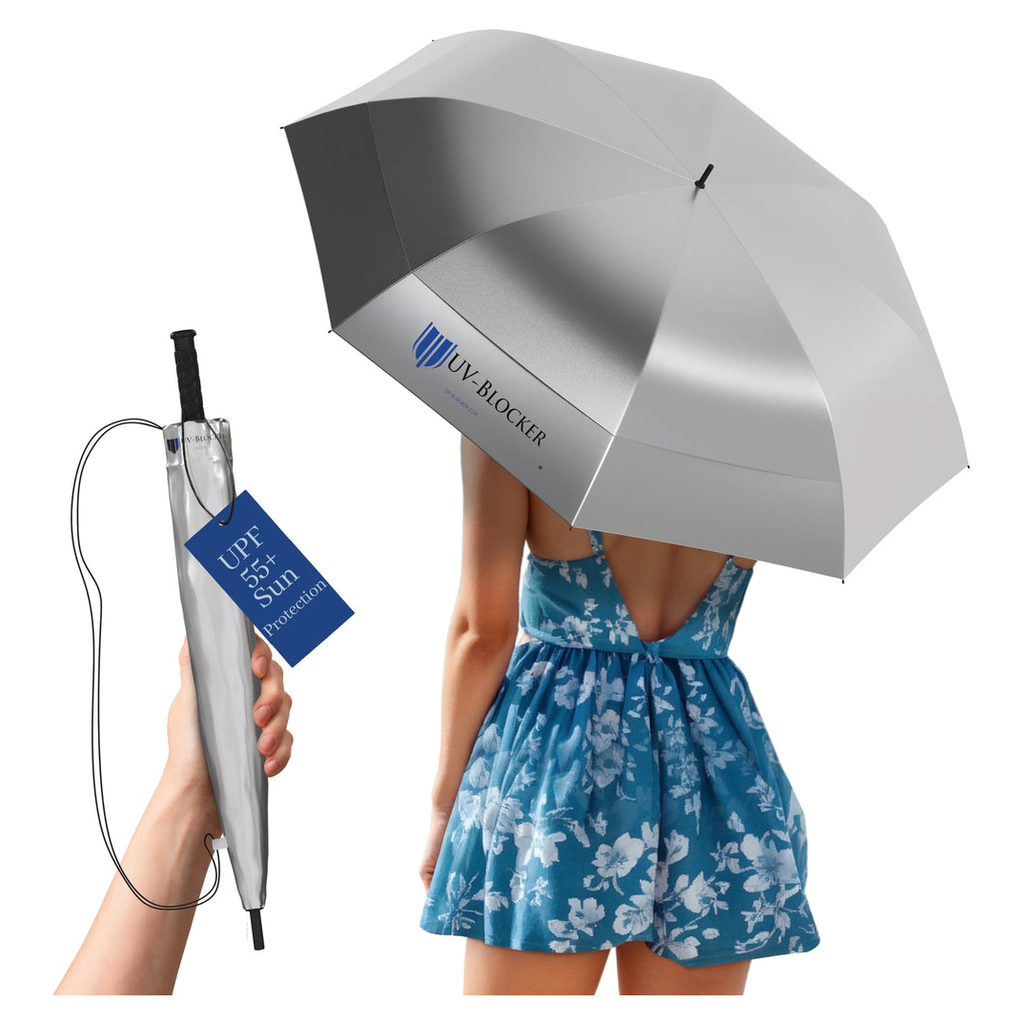
At school events, sports days, field trips, and playground visits, a UPF 50+ umbrella creates instant, portable shade without any permanent installation. Products like the UV-Blocker Compact UV Umbrella ($59.95) fold small enough for a tote bag and block 99% of UV rays with the patented Solarteck reflective coating.
For hands-free shade on bleachers, park benches, or camping chairs, the UV-Blocker Chair Umbrella Holder ($29.95) clamps to most standard seating. Parents already attending kids' sports events or summer camps can use the same setup at playgrounds.
5. Get a Doctor's Note for Sunscreen
In states that still classify sunscreen as a controlled substance at school, a pediatrician's note authorizes a child to carry and apply it daily. This takes about five minutes at the next well-child appointment and solves the policy barrier for the entire school year. Request a note that specifies "self-carry and self-apply" to avoid requiring the school nurse for each application.
Parents can act on every one of these five points starting today. But longer-term change at the infrastructure level requires schools and parks departments to close the systemic gap.
What Should Schools and Parks Departments Know About Playground Sun Safety?
Schools can reduce playground UV exposure through three approaches: rescheduling recess outside peak UV hours, applying for shade grants, and choosing lighter-colored surface materials.
Each approach addresses a different budget tier. At least one is available to every school district regardless of current funding levels.
Recess Scheduling as a Zero-Cost Strategy
Moving outdoor recess to before 10 a.m. or after 3 p.m. removes children from the most intense UV radiation window and also reduces surface burn risk, since playground equipment is cooler in the morning than at midday. Many elementary schools already offer a morning recess slot. Formalizing morning recess as the primary outdoor block requires schedule coordination and staff buy-in, not construction spending.
For schools with lunch periods between 11 a.m. and 1 p.m. that traditionally pair recess with lunch, splitting lunch recess into two shorter breaks (one morning, one late afternoon) distributes outdoor time across lower-UV windows.
AAD Shade Structure Grants
The American Academy of Dermatology awards grants of up to $8,000 for permanent shade structures at schools and nonprofit facilities serving children. Since 1999, the program has funded over 492 shade installations covering shade access for more than 3.7 million people daily.
Eligibility requires status as a 501(c)(3) nonprofit or public school serving children 18 and under. The school or organization must have a sun-safety education program in place for at least one year before applying. Applications open each fall for the following year's funding cycle.
Surface Material Selection for New Builds
When constructing or resurfacing playgrounds, lighter-colored rubber and natural materials (sand, pea gravel, wood fiber) stay 40 to 60 degrees cooler than dark rubber or synthetic turf. The surface temperature comparison table earlier in this guide demonstrates the full range. Specifying lighter materials at the design stage adds modest upfront cost but can eliminate the contact burn hazard without requiring separate shade structures.
The Liability Perspective
The cost of a single pediatric contact burn injury claim, including medical treatment, legal proceedings, and potential settlement, typically exceeds the cost of a shade structure installation by a significant margin. For facilities managers and school board members weighing capital expenditure against risk exposure, playground shade is a straightforward liability reduction.
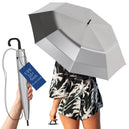
For school outdoor events, field days, graduation ceremonies, and assemblies, portable shade options like the UV-Blocker Large Beach Umbrella provide group coverage that sets up in minutes without permanent installation.
Which Children Need Priority Shade Access?
Children with albinism, photosensitivity disorders, or those taking photosensitizing medications face elevated UV risk and may qualify for shade access as a formal medical accommodation at school.
Not every child carries the same UV risk profile. Several medical conditions and common pediatric medications make sun exposure significantly more dangerous for specific students. Schools should be prepared to accommodate these children with priority shade access during outdoor time.
Conditions Requiring Extra Protection
Children with albinism have minimal melanin production and can sustain burns within minutes of direct sun exposure. Juvenile lupus patients experience disease flares triggered directly by UV radiation, making unshaded outdoor time a medical risk. Xeroderma pigmentosum (XP) involves a DNA repair deficiency where any UV exposure carries significant cancer risk. Polymorphous light eruption (PMLE) triggers painful, itchy rashes even from moderate sun exposure.
Medications That Increase Photosensitivity
Several common prescriptions significantly raise UV sensitivity in children. Isotretinoin (Accutane), prescribed for severe acne, dramatically increases sunburn risk and is one of the most common photosensitizing medications in the adolescent population. Antibiotics including doxycycline and tetracycline cause well-documented photosensitive reactions. Some ADHD medications and antifungal treatments carry similar warnings.
Parents should proactively inform school administrators when a child takes any photosensitizing medication so that recess and PE accommodations can be arranged before an incident occurs.
ADA and 504 Plan Considerations
Students with documented photosensitivity conditions may qualify for formal shade accommodations under disability law. A Section 504 plan can require the school to provide access to shaded play areas during recess, PE, and outdoor events. Parents should contact their school's 504 coordinator to begin this process.
Children undergoing chemotherapy have severely compromised UV tolerance and require the highest level of shade protection. Schools with students in active cancer treatment should coordinate directly with the family's oncology team on outdoor activity restrictions and shade protocols.
For any child with elevated UV sensitivity, a UPF 50+ umbrella designed for kids provides a personal shade solution that travels with the child throughout the school day.
Frequently Asked Questions About Sun Protection for Playgrounds
These are the most common questions parents and school administrators ask about playground sun safety, surface burns, and UV protection for playgrounds.
Can a child get burned by playground rubber?
Yes. Rubber pour-in-place surfaces can exceed 170 degrees in direct sunlight, which sits well above the 131-degree threshold for second-degree burns. Children's thinner skin makes them more susceptible to contact burns than adults, and the injury develops in seconds rather than minutes on the hottest surfaces.
What temperature is too hot for playground equipment?
Any surface above 118 degrees (48 degrees Celsius) can cause first-degree burns on contact. The 7-second hand test is the simplest field check: press your palm flat against the surface and hold for a full seven-second count. If the heat is uncomfortable for an adult hand, it is dangerous for a child's skin. Test slides, railings, rubber surfacing, and synthetic turf before allowing play.
Are schools required to provide shade on playgrounds?
No federal law mandates shade on school playgrounds. However, students with documented photosensitivity conditions may qualify for shade accommodations under the Americans with Disabilities Act or Section 504 plans. The AAD shade grant program provides up to $8,000 in funding for schools that want to install permanent shade structures, and applications open each fall.
Why can't my child bring sunscreen to school?
The FDA classifies sunscreen as an over-the-counter drug. In 21 states, schools still treat it like prescription medication and require a doctor's note before students can carry or apply it. A simple pediatrician's note resolves this restriction in any state.
What UV index means kids should stay inside?
A UV index of 6 or higher (rated "High") calls for additional protection measures including shade access, wide-brim hats, UPF clothing, and sunscreen. At UV index 8 or above ("Very High"), outdoor exposure during 10 a.m. to 2 p.m. should be actively limited. Check the daily UV index forecast at weather.gov before planning outdoor activities. Even on cloudy days, up to 80% of UV radiation passes through cloud cover and reaches ground level.
How can schools apply for shade structure funding?
The American Academy of Dermatology awards grants of up to $8,000 for permanent shade structures at public schools and 501(c)(3) nonprofits serving children 18 and under. Applicants need an existing sun-safety curriculum running for at least one year before the application date. Applications open each fall for the following year.
Conclusion
Sun protection for playgrounds comes down to three intersecting problems: surfaces hot enough to cause burns, a national shade deficit, and policies that restrict children from carrying the most basic personal protection.
The temperature data tells the clearest story. Rubber at 170 degrees and plastic slides at 160 degrees are not worst-case outliers. Those are routine measurements on a routine summer day. The 3% full-shade statistic from the National Program for Playground Safety confirms this is a systemic infrastructure failure, not a handful of neglected parks. And the ongoing sunscreen restrictions in 21 states add a compounding layer of risk that most parents do not realize exists until their child comes home with a burn.
The tools to address it already exist. Parents have the hand test, smarter timing, UPF clothing, portable UV shade, and a five-minute doctor's note. Schools have recess rescheduling (free), AAD grant funding (up to $8,000), and material selection guidelines for new builds. Neither group needs to wait for the other to take the first step.
For families with young children or kids heading to summer camp, every recommendation in this playground sun safety guide applies equally to any outdoor setting where shade is absent and the UV index is high.
School and Playground UV Protection Standards: What Parents and Administrators Need to Know
Children receive approximately 25% of their lifetime UV exposure before age 18 — and school recess accounts for a significant portion of that. UV-induced DNA damage from childhood is one of the strongest predictors of adult melanoma, making playground sun protection a public health priority, not a luxury.
UV Exposure During School Recess: The Data
- A 30-minute midday recess in summer delivers a UV dose equivalent to over 100 mJ/cm² — more than enough to cause significant DNA damage in children's thinner, more UV-sensitive skin.
- Children are less likely than adults to notice sunburn onset due to lower pain sensitivity and higher activity engagement, making behavioral sun-safety signals unreliable.
- Studies show only 4% of children apply sunscreen correctly without supervision — and school policies often prohibit staff from applying sunscreen without parental consent forms.
School Sun Protection Policy Framework
The World Cancer Research Fund International recommends schools implement a "Sun Safe" policy covering:
- Scheduling outdoor activities outside peak UV hours (10 a.m.–2 p.m.) when UV index exceeds 6
- Permanent shade structures over 50% of playground surface area
- Portable shade (UPF 50+ umbrellas or shade sails) for areas without permanent structures
- Mandatory sun-protective hats for outdoor activities
- UV index monitoring and parent/student communication
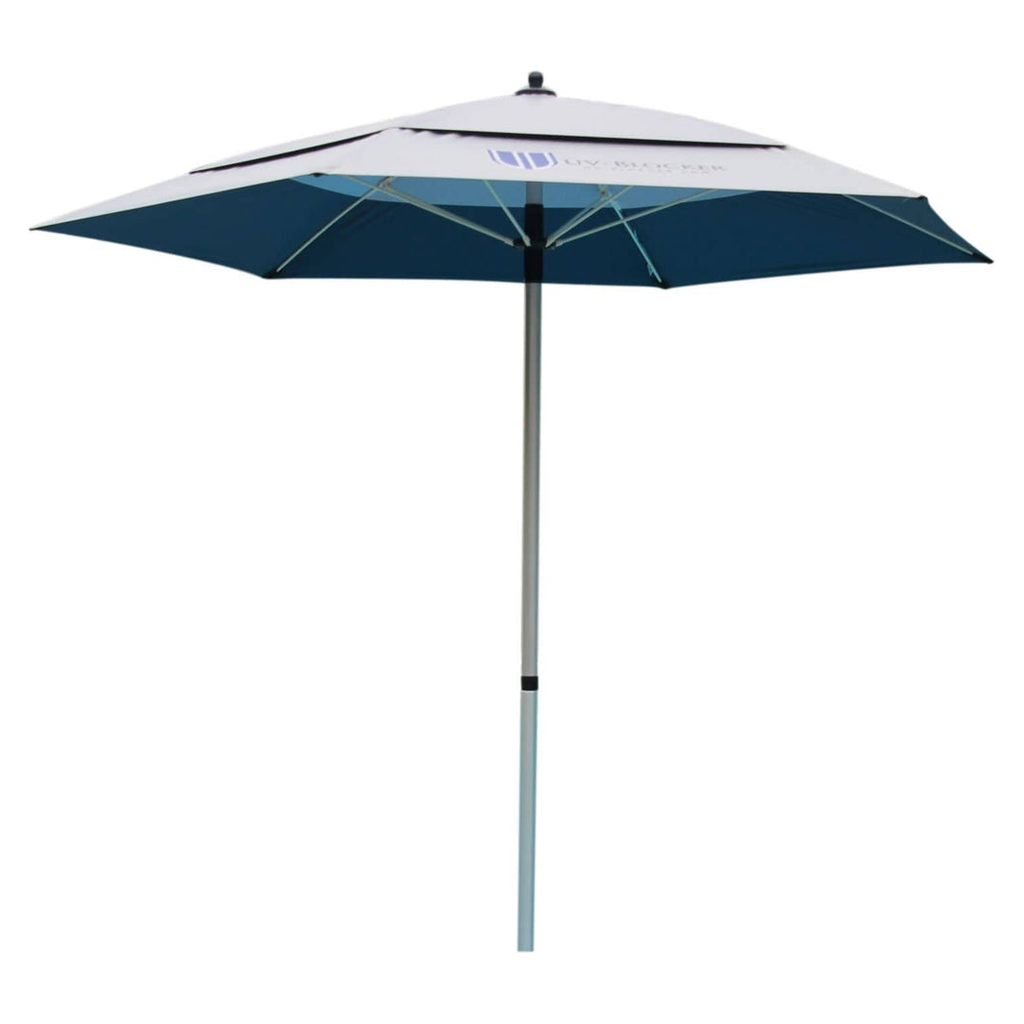
UV-Blocker's 7.5-foot ServiceShield with magnetic or weighted base can be deployed without permanent installation, making it an ideal solution for schools unable to fund permanent shade structures.
Ready for Real UV Protection?
UV-Blocker umbrellas block 99%+ of UV rays, keep you up to 15°F cooler, and carry the only Melanoma International Foundation approval of any umbrella. Dermatologist-recommended. Loved by melanoma survivors, outdoor workers, and sun-sensitive individuals worldwide.
Shop UV-Blocker Umbrellas →Sun Safety in Canada
Canada experiences meaningful UV exposure throughout the year, with UV Index levels regularly reaching 8–10 or higher during summer months in cities such as Vancouver, Calgary, Toronto, and Ottawa. Health Canada and Environment and Climate Change Canada publish daily UV Index forecasts and recommend protective measures whenever the index exceeds 3 — a threshold reached on most clear days between May and August across the country.
Key resources for Canadian sun safety:
- Health Canada UV Index: Published daily via the Environment and Climate Change Canada weather portal (weather.gc.ca). Canadians can track UV levels by city and receive alerts when protection is recommended.
- Canadian Cancer Society: Recommends UPF 50+ clothing, hats, sunscreen, and shade-seeking as primary sun protection strategies. Physical UV barriers — such as UPF 50+ umbrellas — are emphasized for prolonged outdoor exposure.
- Canadian Dermatology Association: Endorses broad-spectrum sun protection strategies, including shade structures and UV-blocking accessories, especially for individuals with fair skin or a personal or family history of skin cancer.
For Canadians spending extended time outdoors — whether working, playing sports, or enjoying recreational activities — a UV-blocking umbrella rated UPF 50+ provides continuous, reapplication-free protection. The UV-Blocker umbrella, independently tested and approved by the Melanoma International Foundation, blocks 99% of UV rays and keeps users up to 15°F cooler — making it a practical and reliable companion for Canadian summers.