

TL;DR
- The "Dry Heat" Deception: Sweat evaporates instantly in Vegas, hiding signs of rapid dehydration.
- Concrete Reflector Effect: Ground temperatures exceed 140°F, cooking you from below even if you wear a hat.
- Distance Trap: Walking between neighboring casinos like Bellagio and Caesars takes 15-20 minutes in direct sun.
- Hat vs. Umbrella: Hats trap body heat; UV umbrellas block sun while allowing airflow.
- Queue Survival: A compact UV umbrella is the only way to survive 45-minute pool party lines without heat exhaustion.
Las Vegas in July tests human endurance. The air temperature hovers around 105°F, but that number is deceptively low. Unlike the humid heat of Florida or Singapore, Vegas heat is dry, intense, and relentless. It doesn't just surround you; it radiates from every surface.
Most tourists arrive prepared for "sunny weather." They bring baseball caps, sunglasses, and water. Within 24 hours, they are exhausted, sunburned, and hiding in the hotel casino, wondering why they feel so drained.
The problem isn't just the sun above you. It's the physics of the environment around you. To survive the Strip in summer, blocking out radiation while maintaining energy, you need to understand how heat actually works in a concrete desert.
The Deceptive Distance: Why "Just One Casino Over" Is a Trap
The visual scale of the Las Vegas Strip distorts reality. The hotels are massive, making them appear closer than they are. Standing at the Bellagio fountains, Caesars Palace looks like it's right next door.
In reality, that "short walk" is nearly a mile of obstacle courses, pedestrian bridges, and unshaded sidewalks. At a normal walking pace, it takes 15 to 20 minutes.
The "Dry Heat" Danger
In 15% humidity, sweat evaporates from your skin almost instantly. You don't feel sweaty, so your body's natural "stop and drink" alarm doesn't go off. You assume you're fine.
Meanwhile, you are losing fluid rapidly. By the time you feel thirsty, you are already dehydrated. This is why you see tourists fainting in the lobby of the Venetian. They walked from the Mirage, felt "fine" the whole way, and collapsed the moment their adrenaline dropped.
Actionable Advice: * Measure in Minutes, Not Sight: Check walking times on your phone before you commit. * Carry Water: Never leave a casino without a bottle of water, even for a 10-minute walk. * Assume Exposure: There is almost no shade on the sidewalks between casinos.
The Concrete Reflector: Why It Feels 120°F When It's 105°F
Weather apps report air temperature, which is measured in the shade. They do not report the radiant temperature of the environment.
Concrete and asphalt have high thermal mass. They absorb solar radiation all day and re-radiate it back upward. On a day where the air temperature is 105°F, the pavement temperature on the Strip often exceeds 140°F [1].

This creates a "micro-oven" effect. You are being cooked by direct UV rays from the sun above and infrared heat radiating from the ground below. Your legs and torso absorb this radiant heat, increasing your core temperature faster than the air alone would suggest.
This is why traditional sun protection measures fail in Vegas. Sunscreen protects your skin from burning, but it does nothing to stop the radiant heat load that exhausts your body. You need a physical barrier that reflects radiation.
The Hat Trap: Why Traditional Cover Fails in the Desert
The standard advice for sun safety is "wear a hat." In the desert, this can backfire.
Thermodynamics dictates that heat rises. Your head is a primary release point for body heat. When you wear a tight-fitting baseball cap or a heavy straw hat, you are capping that chimney. You trap the heat against your scalp.
While the brim sheds some sun from your face, the trapped heat increases your thermal stress. You feel hotter, your face flushes, and your heart rate rises as your body struggles to cool down.
The ideal desert headgear acts like a roof, not a lid. You need shade to block the UV rays, but you also need open space for air to circulate and remove body heat.
The "Personal AC" Effect: Thermodynamics of UV Umbrellas
This is where a dedicated UV umbrella becomes essential gear rather than a novelty. Unlike a hat, an umbrella floats above your head. It blocks the direct sun but leaves the air around your head completely open for ventilation.
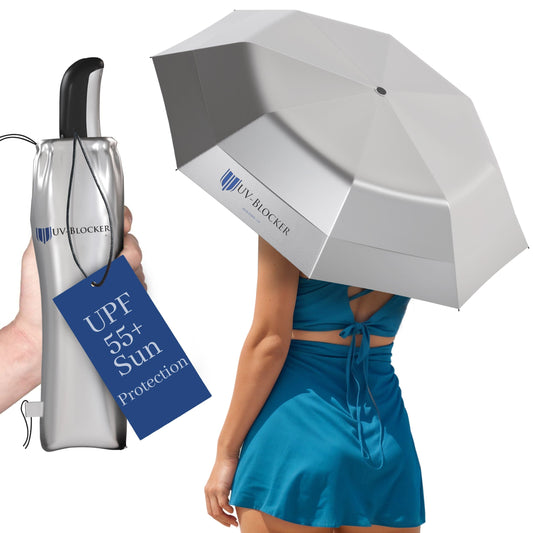
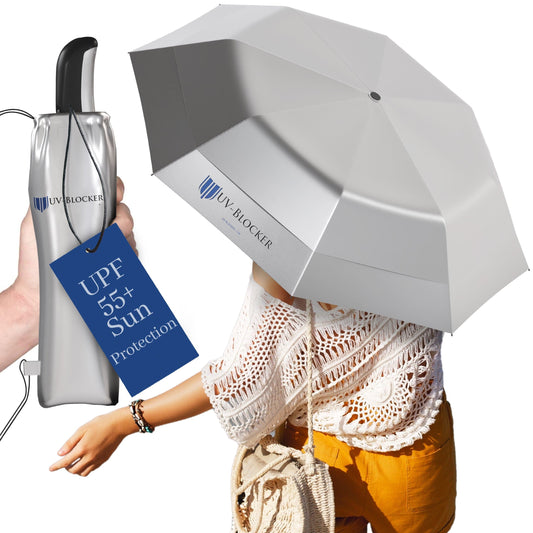
The UV-Blocker Travel Umbrella uses Solarteck™ fabric, which is specifically engineered to reflect 99% of UV and heat.
The Mechanism of Cooling
Because the silver surface reflects the solar energy before it touches you, the air pocket underneath the canopy is significantly cooler than the surrounding sunlight, often by up to 15°F.
Standing under this canopy feels like stepping into the shade of a thick tree. The biting sensation of the sun on your skin disappears immediately. The Las Vegas breeze, which feels like a hair dryer in direct sun, suddenly feels refreshing because it's moving through your shaded microclimate, evaporating sweat effectively.
For walking the Strip, this "Personal AC" effect allows you to cover distances that would otherwise leave you drenched and exhausted.
Pool Party & Day Club Protocol: Surviving the Queue
Vegas day clubs like Wet Republic, Encore Beach Club, and Tao Beach are legendary. Also legendary are their entry lines.
Even if you have a ticket, you will likely wait in line for 30 to 60 minutes. These lines are almost exclusively outdoors, on concrete, in direct sunlight. Security checkpoints move slowly. This is the most dangerous part of the day for heat exhaustion. By the time many people get inside, they are too headache-y and drained to enjoy the party.

The "Silver Shield" Strategy
Pack a proper Compact UV Umbrella. It fits easily in a small purse or day bag.
- In Line: Deploy the umbrella. You create an instant zone of 15°F cooler air. You preserve your energy and hydration levels while everyone around you melts.
- Security: It folds down to less than 12 inches. Security is familiar with umbrellas; they are looking for weapons and outside liquids, not shade gear.
- Inside: Stash it in a locker or your bag.
You will be the envy of the line. We frequently hear from customers who made "best friends" with the people behind them just by sharing a few inches of shade.
Vegas Summer Gear List
To conquer the Strip in July, abandon the "minimalist" tourist approach. Treat it like an expedition.
- Specialized Footwear: Wear shoes with thick soles. Thin sandals or flip-flops bring your feet too close to the 140°F pavement. The heat will penetrate the soles and burn your feet.
- Electrolytes: Water isn't enough. You are losing salt rapidly. Carry packets of Liquid IV or similar electrolytes to keep your chemistry balanced.
- Breathable Fabrics: Wear linen, cotton, or moisture-wicking synthetics. Avoid gray fabrics that show sweat—you will sweat, even if it dries fast.
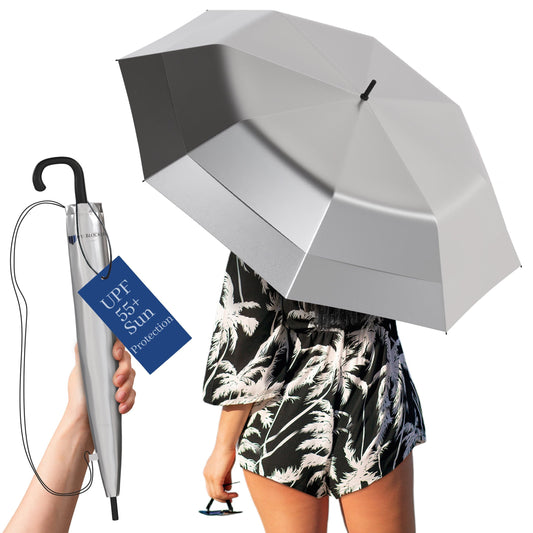
- UV-Blocker Umbrella: Your portable shade system. The Large Folding UV Umbrella offers more coverage if you plan to walk extensively with a partner.
Frequently Asked Questions
Q: Can I take an umbrella into Vegas casinos? A: Yes. Casinos are public spaces. As long as the umbrella is closed when you are indoors, there are no restrictions. Security may ask to inspect it at night club checkpoints, but it is permitted gear.
Q: Is a black umbrella okay for Vegas? A: No. A black umbrella absorbs heat. While it provides shade, the fabric itself heats up and radiates that heat down onto your head, creating a "heat dome." You need a silver reflective surface to bounce the heat away.
Q: Will I look weird carrying an umbrella when it's not raining? A: In Las Vegas? You will be the least "weird" thing on the sidewalk. More importantly, when it's 108°F, nobody cares about fashion—they care about survival. You will look like the smartest person on the street.
Q: What is the best times to walk the Strip? A: Before 10:00 AM or after 7:00 PM. Between 1:00 PM and 5:00 PM, UV levels are at their peak. If you must walk during these hours, shade is non-negotiable.
Q: Does the "dry heat" really make a difference? A: Yes. It tricks you. Because you aren't dripping sweat, you don't realize how much water you're losing. Drink twice as much water as you think you need.