

TL;DR:
- The top reasons people skip sunscreen are sensory, not chemical: 36.2% say it is too sticky or oily
- 19.7% report a white film, 14.2% say it burns their eyes, 13.8% object to the odour
- Reapplying every two hours is the complaint no reformulation removes
- A UPF 50+ canopy blocks 100% of UV-B and 99.97% of UV-A under AATCC TM183-2020 testing, and never touches skin
- One trial found a stationary beach umbrella alone was not enough at peak sun, which is why layering matters
The short answer: For someone who has decided against lotion, the workable substitute is protection that is carried rather than applied. A tested UPF 50+ canopy cannot feel greasy, sting, smell or leave a cast.
Most advice for people who dislike sunscreen suggests a different bottle. A lighter gel. A dry-touch spray. A mineral stick. The answer is always another product to rub on.
That misses the actual objection. For a large share of people who avoid sunscreen, the problem is not what is in it. It is the experience of wearing it.
That distinction is why UV-Blocker exists. Ron Walker was diagnosed with Stage 1 melanoma in 2003, needed daily protection afterwards, and founded the company in 2005 around a canopy rather than a bottle.
This article takes those physical complaints one at a time and covers what works for a reader whose honest answer is "nothing on my skin." Anyone wanting the ingredient debate will find it in this guide to choosing a sunscreen alternative.
Which Sunscreen Complaints Show Up Most in the Research?
Inconvenience and texture lead by a wide margin. Among people who rarely or never use sunscreen, 45.8% called it too inconvenient and 36.2% called it too sticky or oily.
Those figures come from Diehl and colleagues in the Journal of Cancer Education, 2020. The sample was 617 people in Germany aged 14 to 45 who reported infrequent or no sunscreen use, surveyed in late 2018. The percentages describe that group specifically and are self-reported, so they are not a general population figure for the United States.
They remain the clearest item-level picture of what actually stops people.
| Reason given for not using sunscreen | Share of the 617 non-users |
|---|---|
| It is too inconvenient | 45.8% |
| It is too sticky or oily | 36.2% |
| It bothers me to reapply it | 35.4% |
| I often forget it | 35.4% |
| Sand sticks to my skin | 30.8% |
| It leaves a white film | 19.7% |
| It burns my eyes | 14.2% |
| I get pimples when I use it | 14.2% |
| It has an unpleasant odour | 13.8% |
| It makes my skin shine too much | 10.6% |
| My skin reacts allergically | 10.5% |

A pattern appears in that list. Almost every top-ranked answer describes a sensation, and not one of the leading reasons is about safety.
The scale of avoidance is not small. CDC figures from the 2020 National Health Interview Survey found only 12.3% of men and 29.0% of women aged 18 and over always use sunscreen outdoors for more than an hour on a sunny day. Among men aged 18 to 29 it was 8.2%. The forgetting side of that gap is covered in this article on sun protection for people who don't wear sunscreen.
Is It Greasy or Sticky? Why 36% Name Texture First
Texture is the single most cited complaint. Oil-heavy formulas feel greasy, and the ingredients that fix greasiness tend to feel tacky instead, so reformulating trades one sensation for another.
Why the greasy feeling exists
UV filters have to sit on skin in an even, continuous film, and that film needs something to spread it. Emollients and oils do that job well, which is exactly why the result feels slick. The property that makes a sunscreen protective is the property that makes it noticeable.
That is also why sand sticks, a complaint 30.8% of non-users raised. Anything tacky enough to survive a beach afternoon holds whatever touches it.
Why "dry touch" often feels tacky
Dry-touch and matte products lean on film-forming polymers and absorbent powders like silica. These soak up surface oil and cut the shine, addressing the 10.6% who said sunscreen makes their skin shine too much. In humidity, the same polymers can read as squeaky against clothing.
A better formula genuinely helps some people. But it is still a layer on skin, and it still goes back on every two hours.
Why Does Sunscreen Sting Your Eyes When You Sweat?
Sweat carries sunscreen off the forehead and into the eyes, where emulsifiers and UV filters irritate the surface. Among people who avoid sunscreen, 14.2% named eye stinging directly.
The mechanism is straightforward. A film at the hairline and brow sits directly above the eyes, on the part of the body that sweats first and most, and perspiration breaks that film apart and carries it downward. The emulsifiers that keep a lotion spreadable are surfactants, and surfactants disrupt the eye's tear film, which produces the sharp sting.
The usual advice is a wax-based mineral stick above the brow. That advice is sound, and the athlete version of it appears in this guide to sun protection for runners. A stick resists migration better than a lotion because it is not designed to flow.
It is not a complete fix. On a hot day sweat still moves product, and a stick needs reapplying like everything else. Nothing applied above the eyes is genuinely sweat-proof. That is why overhead shade answers this complaint differently: it removes the product from above the eyes entirely.
What Causes Sunscreen's Smell and White Cast?
Odour comes from the raw filters and carrier ingredients, so fragrance-free products still smell. White cast comes from mineral particles sitting on the skin and scattering light.
Why fragrance-free still smells
Around 13.8% of non-users cited unpleasant odour. The scent is rarely an added perfume. Chemical UV filters, emulsifiers and preservatives each carry their own smell, and the familiar note most people associate with sunscreen comes largely from the filters.
That is why fragrance-free can smell stronger rather than cleaner. It means no fragrance was added, not that the product has no odour, and a masking fragrance is often what keeps a scented version pleasant. Remove the mask and the raw base is what remains.
Why the white cast is worse on deeper skin tones
Mineral sunscreens work because zinc oxide and titanium dioxide sit on the surface and scatter ultraviolet light. Visible light scatters too, producing the pale film that 19.7% of non-users reported.
On light skin that film reads as faint chalkiness. On deeper skin tones it reads as a grey or ashen cast, plainly visible in daylight and in photographs.
The same product is a small annoyance for one person and a reason not to leave the house for another, which makes this complaint more consequential than it is usually treated. Tinted formulas reduce it, but a tint has to match the wearer, and it is still one more thing to reapply.
What Sun Protection Without Sunscreen Requires No Application at All?
A certified UPF 50+ canopy carried overhead. It never touches skin, so it cannot feel greasy, sting the eyes, smell or leave a cast, and it does not need reapplying.
The American Academy of Dermatology makes this point in its guidance for protecting babies, advising parents to "keep your baby in the shade as much as possible, and if you can't find shade, create your own using an umbrella, canopy, or the hood of a stroller." Carrying shade rather than applying protection is not a workaround. It is standard dermatological advice.
Fabric is rated on the UPF scale rather than SPF, as explained in this breakdown of SPF versus UPF. UPF describes how much ultraviolet radiation a material blocks.
UV-Blocker canopies use a Solarteck® silver reflective coating and are tested to AATCC TM183-2020, blocking 100% of UV-B and 99.97% of UV-A, which is where the 99% UVA/UVB figure comes from. The reflective surface keeps the air underneath up to 15°F cooler, and the fabric is recycled RPET. The full UPF 50+ test results are published rather than summarised.
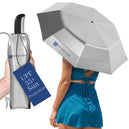
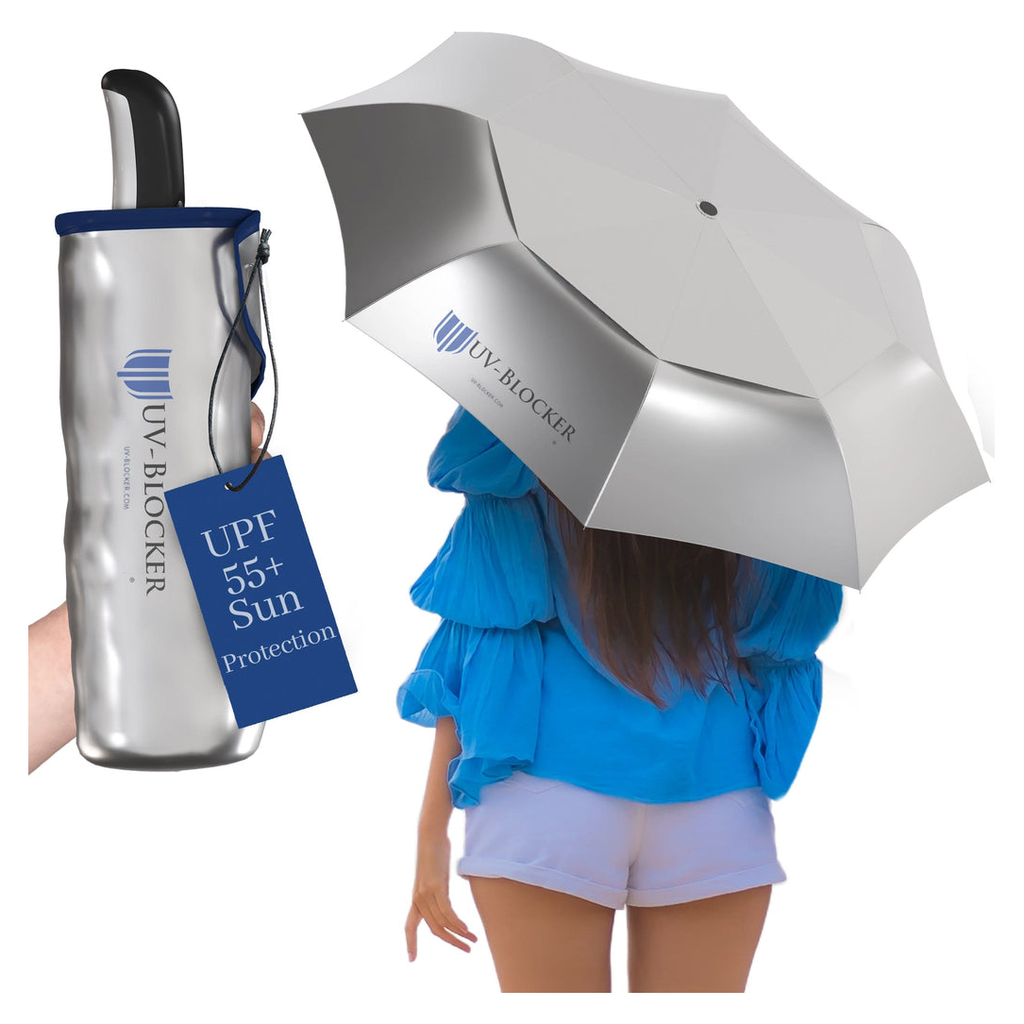
The real contrast is the reapplication cycle. The AAD advises reapplying roughly every two hours, or after swimming or sweating, and notes many people apply only 20% to 50% of the amount needed to reach the SPF on the label. A canopy delivers the same protection in hour four as in minute one. The Compact UV Umbrella at $59.95 packs into a bag for that reason.
Does a UV Umbrella Actually Block Enough UV?
A tested UPF 50+ canopy blocks nearly all ultraviolet light that reaches it. But the strongest trial found a stationary beach umbrella alone was not enough at peak exposure.
Two things need saying before any umbrella gets recommended, and both cut against the category.
The first is that most umbrella UV claims are not backed by anything. A 2024 study in Cureus evaluated 10 handheld umbrella products and found 100% claimed UPF 50+, yet only 20% could produce UPF testing data when asked.
Four in five could not substantiate the number on their own label. A buyer's only defence is asking for the test standard by name, as covered in this guide to telling whether an umbrella really blocks UV.
Performance varies enormously between products, too. A 2013 research letter in JAMA Dermatology tested 23 umbrellas at a UV index of 8. Blocking ranged from 77% for a white Totes model to 99% for a silver Coolibar, and every black umbrella blocked at least 90%.
The second point is harder. A 2017 randomised trial in JAMA Dermatology put a beach umbrella against SPF 100 sunscreen at Lake Lewisville, Texas, over three and a half midday hours.
In the umbrella group, 32 of 41 participants (78%) developed some sunburn, with 142 total incidences. In the sunscreen group it was 10 of 40 (25%), with 17 incidences. Both arms were actively managed: the sunscreen group reapplied an average of 2.3 times, and staff repositioned the umbrella as the sun moved.
The authors concluded that "a beach umbrella alone may not provide sufficient protection for extended UV exposure" and that "combining multiple sun protection measures may be needed to achieve optimal protection."
That second sentence is the honest answer. A canopy is the base layer for someone who will not use lotion, not a force field, because scattered and reflected ultraviolet light still arrives from the sides.
How Do You Layer Sun Protection If You Still Won't Use Lotion?
Combine overhead shade with closely woven clothing, a wide-brim hat, UV-blocking sunglasses and better timing. Each layer covers a gap the others leave, and none of it requires lotion.
- Carry the canopy. A UPF 50+ umbrella covers the head, face, shoulders and upper body, where most incidental exposure lands on a walk or a commute.
- Let fabric do the heavy lifting. The AAD notes a long-sleeved denim shirt provides an SPF of about 1,700, while a white t-shirt provides about SPF 7. Weave and weight matter more than most people assume, and UV-Blocker does not sell clothing, so this costs nothing to act on.
- Add a brim and sunglasses. A canopy held at an angle can leave the eye and cheek zone exposed when the sun is low. A wide brim and UV-blocking lenses close that gap.
- Move the timing. Ultraviolet intensity peaks in the middle of the day. Shifting a walk or run earlier or later reduces the dose with no product at all.
- Consider the smallest tolerable dose. On the backs of the hands, ears and nose, a mineral stick covers a few square inches in seconds. For someone who rejects full-body lotion, that is often the one concession that still feels acceptable, and the shade layer works either way.
Which UV Umbrella Fits Your Day?
Choose by how it will be carried. Every model uses the same Solarteck® fabric and AATCC TM183-2020 result, so the difference is coverage, handle style and packing.
| Model | Arc | Price | Best for |
|---|---|---|---|
| Compact UV Umbrella | 42" | $59.95 | Bag or briefcase carry, commuting, auto open and close |
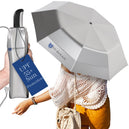
| Travel UV Umbrella | 44" | $59.95 | Everyday carry, deeper dome for low-angle sun |
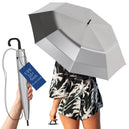
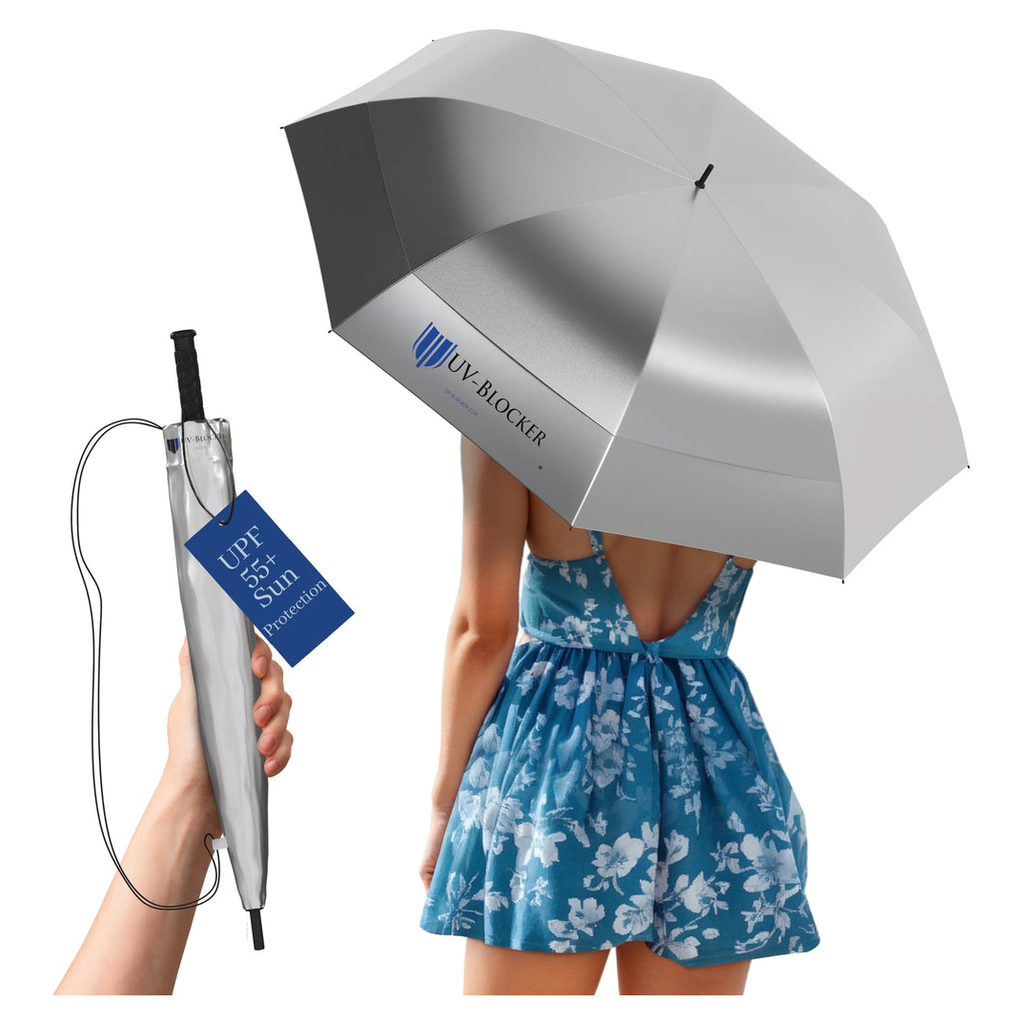
| Fashion UV Umbrella | 48" | $59.95 | Stick-style crook handle, walking and city use |
| Large Folding UV Umbrella | 58" | $64.95 | Two people, strollers, maximum folding coverage |
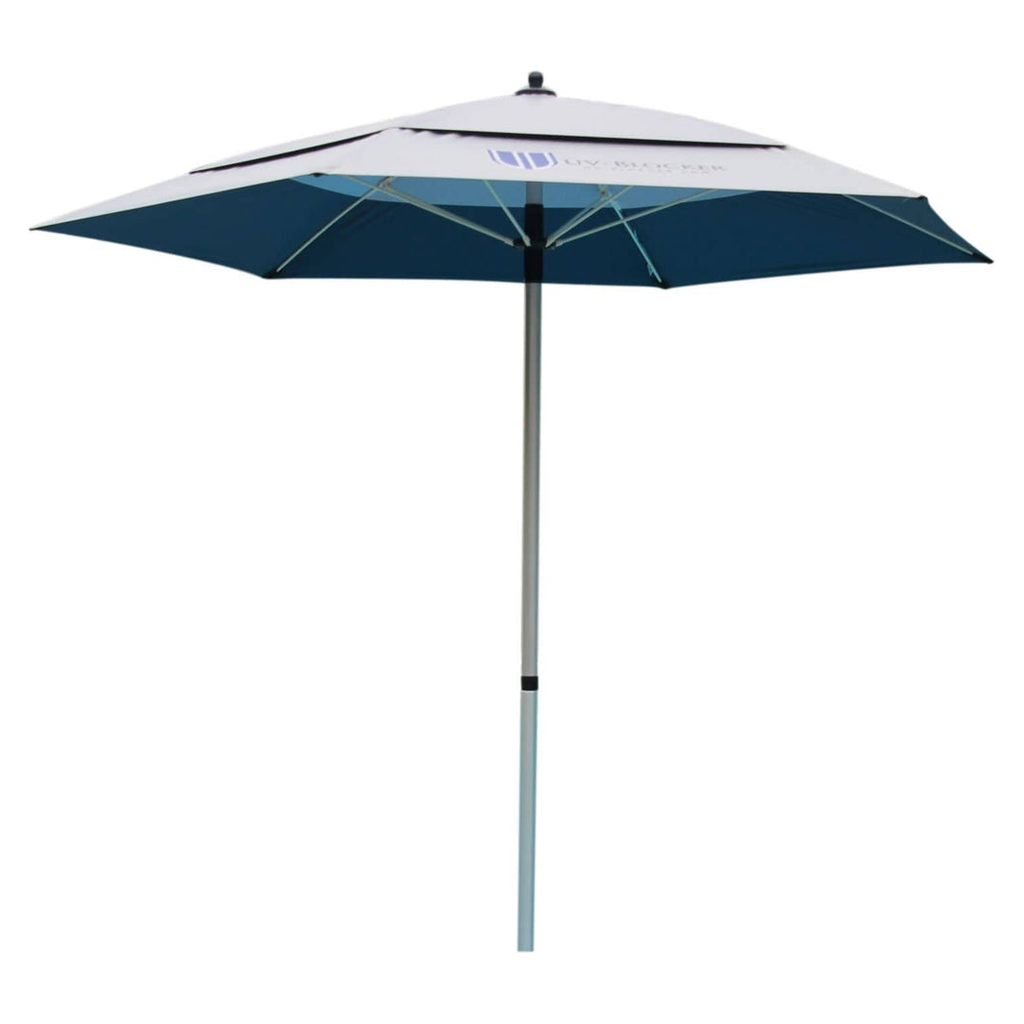
Every model is UPF 50+, blocks 99% of UVA and UVB rays, and runs up to 15°F cooler underneath. Holders are available for chairs and strollers when hands need to stay free.
Sun Protection Without Sunscreen: Frequently Asked Questions
Common questions from readers who have already decided against applying lotion and want a workable substitute.
Is there a sun protection that doesn't feel like anything on your skin?
Yes. Shade, clothing and a UPF 50+ umbrella all protect without contact. A canopy is the only one that covers the face and shoulders while leaving skin bare, which is why it suits people whose objection is sensory.
Why does my sunscreen smell like that even when it says fragrance-free?
Fragrance-free means no fragrance was added, not that the product has no smell. UV filters, emulsifiers and preservatives each have their own odour. Scented products use fragrance to mask that base, so removing it can make the raw smell more noticeable.
Can I skip sunscreen entirely if I carry a UV umbrella?
Not for extended peak exposure. The 2017 JAMA Dermatology trial found 78% of the umbrella-only group burned across three and a half midday hours, against 25% using SPF 100. A canopy is a strong base layer, best combined with clothing, timing and a brim.
What's the best sun protection if sunscreen makes me break out?
Around 14.2% of sunscreen avoiders report pimples. Non-topical protection removes the trigger, because nothing is applied at all. A UPF 50+ umbrella and closely woven clothing cover the same exposure. Anyone with persistent skin reactions should speak to a dermatologist.
Does a UV umbrella work on cloudy days or near water and sand?
It still blocks direct ultraviolet light, and cloud cover transmits a substantial amount of UV. Near water and sand, reflected light arrives from below and the sides, so a canopy covers less. Add sunglasses, a brim and clothing in those settings.
Conclusion
People abandon sunscreen because of the greasiness, the sting, the smell, the cast and the two-hour clock. Those complaints are measured, and no reformulation removes the last one.
Changing the delivery method solves what changing the formula cannot. A tested UPF 50+ canopy protects without touching skin, works as well at hour four as at minute one, and layers with clothing and timing for what it cannot cover alone. Sun protection without sunscreen is not about doing less. It is about protection that gets used.
Small price to pay. Isn't your health worth it?
Key Takeaways
- UVA rays (320–400nm) are longer waves that penetrate deep into the skin, causing photoaging, wrinkles, and contributing to melanoma.
- A UPF 50+ umbrella blocks 99%+ of direct overhead UV — more reliable than sunscreen because it doesn't require reapplication, doesn't wash off with...
- UV radiation is highest between 10am and 4pm, peaking around noon in most locations.
- All skin tones are affected by UV radiation, but the risk and presentation differ.
Frequently Asked Questions
What is the difference between UVA and UVB rays, and why does it matter?
UVA rays (320–400nm) are longer waves that penetrate deep into the skin, causing photoaging, wrinkles, and contributing to melanoma. They pass through glass and clouds and are relatively constant year-round. UVB rays (290–320nm) are shorter, cause sunburn, and are the primary driver of skin cancer. They're most intense midday (10am–4pm) and in summer. Effective sun protection must block both.
How effective is a UPF 50+ umbrella compared to sunscreen alone?
A UPF 50+ umbrella blocks 99%+ of direct overhead UV — more reliable than sunscreen because it doesn't require reapplication, doesn't wash off with sweat, and provides consistent protection. However, reflected UV from surfaces still reaches skin under an umbrella. The ideal combination is SPF 50+ sunscreen + UPF 50+ umbrella for 95–99% total UV reduction. UV-Blocker's umbrellas are dermatologist-recommended for this purpose.
What time of day poses the highest UV risk?
UV radiation is highest between 10am and 4pm, peaking around noon in most locations. The UV Index is the most accurate measure — when it reaches 6 or above, unprotected skin can begin to burn in as little as 15 minutes. Cloud cover reduces UV intensity but doesn't eliminate it: 80% of UV penetrates light cloud cover.
Does skin tone affect UV damage risk?
All skin tones are affected by UV radiation, but the risk and presentation differ. People with lighter skin (Fitzpatrick types I–III) burn faster and have higher non-melanoma skin cancer rates. People with darker skin (types IV–VI) are more prone to hyperpigmentation and have a higher risk of melanoma being diagnosed at later stages. Sun protection is essential for every skin tone.
What are early warning signs of skin cancer I should watch for?
Use the ABCDE rule for moles: Asymmetry, Border irregularity, Color variation, Diameter larger than 6mm, and Evolving (any change over time). Also watch for sores that don't heal, new pink or pearly bumps, and flat red or pink patches. Annual dermatologist screenings are recommended for anyone with significant sun exposure history or a family history of skin cancer.
Expert Sun Protection Recommendations
- Check the daily UV Index at weather.gov or a UV app before any extended outdoor activity
- Apply SPF 30+ broad-spectrum sunscreen 30 minutes before going outdoors, not right before sun exposure
- Reapply sunscreen every 2 hours and after swimming or heavy sweating
- Use a UPF 50+ umbrella for hands-free shade during outdoor dining, sports, or work
- Wear UV-blocking sunglasses that block 99–100% of UVA and UVB — eyes are vulnerable to UV-related damage
- Annual skin screenings with a board-certified dermatologist can catch early-stage skin cancers when highly treatable
Key Takeaways
- UVA rays (320–400nm) are longer waves that penetrate deep into the skin, causing photoaging, wrinkles, and contributing to melanoma.
- A UPF 50+ umbrella blocks 99%+ of direct overhead UV — more reliable than sunscreen because it doesn't require reapplication, doesn't wash off with...
- UV radiation is highest between 10am and 4pm, peaking around noon in most locations.
- All skin tones are affected by UV radiation, but the risk and presentation differ.
Frequently Asked Questions
What is the difference between UVA and UVB rays, and why does it matter?
UVA rays (320–400nm) are longer waves that penetrate deep into the skin, causing photoaging, wrinkles, and contributing to melanoma. They pass through glass and clouds and are relatively constant year-round. UVB rays (290–320nm) are shorter, cause sunburn, and are the primary driver of skin cancer. They're most intense midday (10am–4pm) and in summer. Effective sun protection must block both.
How effective is a UPF 50+ umbrella compared to sunscreen alone?
A UPF 50+ umbrella blocks 99%+ of direct overhead UV — more reliable than sunscreen because it doesn't require reapplication, doesn't wash off with sweat, and provides consistent protection. However, reflected UV from surfaces still reaches skin under an umbrella. The ideal combination is SPF 50+ sunscreen + UPF 50+ umbrella for 95–99% total UV reduction. UV-Blocker's umbrellas are dermatologist-recommended for this purpose.
What time of day poses the highest UV risk?
UV radiation is highest between 10am and 4pm, peaking around noon in most locations. The UV Index is the most accurate measure — when it reaches 6 or above, unprotected skin can begin to burn in as little as 15 minutes. Cloud cover reduces UV intensity but doesn't eliminate it: 80% of UV penetrates light cloud cover.
Does skin tone affect UV damage risk?
All skin tones are affected by UV radiation, but the risk and presentation differ. People with lighter skin (Fitzpatrick types I–III) burn faster and have higher non-melanoma skin cancer rates. People with darker skin (types IV–VI) are more prone to hyperpigmentation and have a higher risk of melanoma being diagnosed at later stages. Sun protection is essential for every skin tone.
What are early warning signs of skin cancer I should watch for?
Use the ABCDE rule for moles: Asymmetry, Border irregularity, Color variation, Diameter larger than 6mm, and Evolving (any change over time). Also watch for sores that don't heal, new pink or pearly bumps, and flat red or pink patches. Annual dermatologist screenings are recommended for anyone with significant sun exposure history or a family history of skin cancer.
Expert Sun Protection Recommendations
- Check the daily UV Index at weather.gov or a UV app before any extended outdoor activity
- Apply SPF 30+ broad-spectrum sunscreen 30 minutes before going outdoors, not right before sun exposure
- Reapply sunscreen every 2 hours and after swimming or heavy sweating
- Use a UPF 50+ umbrella for hands-free shade during outdoor dining, sports, or work
- Wear UV-blocking sunglasses that block 99–100% of UVA and UVB — eyes are vulnerable to UV-related damage
- Annual skin screenings with a board-certified dermatologist can catch early-stage skin cancers when highly treatable