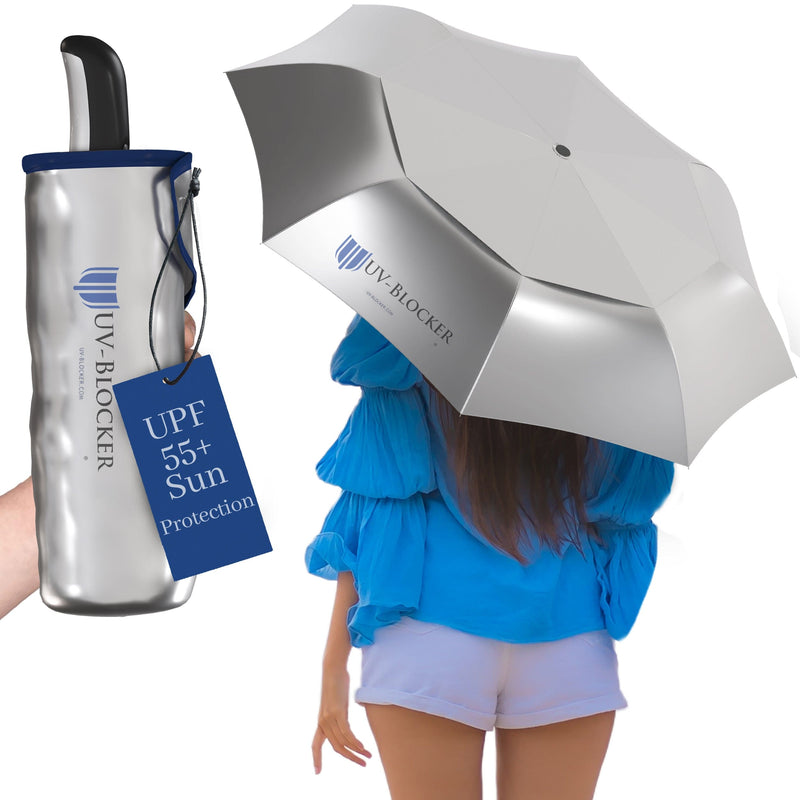



TL;DR: A 2013 JAMA Dermatology study found that UV-blocking umbrellas reduced UVB exposure by up to 99%, while standard umbrellas blocked only 77%. Real-world sunscreen studies consistently show patients apply only 25-50% of the tested thickness, cutting effective SPF by half or more. The clinical takeaway is not "umbrella instead of sunscreen" but rather that physical shade fills the measurable gaps in sunscreen-only protocols. For high-risk patients (melanoma survivors, post-procedure cases, lupus and melasma populations) a layered approach using both modalities delivers the most reliable photoprotection outside of complete sun avoidance.

Do UV Umbrellas vs Sunscreen Studies Show a Clear Winner?
Under controlled conditions, UV-blocking umbrellas reduced UVB radiation by up to 99%, while real-world sunscreen efficacy falls well below labeled SPF due to inadequate application thickness.
The most cited head-to-head data comes from McMichael et al., published in JAMA Dermatology in 2013. The researchers tested 23 commercially available umbrellas under a UV index of 8, conditions typical of a summer afternoon in the mid-Atlantic United States. UV-blocking umbrellas with UPF-rated fabric achieved up to 99% UVB reduction, while standard fashion umbrellas still managed 77% blockage. The key variable was fabric composition: tightly woven, UV-treated materials dramatically outperformed conventional polyester and nylon.
Compare that to sunscreen performance. Labeled SPF assumes application at 2 mg/cm2, the standard set during FDA testing. Observational studies show that patients typically apply between 0.5 and 1.0 mg/cm2, roughly 25-50% of the required thickness. A 2022 study on sunscreen compliance confirmed that even motivated patients who reported consistent sunscreen use demonstrated measurable UV damage on skin biopsies, suggesting that real-world SPF 50 may function closer to SPF 10-25 in practice.
The comparison is not a clean one-to-one. Sunscreen protects exposed skin everywhere it is applied; an umbrella protects only the area under its canopy. But for stationary activities (sitting at a cafe, watching a child's sporting event, reading at the beach) a UV umbrella delivers more consistent protection because it does not depend on user technique.
The clinical question is not which modality is "better." It is which combination eliminates the most exposure gaps for a given patient's lifestyle.
Why Do Dermatologists Still Recommend Sunscreen Over Physical Shade?
Sunscreen dominates clinical guidelines because decades of randomized trials established its efficacy, while physical shade research remains limited to a handful of observational and laboratory studies.
The asymmetry is understandable. Sunscreen has been studied in prospective trials involving thousands of participants, including the landmark Nambour Trial, which demonstrated a 40% reduction in squamous cell carcinoma with daily sunscreen use over 4.5 years. Physical shade interventions (hats, clothing, umbrellas) lack equivalent prospective data, largely because they are harder to standardize in a trial setting. You can randomize a cream application; randomizing umbrella use across diverse outdoor scenarios introduces far more variables.
There is also a historical momentum issue. The AAD's sun protection recommendations and the WHO's UV guidance both list "seek shade" as a core strategy, but sunscreen receives far more granular advice (SPF 30+, broad-spectrum, reapply every 2 hours). Physical shade is mentioned as a behavior, not prescribed as a specific intervention with measurable parameters.
This is starting to change. The McMichael JAMA Dermatology data, combined with mounting evidence on sunscreen non-compliance, has prompted several dermatology practices to integrate UV umbrellas into post-procedure photoprotection protocols. The logic is straightforward: if a patient cannot reliably apply sunscreen at tested thickness, and if a UV umbrella blocks 99% of UVB without requiring any technique, then the umbrella fills a documented gap.
The recommendation is not "replace sunscreen." It is "stop relying on a single modality for a population that demonstrably struggles with correct use of that modality." For patients who already apply sunscreen well, an umbrella adds a margin of safety. For patients who apply it poorly, an umbrella may be the more reliable primary intervention during stationary outdoor exposure.
What Are the Documented Gaps in Sunscreen-Only Protection?
Sunscreen-only protocols have at least four well-documented failure points: insufficient application thickness, missed anatomical zones, reapplication non-compliance, and degradation from sweat and water exposure.
Each of these gaps has been quantified in peer-reviewed literature. The practical question for clinicians is not whether these gaps exist (they do) but whether layered interventions like UV umbrellas can close them.
| Sunscreen Failure Point | Clinical Data | How Physical Shade Addresses It |
|---|---|---|
| Insufficient thickness | Patients apply 25-50% of the 2 mg/cm2 standard, reducing SPF 50 to an effective SPF 10-25 | UV umbrella blocks 99% UVB regardless of user technique |
| Missed areas | Ears, posterior neck, dorsal hands, and scalp part line are missed in 40-80% of applications | Umbrella canopy covers head, neck, and upper body simultaneously |
| Reapplication failure | Only 33% of patients reapply after 2 hours; fewer than 20% reapply after swimming | Umbrella provides continuous protection without reapplication |
| Sweat/water degradation | Even "water-resistant" SPF 50 loses 30-50% efficacy after 80 minutes of water exposure | Umbrella efficacy is unaffected by perspiration or water contact |
Consider a post-Mohs surgery patient told to "avoid sun and wear sunscreen." That patient sits in a park for 45 minutes waiting for a ride. Sunscreen was applied at home 3 hours ago. No reapplication occurred. The ears and posterior neck were not covered. Effective protection on those surfaces is close to zero.
Now consider that same patient carrying a UV umbrella. The canopy covers the surgical site and surrounding skin. No technique is required. No reapplication is needed. The protection is passive, continuous, and independent of the patient's sunscreen habits.
This is not a hypothetical. Practices that have integrated UV umbrellas into their post-procedure recommendations report fewer follow-up calls about unexpected erythema and better overall patient adherence to photoprotection protocols.
How Should Dermatologists Recommend UV Umbrellas to Patients?
Dermatologists should position UV umbrellas as a layered addition to sunscreen, not a replacement, using specific clinical language that frames physical shade as a prescription-grade intervention rather than a lifestyle accessory.

The framing matters. When patients hear "you could also try a UV umbrella," compliance is low. When they hear "I'm adding a UPF 50+ umbrella to your photoprotection protocol because your sunscreen alone is not covering the surgical site reliably," compliance increases significantly. The language of prescription carries weight that the language of suggestion does not.
Here is a counseling framework that practices using UV umbrellas have found effective:
Step 1: Identify the exposure scenario. Ask the patient: "Describe a typical time you're outdoors for more than 15 minutes." For most patients, this is a stationary activity: waiting for a child, eating lunch, walking to a car, gardening.
Step 2: Assess sunscreen reliability. Ask: "Walk me through how you apply sunscreen." Most patients will reveal gaps: no reapplication, missed areas, application over makeup. Do not correct them; note the gap.
Step 3: Prescribe the umbrella for the specific gap. Say: "For those 30 minutes at your daughter's soccer game, I want you carrying a UPF 50+ umbrella. It will cover your face and neck without you having to reapply anything."
Step 4: Maintain sunscreen as baseline. Emphasize: "Keep using your SPF 50 on all exposed skin. The umbrella is your backup for the areas sunscreen misses or wears off."
This approach works particularly well for melasma management, where even brief, incidental UV exposure can trigger recurrence. It also aligns with post-procedure photoprotection protocols where wound sites may not tolerate topical sunscreen application.
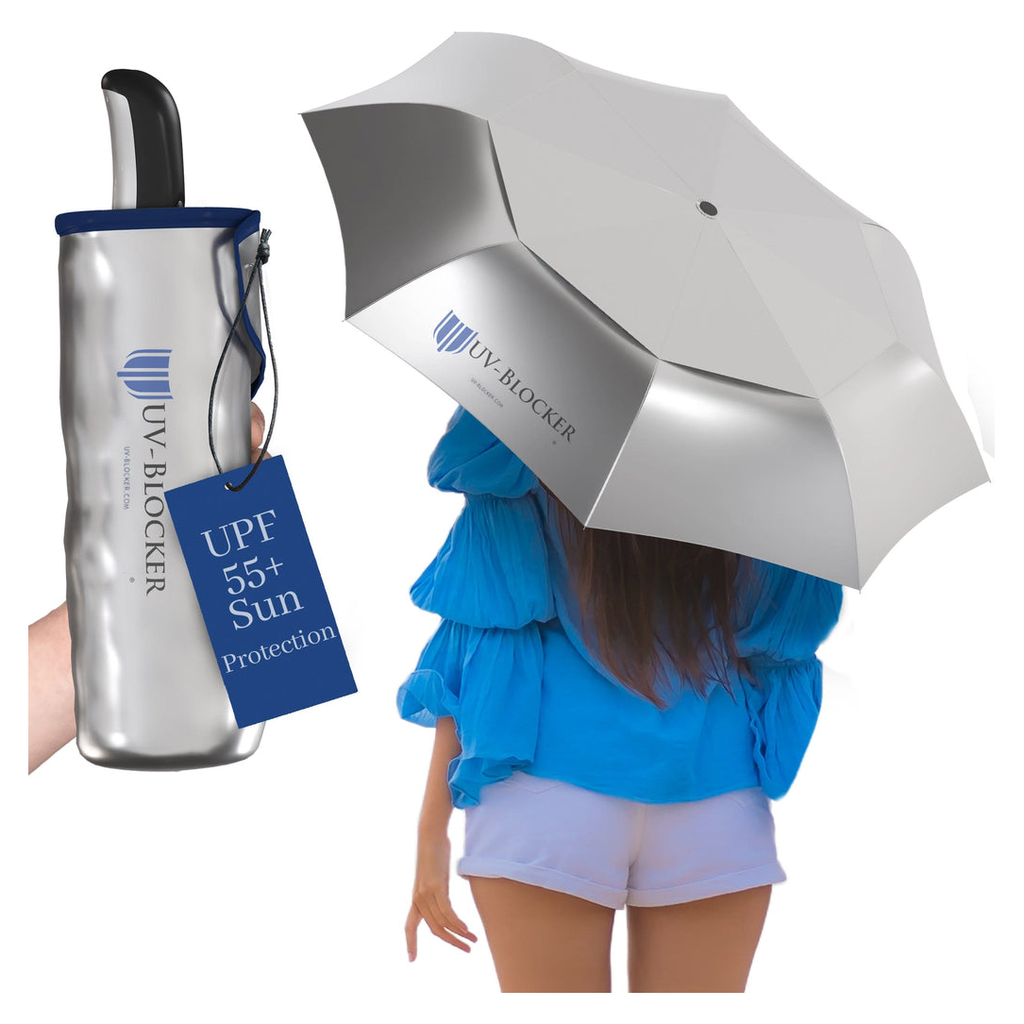
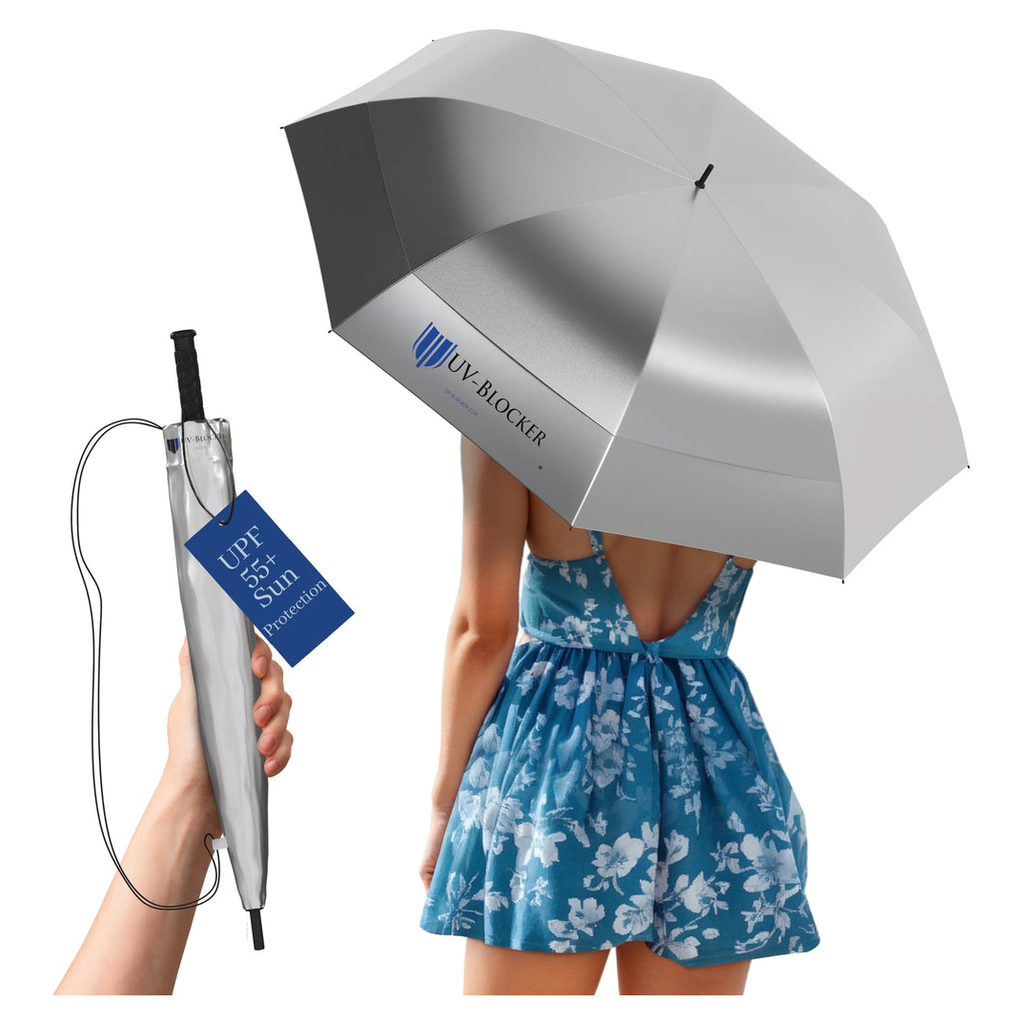
The UV-Blocker Dermatologist Program offers clinic-branded UV umbrellas with UPF 50+ SolarTek fabric, designed specifically for clinical recommendation. Patients receive a physical shade tool that their dermatologist selected, not something they found online. Learn more about the program.
What Does the JAMA Dermatology UV Umbrella Study Actually Show?
The McMichael et al. study tested 23 umbrellas across multiple fabric types and found that UV-blocking models reduced UVB by up to 99%, establishing the first controlled evidence base for umbrella-based photoprotection.

The full study was conducted in Winston-Salem, North Carolina, during peak summer UV conditions (UV index 8). Researchers positioned dosimeters at multiple points beneath each umbrella canopy and measured both direct and reflected UV transmission. This methodology matters because it accounts for ground reflection, which can contribute 10-25% of total UV exposure depending on surface type.
Key findings from the study:
- 23 umbrellas tested, including standard fashion umbrellas, travel umbrellas, and UV-specific models
- UV-blocking umbrellas achieved up to 99% UVB reduction directly beneath the canopy
- Standard umbrellas still blocked 77% of UVB, suggesting even non-specialized shade has measurable benefit
- Ground reflection remained a factor: dosimeters at the canopy edge showed higher UV readings than those at center
- Fabric density, weave tightness, and UV-absorbing coatings were the primary determinants of blocking efficacy
The study's limitations should be noted. Testing occurred at a fixed UV index under clear-sky conditions. Real-world variables (wind shifting the canopy, patient movement, varying sun angles throughout the day) were not modeled. The sample of 23 umbrellas, while diverse, cannot represent every product on the market.
The core finding is robust: purpose-built UV umbrellas with UPF-rated fabric deliver protection that is both measurable and independent of user behavior. This is a meaningful advantage in a field where patient compliance with sunscreen protocols remains inconsistently achieved.
For clinicians, the study provides a citeable evidence base when recommending UV umbrellas. The citation is: McMichael JR, et al. "Protective Effects of Handheld Umbrellas on Ultraviolet Exposure and Sunburn." JAMA Dermatology. 2013;149(12):1413-1416.
Are UV Umbrellas Cost-Effective Compared to Prescription Sunscreens?
A quality UV umbrella costs $35-85 as a one-time purchase and lasts 3-5 years, while prescription sunscreens run $30-50 per month, making physical shade one of the most cost-effective photoprotection tools available.
For patients managing chronic photoprotection (melanoma surveillance, melasma, lupus, xeroderma pigmentosum) the cumulative cost of sunscreen is substantial. Many prescription and medical-grade sunscreens are not fully covered by insurance, and OTC options at the recommended application thickness deplete faster than patients expect.
| Photoprotection Method | Initial Cost | Monthly Cost | Annual Cost (Year 1) | 3-Year Cost | HSA/FSA Eligible |
|---|---|---|---|---|---|
| UV umbrella (UPF 50+) | $49-85 | $0 | $49-85 | $49-85 | Yes |
| OTC sunscreen (SPF 50) | $12-18 | $24-36 | $288-432 | $864-1,296 | Yes |
| Rx sunscreen (medical-grade) | $35-50 | $35-50 | $420-600 | $1,260-1,800 | Yes |
| UV umbrella + OTC sunscreen | $61-103 | $24-36 | $337-517 | $913-1,381 | Yes |
Two points deserve emphasis. First, the UV umbrella is not replacing sunscreen expenditure. Patients still need sunscreen for exposed skin not covered by the canopy. But the umbrella reduces the reliance on heavy, frequent application during stationary outdoor exposure, which is when most patients report the highest sunscreen consumption.
Second, UV umbrellas are HSA/FSA eligible as a sun protection medical device. This is a meaningful talking point for patients who ask about cost. A $65 umbrella purchased with pre-tax health savings dollars effectively costs $45-50 after the tax benefit, and it lasts for years.
For practices, there is also a clinical efficiency argument. A patient who carries a UV umbrella to every outdoor appointment, soccer game, and lunch break is a patient who arrives at follow-up with less UV damage to discuss. Over time, this reduces the clinical burden of managing photoprotection non-compliance, a conversation that consumes significant visit time across dermatology practices.
Frequently Asked Questions
Can I stop wearing sunscreen if I use a UV umbrella?
No. UV umbrellas protect the skin directly beneath the canopy, but they do not block UV reflected from ground surfaces or reaching exposed skin outside the shade zone. Sunscreen remains necessary for all exposed areas. The combination of umbrella plus sunscreen covers both the direct UV blocked by the canopy and the incidental UV reaching peripheral skin.
What UPF rating should I look for in a UV umbrella?
Look for UPF 50+ or higher. A UPF 50 rating means the fabric allows only 1/50th (2%) of UV radiation to pass through. UPF 50+ (like UV-Blocker's SolarTek fabric) blocks over 98% of UV, matching the highest protection category recognized by dermatology guidelines.
Does sunscreen SPF equal umbrella UPF?
No. SPF measures protection against UVB only and is tested on skin at a specific application thickness. UPF measures protection against both UVA and UVB through fabric, regardless of application technique. A UPF 50+ umbrella provides broad-spectrum protection that does not degrade with sweat, water, or time. Learn more in our guide to SPF vs UPF rating systems.
Are UV umbrellas effective on cloudy days?
Yes. Up to 80% of UV radiation penetrates cloud cover. A UV umbrella with UPF 50+ fabric blocks the same percentage of UV regardless of whether the sky is clear or overcast. The umbrella's protection is determined by fabric properties, not ambient light conditions.
How do UV umbrellas compare to sun hats for UV protection?
UV umbrellas provide significantly larger coverage area than hats. A standard sun hat covers the scalp and partial face; a UV umbrella covers the head, neck, shoulders, and upper torso. The McMichael JAMA Dermatology study measured up to 99% UVB reduction beneath umbrella canopies, while most wide-brim hats achieve 50-70% reduction for the face and neck. For a deeper comparison, see our analysis of sun hat vs UV umbrella coverage.
Ready to Add Physical Shade to Your Practice?
The research is clear: sunscreen alone leaves measurable gaps in photoprotection, and UV umbrellas fill those gaps without requiring patient technique or compliance. For dermatology practices treating high-risk populations, integrating a physical shade recommendation is a low-cost, evidence-backed way to improve patient outcomes.
The UV-Blocker Dermatologist Program provides clinic-branded UPF 50+ umbrellas with SolarTek fabric that blocks 98%+ of UV radiation and reduces under-canopy temperature by up to 15 degrees Fahrenheit. Each umbrella comes with patient education materials and your practice branding.
Next steps:
- View the Dermatologist Program details
- Order your first case
- Browse all UV umbrellas vs sunscreen protection options