

TLDR:
- Yes. A UV umbrella keeps you measurably cooler than a regular umbrella, not just shadier.
- A customer in Florida put an infrared thermometer on a pad on hot pavement in July and read three conditions in a row: direct sun, a regular umbrella, and a UV-Blocker.
- Direct sun: 171°F to 192°F. Regular umbrella: 141°F to 148°F. UV-Blocker: 125°F to 128°F.
- That is roughly 15°F to 20°F cooler than an ordinary umbrella, and 46°F to 64°F cooler than no shade at all.
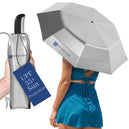
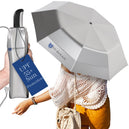
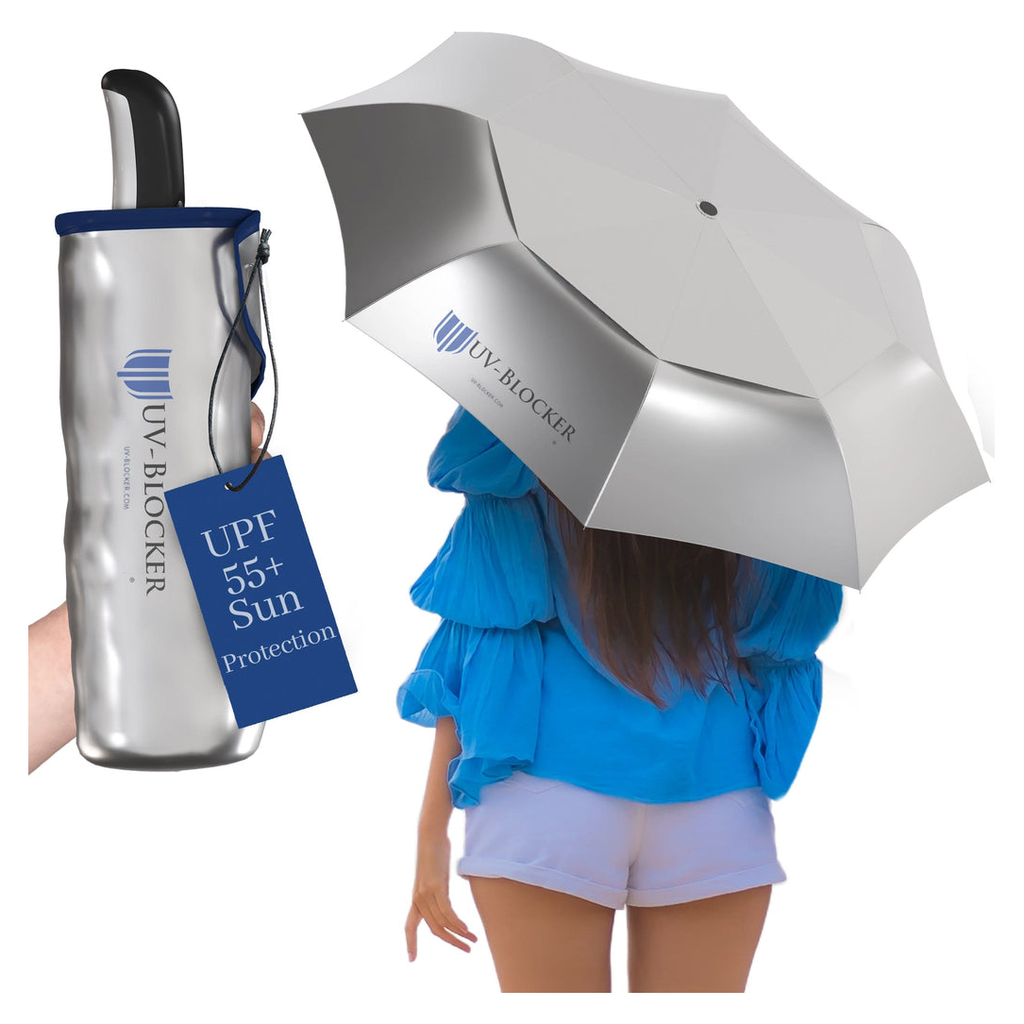
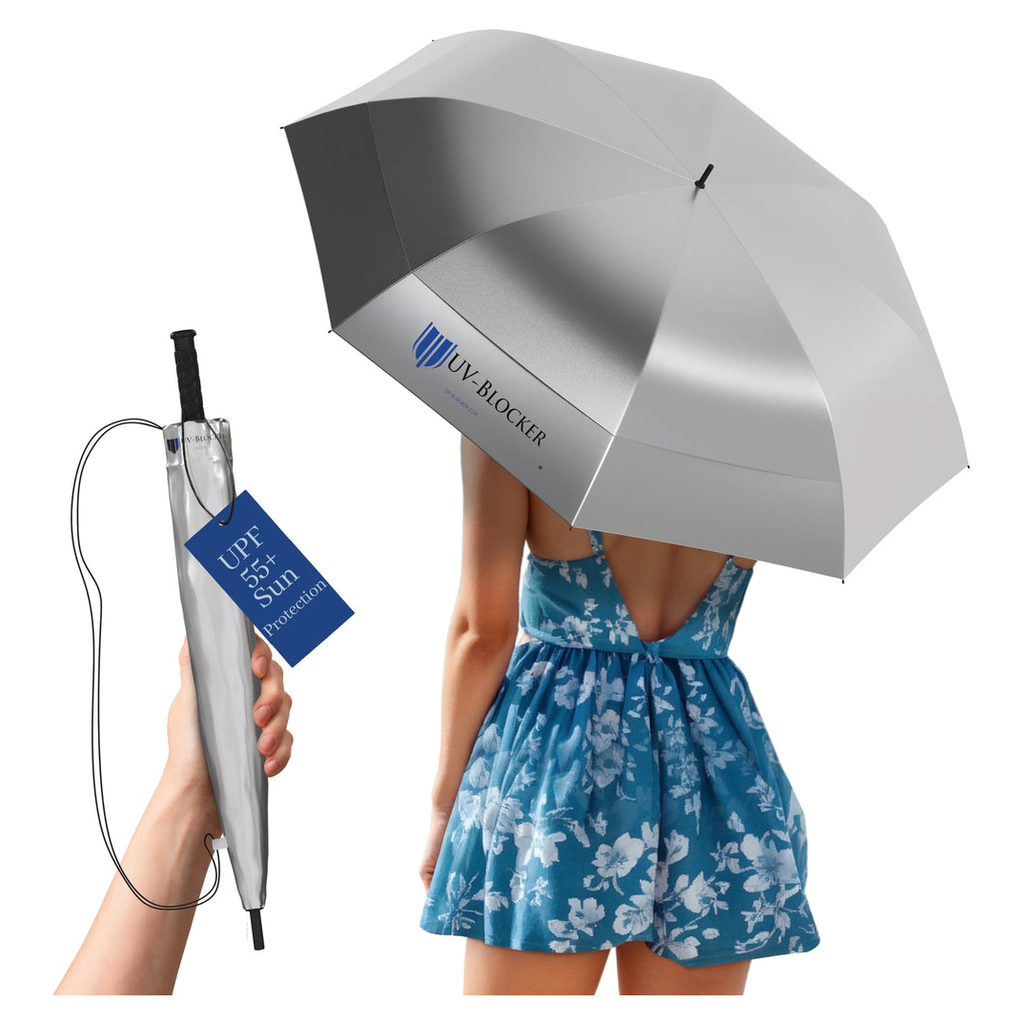
- The difference is the canopy, not the shade. A silver Solarteck® reflective outer layer bounces heat and UV away instead of absorbing them.
- Cooler is not the same as protected. The same canopy is what blocks 100% of UV-B and 99.97% of UV-A in AATCC TM183 testing.
Ron Walker's uncle called the first UV-Blocker "the air-conditioned umbrella." It stuck, because that is what it feels like when you step under one.
Feelings are not evidence, though. So when a customer decided to point a thermometer at ours and film the result, that was worth more than anything we could write ourselves.
Do UV umbrellas keep you cool?
Yes. In a July test on Florida pavement, the surface under a UV-Blocker read 125°F to 128°F against 141°F to 148°F under a regular umbrella.
That is a gap of roughly 15°F to 20°F, measured minutes apart on the same spot.
Any umbrella blocks direct sunlight. That alone takes a large bite out of the heat. What separates a UV umbrella is what the canopy does with the energy it intercepts: a dark nylon canopy absorbs it and radiates it back down onto you, while a reflective UV canopy sends it back up.
That second step is the 15°F.
What the thermometer test actually measured
Dr. Joseph F., a verified Amazon customer, took infrared readings on a pad on Florida pavement in July under three conditions, minutes apart.
He filmed the whole thing, thermometer display included.
| Condition | First pass | Second pass |
|---|---|---|
| Direct sun on the pavement | 171°F to 180°F | 180°F to 192°F |
| Under a regular umbrella | about 141°F to 143°F | 145°F to 148°F |
| Under a UV-Blocker umbrella | about 125°F | 128°F |
His own summary: "It does decrease the temperature more than a regular umbrella by in the neighborhood of 15 degrees."
Watch the test
"Temps show....it's cooler" - 2 minutes, filmed by Dr. Joseph F. with an infrared thermometer on Florida pavement.
Watch the 2-minute test on AmazonTwo honest caveats, because the number only means something if you know what was measured.
These are surface temperatures of a pad on pavement taken with an infrared thermometer, not air temperature, and pavement runs far hotter than the air above it. This is also one customer's test on one afternoon, not a laboratory protocol.
What it shows clearly is the relative gap between the three conditions, measured minutes apart in the same spot. That gap is the part that matters when you are choosing what to carry.
Why is a UV umbrella cooler than a regular umbrella?
Because of what the fabric does with sunlight before it reaches you: a reflective silver canopy sends energy back up, while dark fabric absorbs it and radiates heat down.
- A reflective silver outer layer. The patented Solarteck® canopy is silver on the outside. Reflected energy never becomes heat under the canopy. A standard black or navy umbrella absorbs that energy, heats up, and re-radiates it downward, which is why the air under a cheap umbrella can feel close and stuffy.
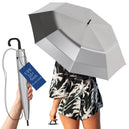
- A vented double canopy. Two layers with a vent between them let hot air escape at the top and let wind pass through instead of flipping the umbrella. Trapped air under a single-layer canopy is what turns shade into a warm pocket.
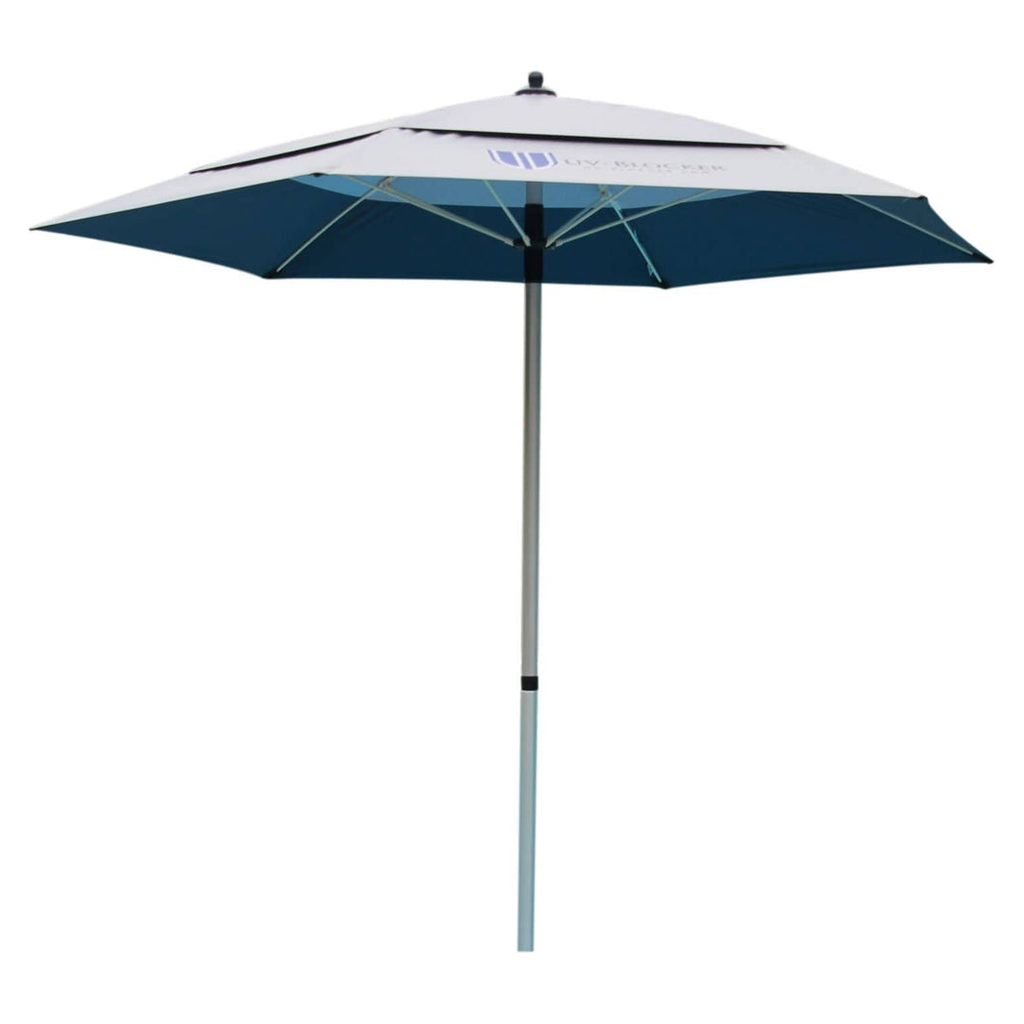
- Coverage that stays with you. A handheld canopy travels with your body, so your head, face, and shoulders stay in the shade as the sun moves, unlike a fixed patio umbrella you keep chasing.
The fabric itself is RPET, woven from recycled plastic bottles.
Does a black umbrella keep you cool?
Less than a reflective one. Black fabric absorbs sunlight across the spectrum and gets hot, then radiates that heat down into the space underneath.
This is the part most people get backwards. A dark canopy can look like better shade, because the shadow it casts is deeper. Depth of shadow tells you about visible light, not about heat. What you want overhead is a surface that rejects energy rather than one that stores it, which is why the test above put 141°F to 148°F under an ordinary umbrella and 125°F to 128°F under a silver one at the same moment.
How can you test an umbrella's cooling for yourself?
Point an infrared thermometer at the same patch of ground under each umbrella within a minute or two of each other, in full midday sun, and compare the readings.
Anyone can repeat what was filmed here, and it costs about the price of a cheap kitchen gadget. The method matters more than the equipment:
- Pick one surface and stay on it. Pavement, a paving slab, or a mat. Concrete, grass, and sand all behave differently, so comparing across them tells you nothing.
- Take all readings within a few minutes. Cloud, wind, and the sun's angle change fast. A gap of twenty minutes between readings measures the weather, not the umbrella.
- Hold each canopy at the same height. A canopy held closer to the ground casts a smaller, hotter patch of shade.
- Read the shaded spot, not the canopy. You want the temperature of the surface you would be sitting on, not the fabric.
- Take a direct-sun reading between each one. That is your control, and it tells you whether conditions shifted mid-test.
If the two umbrellas come back within a couple of degrees of each other, the canopy you are testing is giving you shade and nothing more. A reflective UPF canopy should open a gap you can see on the display, not one you have to squint at.
What does 15°F cooler actually change?
It changes how long you can stay out before heat becomes a medical problem rather than a comfort problem.
Heat illness builds from total heat load: air temperature, humidity, radiant heat from the sun and from surfaces like pavement or sand, and how hard you are working. Radiant load is the one you can remove instantly, and it is the one a reflective canopy removes. Our guide on heat stroke vs heat exhaustion covers the warning signs worth knowing before you spend a full day out.
For anyone on a photosensitizing medication, living with lupus, or recovering from skin cancer treatment, the cooling is a bonus and the UV blocking is the point.
Does cooler mean protected?
Not automatically, and this is worth being precise about. Comfort and UV protection are two different measurements, and plenty of umbrellas deliver the first without the second.
UV-Blocker canopies are tested to AATCC TM183-2020 at 100% UV-B blocked and 99.97% UV-A blocked, which is what UPF 50+ means in practice. The range is MIF approved through the Melanoma International Foundation and recommended by dermatologists. If you want the detail on what those ratings do and do not cover, read what makes a UV umbrella actually block UV.
One more thing the canopy does not do: UV reflects off sand, water, and concrete, so it reaches you from the side and from below as well as from above. Shade is the strongest single layer, not the only one.
Frequently asked questions
Short answers to the questions people ask most about UV umbrellas, cooling, and how that compares with an ordinary umbrella or sunscreen.
Do UV umbrellas keep you cool? Yes. In a customer's infrared test in Florida in July, the surface under a UV-Blocker read 125°F to 128°F against 141°F to 148°F under a regular umbrella and 171°F to 192°F in direct sun.
How much cooler is a UV umbrella than a regular umbrella? Roughly 15°F to 20°F in that test. UV-Blocker's long-standing claim is 15°F cooler, which is what the measurements landed on.
Does a UV umbrella work on a cloudy day? Yes for UV. Up to 80% of UV passes through light cloud, so the canopy is still working even when the cooling is less noticeable.
Is a UV umbrella better than sunscreen? It is a different layer, not a replacement. Shade removes the exposure; sunscreen reduces what gets through on the skin you cannot shade. Most people under-apply sunscreen, which is why a physical barrier carries so much of the load.
What color umbrella keeps you cool? A reflective silver outer surface with a dark underside. The silver rejects heat and UV; the dark underside cuts glare bouncing back up into your eyes.
The bottom line
A regular umbrella gives you shade. A UV umbrella gives you shade that is 15°F cooler and blocks essentially all of the UV.
A customer with a thermometer showed exactly that on a July afternoon in Florida.
Shop UV Protection Umbrellas or start with the two most popular: the Compact UV Umbrella for everyday carry and the Travel UV Umbrella for wider coverage.
Small price to pay. Isn't your health worth it?