

Plenty of Australians have wondered the same thing on a 38-degree afternoon. Is it weird to use an umbrella in the sun? The answer is no, and Australia's own cancer authority is the reason why.
Cancer Council Australia recommends portable shade during peak UV radiation times, and its own shop sells UPF 50+ rated handheld umbrellas alongside hats and sunscreen. The practice is national guidance, not a foreign import.
What follows covers where the hesitation came from, what Australian health authorities actually say, how an umbrella compares with a broad-brimmed hat, and the everyday situations where carrying one draws no attention at all.
Is It Weird to Use an Umbrella in the Sun in Australia?
No. Cancer Council Australia recommends portable shade during peak UV, and its own shop sells UPF 50+ handheld umbrellas. Uncommon is not the same as weird.
The Cancer Council's national sun protection policy states that "built, natural and portable shade are all recommended for sun protection during peak UV radiation times". Portable shade means shade a person carries. An umbrella is the most portable version of it there is.
The same organisation puts its retail range where its policy is. The Cancer Council Shop's shade collection lists auto-open and long-handled UPF 50+ umbrellas next to its compact beach models. Australia's peak cancer charity is not selling a novelty item.
That said, the social observation behind the question is fair. A handheld sun umbrella is still an unusual sight on a footpath in Perth or Parramatta. Uncommon is a description of frequency, not a verdict on sense. Bike helmets, sunglasses and the broad-brimmed hat itself were all uncommon in this country within living memory.
Why Do Australians Think Sun Umbrellas Are Unusual?
Slip Slop Slap built a national habit around hats and sunscreen from 1981. Umbrellas were never part of the campaign, so they never entered the default routine.
The campaign that shaped Australian sun behaviour taught a specific toolkit: slip on clothing, slop on sunscreen, slap on a hat. Seek shade and slide on sunglasses were added later, making five steps in total. Handheld shade was simply not one of them.
Absence from the script became absence from the culture. Two generations of Australians learned what sun protection looks like, and an umbrella was not in the picture. That is the entire origin of the hesitation. It is a gap in a public health message, not a judgement anyone actually made.
The routine Australians follow is leakier than most people assume
The Australian Bureau of Statistics has since published the country's first national estimates of sun protection behaviour, funded by the Cancer Councils of Australia. The findings are worth sitting with:
- 60.6% of Australians spent more than 15 minutes outdoors during peak UV times.
- Only 38.1% used SPF30 or higher sunscreen on most days.
- Among men, that figure drops to 27.0%, against 48.8% of women.
- 6.9% had been sunburnt in the previous week, rising to 15.2% of 15 to 24-year-olds.

Read those numbers back against the original question. Three in five Australians are outdoors at the worst time of day, and fewer than two in five are reliably wearing sunscreen. Judged by what the population actually does, the unusual behaviour here is not carrying an umbrella.
What Do Australian Health Authorities Say About Sun Umbrellas?
Cancer Council recommends portable shade, rates shade fabric on a formal UVE scale, and notes that shade structures can reduce UV exposure by up to 75%.
Shade is treated as measurable infrastructure in Australia, not a vague comfort. Cancer Council notes that "shade fabric designed for human protection is assigned a UVE (Ultraviolet Effectiveness) rating, expressed as a percentage", and that shade structures can cut UV exposure by up to 75%. ARPANSA, Australia's radiation protection agency, lists umbrellas among the shade products carrying a UVE rating.
The trigger point is low. Cancer Council's SunSmart guidance is that "sun protection is recommended whenever UV levels reach 3 or higher". That threshold is crossed on most days across much of the country, which is why sun protection here is treated as a year-round question rather than a summer one.
One honest limit belongs here. Shade alone is not a complete answer. A 2017 randomised clinical trial put one group under a standard beach umbrella and another on high-SPF sunscreen for three and a half hours of midday sun. Sunburn showed in 78% of the umbrella group and 25% of the sunscreen group. Neither approach alone prevented burning.
Cancer Council's position is the same: combine shade with clothing, a hat, sunglasses and sunscreen. An umbrella is a strong layer, not a substitute for the rest. (For a fuller treatment of that trial and what it means for UPF-rated canopies, see can you get sunburn under an umbrella.)
Why Do Japanese and Korean Cities Use Sun Umbrellas So Widely?
In hot, high-density cities where people walk everywhere, handheld shade is the only protection that travels with a person and covers more than a hat brim reaches.
Across Japan, Korea, China and parts of southern Europe, the parasol never left everyday use. Office workers carry one to the station. Parents carry one at the school gate. Nobody registers it, because the practice was never interrupted the way it was in Anglophone countries.
The reframe matters more than the trivia. Those populations are not making a cultural statement, they are responding to UV intensity and time spent on foot. On both of those measures Australia has the stronger case, not the weaker one. The habit has been spreading well beyond Asia for exactly that reason.
Does a Sun Umbrella Work Better Than a Hat?
A broad-brimmed hat shades the face, ears and neck. A 97 cm canopy shades the head, shoulders, arms and upper torso, and the shade moves with the wearer.
These are different tools rather than competitors, and the honest comparison makes that clear:
| Protection method | What it covers | Works while walking | Cooling effect | Limitation |
|---|---|---|---|---|
| Broad-brimmed hat | Face, ears, neck | Yes | Minimal | Leaves shoulders, arms and chest exposed |
| SPF30+ sunscreen | Wherever it is applied | Yes | None | Needs reapplying, and most Australians skip it |
| Fixed shade (tree, structure) | Whatever sits beneath it | No | Moderate | Cannot be taken along |
| UPF 50+ sun umbrella | Head, shoulders, arms, upper torso | Yes | Up to 8°C cooler beneath | Not a complete answer alone, and wind needs a vented canopy |
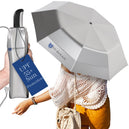
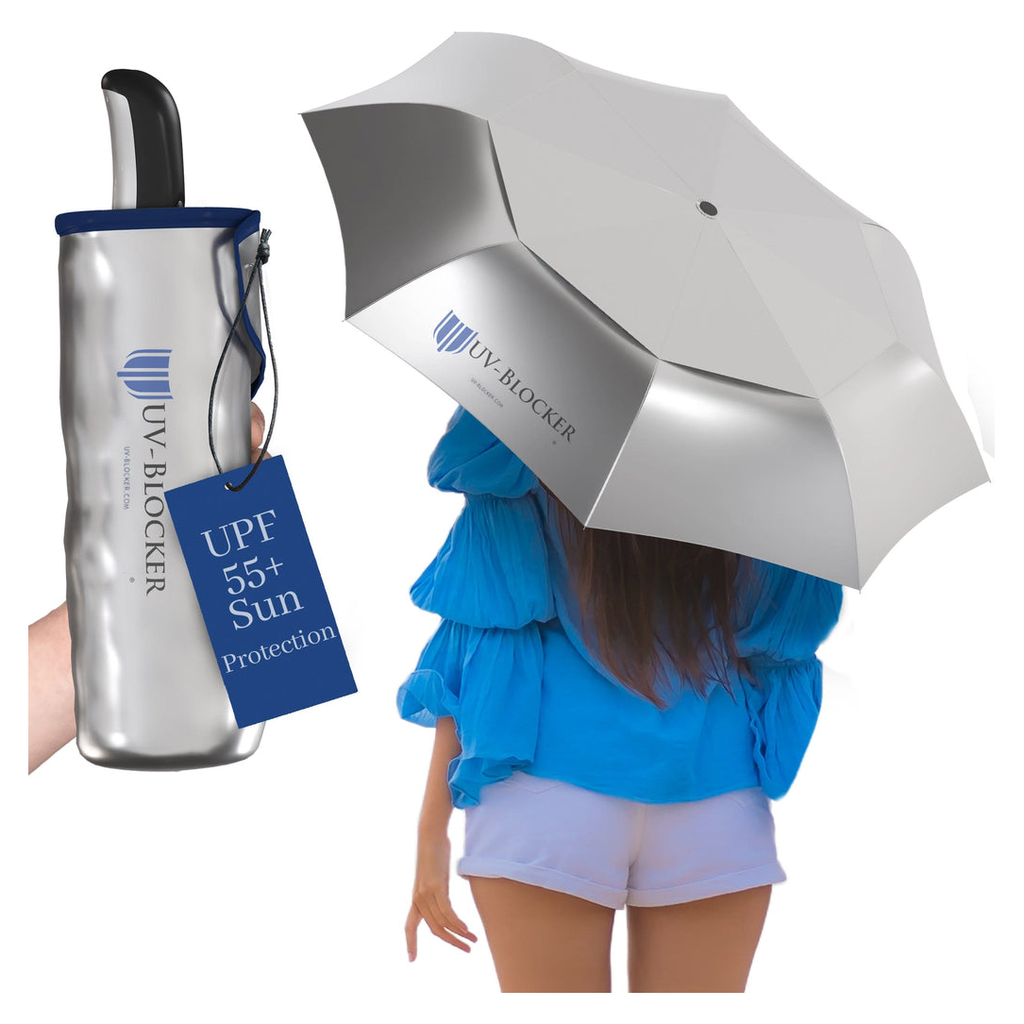
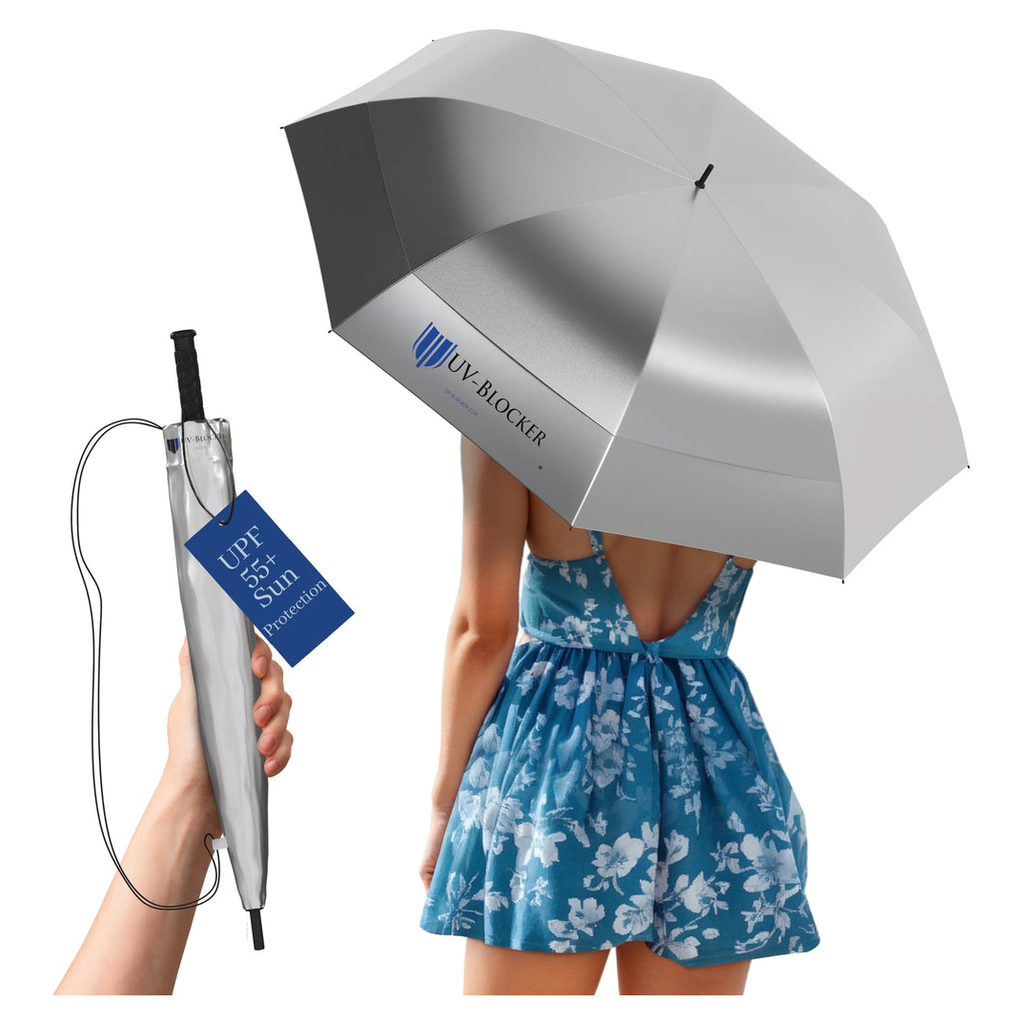
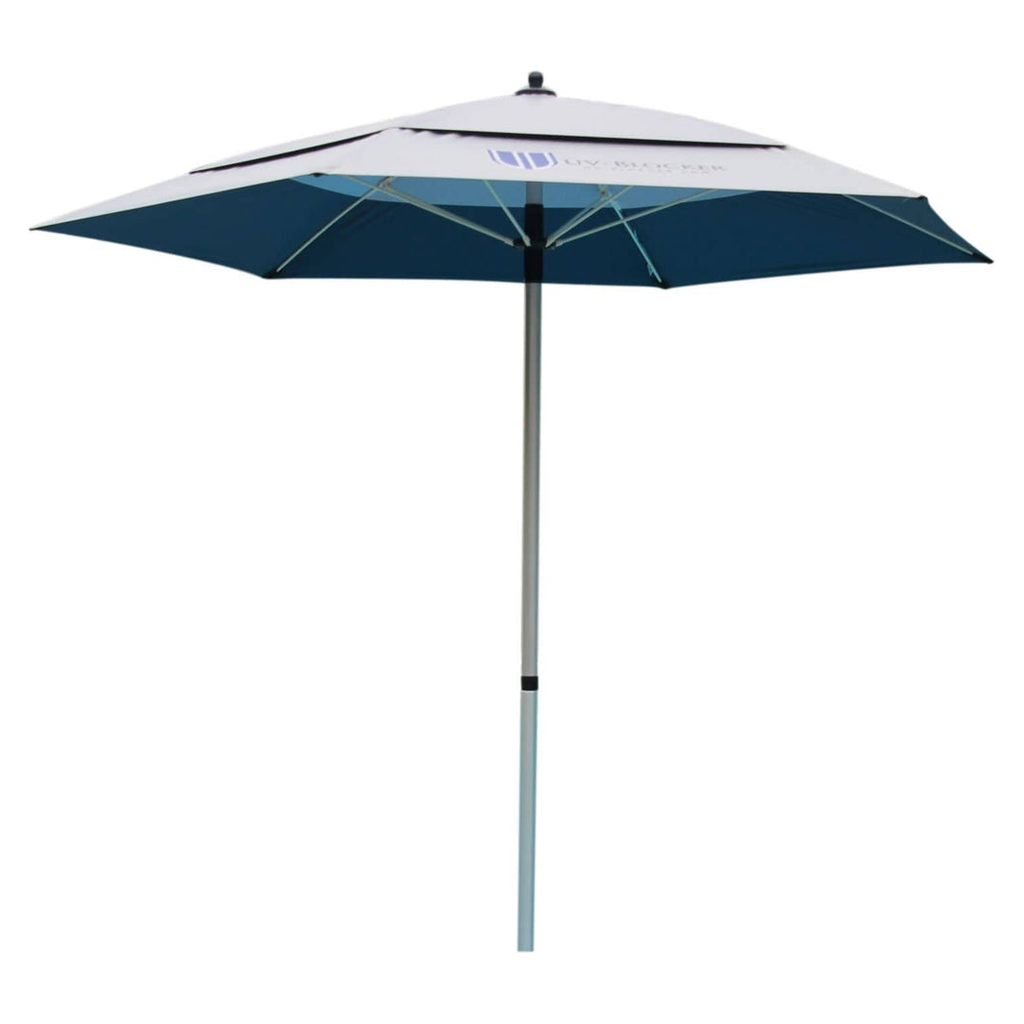
The construction is what separates a sun umbrella from a black rain umbrella. UV-Blocker canopies use patented Solarteck® fabric with a silver reflective outer layer and a navy underside. The silver surface bounces UV and infrared away rather than absorbing it, which is why the air beneath sits up to 8°C cooler than direct sun.
Independent AATCC TM183-2020 testing measured 100% UV-B and 99.97% UV-A block, which is a UPF 50+ rating. A patented vented double canopy lets gusts pass through instead of inverting the frame, and the fabric is RPET made from recycled bottles. The range is approved by the Melanoma International Foundation and recommended by dermatologists. For the difference between these and a decorative parasol, see parasol vs umbrella.
Where Can You Use a Sun Umbrella in Australia Without Standing Out?
Anywhere shade is already expected. School pickup, the sideline at junior sport, markets, uncovered platforms and beach walks are all settings where nobody looks twice.
For anyone still asking is it weird to use an umbrella in the sun, the answer changes with the setting. These are the everyday Australian situations where it reads as obvious rather than odd:
- School pickup and the walk home. Standing on an uncovered footpath at 3pm is exactly the exposure the guidance is written for.
- The sideline at junior cricket, netball or footy. Two hours in the open, and the shade travels between grounds.
- Weekend markets and outdoor festivals. Half the stalls already have a canopy overhead. Bringing your own is a difference of degree.
- Walking the dog between 10am and 3pm. The window with the highest UV and the least available shade.
- Waiting on an uncovered bus, tram or train platform. Short exposures that repeat daily, which is how most UV damage accumulates.
- Outdoor dining where the café umbrella does not quite reach. A familiar problem with an easy fix.
- Watching the tennis or the cricket from an unshaded seat. Hats are universal at these grounds, which is the point: shade is already the norm there.
- The beach walk, before and after the swim. Reflected UV off sand and water raises exposure well above the ambient reading.
There is also a group for whom this stops being a question of style. Australians on photosensitising medication, living with lupus, or in follow-up after skin cancer treatment need reliable coverage that does not wash off or wear away over an afternoon. Ron Walker started UV-Blocker in 2005, two years after his own Stage 1 melanoma diagnosis, for precisely that reason.
Which Sun Umbrella Is Least Conspicuous in Australia?
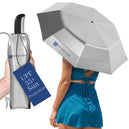
A compact folding model. It packs down to roughly 29 cm, weighs about 425 g, and reads as an ordinary umbrella until it is open.
Two models suit Australian everyday use, and both are built on the same silver Solarteck® canopy with a navy underside:
- Compact UV Umbrella: 107 cm arc, 97 cm of coverage, folds to about 29 cm, roughly 425 g. Automatic open and close, so it fits in a handbag, backpack or the door pocket of a car.
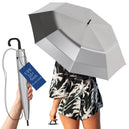
- Travel UV Umbrella: 112 cm arc, 99 cm of coverage, folds to about 44 cm, roughly 595 g. Automatic open with a manual close, and the larger canopy suits spectating and longer walks.
Both carry UPF 50+ protection, the patented vented double canopy, and a one-year limited warranty against defects. Both are small enough to pass as carry-on, which matters if you are flying somewhere sunnier within Australia.
The compact is the honest recommendation for anyone whose hesitation is social rather than practical. Closed, it looks like every other folding umbrella in the country. Small price to pay. Isn't your health worth it?
Frequently Asked Questions
The five questions Australians most often search alongside this one, answered against Cancer Council guidance and the clinical evidence on portable shade.
Is it good to use an umbrella in the sun?
Yes, provided the canopy is rated for UV. Cancer Council Australia recommends portable shade during peak UV radiation times, and notes that shade structures can reduce UV exposure by up to 75%. A UPF 50+ umbrella also keeps the air beneath it cooler, which matters on high-heat days.
Can I use a regular rain umbrella for sun protection?
A rain umbrella gives some shade but no measured UV rating, and a dark canopy absorbs heat rather than reflecting it. Sun-specific umbrellas use a reflective outer coating and carry a tested UPF or UVE figure, so the level of protection is known rather than assumed.
Why do Japanese people use umbrellas in the sun?
Because the practice never stopped there. In cities where most journeys are made on foot in high summer heat, a parasol is the only protection that moves with the person and shades more than a hat brim can reach. It is a response to UV and walking distance, not a fashion.
Can you still get sunburnt under an umbrella?
Yes. UV reflects off sand, water, concrete and glass, so it reaches skin from the sides even under good shade. A 2017 clinical trial found 78% of participants using only a beach umbrella still showed sunburn after three and a half hours of midday sun.
Do I need sunscreen if I use a sun umbrella?
Yes. Cancer Council recommends combining shade with clothing, a broad-brimmed hat, sunglasses and SPF30 or higher sunscreen. An umbrella is a strong layer in that routine and removes the bulk of direct overhead UV, but it is not designed to replace the other four steps.
Conclusion
Portable shade is Australian sun-safety guidance, not a foreign habit. The remaining question is which umbrella suits the situation, not whether to carry one.
- Portable shade is Australian national guidance. Cancer Council recommends it during peak UV and sells UPF 50+ rated handheld umbrellas in its own shop.
- The hesitation is a gap in the Slip Slop Slap script, not a judgement. Umbrellas were never one of the five steps, so they never entered the routine.
- By the ABS numbers, 60.6% of Australians are outdoors at peak UV while only 38.1% wear sunscreen on most days. The statistically unusual behaviour is going unprotected.
- A hat covers the face and neck. A 97 cm canopy covers the head, shoulders, arms and torso, and sits up to 8°C cooler beneath.
- Combine it with the rest of the routine, and pick the compact model if the hesitation was ever social rather than practical.