

TLDR:
- Melanin is genuine photoprotection, but it is weighted toward UVB and does far less against UVA.
- The widely quoted "SPF 13" figure is estimated from epidermal tissue, not measured. Modern in-vivo work puts melanin's real protection factor closer to 2 to 6.
- Against visible light the relationship reverses: it drives pigmentation in deeper skin tones and not in lighter ones.
- The melanoma survival gap is driven by stage at diagnosis, not biology. Among Black patients, 5-year survival runs from 85.8% when caught early to 19.0% once it has spread.
- Melanoma in darker skin most often appears on palms, soles and nail beds. Self-examination finds it, not sunscreen.
- Layered protection works best: shade first, then tinted mineral SPF 30 or higher, then UPF 50+ fabric.
Melanin is real sun protection. That part is not a myth.
The problem is that it protects against one part of the spectrum while the rest keeps going. It absorbs ultraviolet B reasonably well, ultraviolet A considerably less, and against visible light the relationship inverts entirely.
That narrow scope shows up in the data as dark spots lasting years and melanomas found late. Useful sun protection for dark skin starts with being precise about where melanin's protection ends.
Does dark skin need sun protection?
Yes. Melanin reduces the ultraviolet radiation reaching the lower epidermis, but it offers far less defence against UVA and none against the visible light that drives dark spots.
The instinct behind the question is not wrong. Deeply pigmented skin burns less readily, wrinkles more slowly, and develops melanoma far less often. Dismissing that would be dishonest.
What gets concluded from it does not hold, though. The Centers for Disease Control and Prevention puts it plainly: "It doesn't matter if your skin is light, dark, or in between, you can get skin cancer."
What melanin protects against, and what it doesn't
Melanin absorbs UVB well, UVA considerably less, and against visible light the relationship reverses, with deeper skin tones pigmenting more rather than less.
The number cited most often here deserves a correction, because it travels almost everywhere without its caveats.
Lab measurements on isolated epidermis estimate darker skin's intrinsic UVB protection at roughly SPF 13, against roughly SPF 3 for light skin. That figure is UVB-only, it was estimated from epidermal tissue rather than measured on living skin, and more recent in-vivo work puts melanin's real protection factor closer to 2 to 6.
Either way it sits far below the SPF 30 floor dermatologists recommend for everyone, and it does essentially nothing against visible light.
Where the "SPF 13" number comes from
It traces to a 1979 study by Kaidbey and colleagues, published in the Journal of the American Academy of Dermatology. Reviewing those measurements, Tsai and Chien report UVB transmission through black epidermis at 7.4% against 29.4% for white epidermis, and UVA at 17.5% against 55.5%.

Three caveats matter. The SPF value is approximately the reciprocal of that UVB transmission figure, so it is derived rather than measured. It came from epidermal sheets isolated from cadavers, not an in-vivo SPF test. And it describes UVB alone.
Kaidbey's broader finding is the more useful one: "on the average, five times as much ultraviolet light (UVB and UVA) reaches the upper dermis of Caucasians as reaches that of blacks."
Later work revised the estimate down. Fajuyigbe and Young report that the melanin protection factor "is typically about 2-3 when UVR doses have been the same," rising "to about 6 when doses are based on MED." They describe it as equivalent to a very low SPF sunscreen.
One footnote worth knowing: the American Academy of Dermatology publishes no SPF value for melanin at all. The confusion arises because Kaidbey's paper appeared in the Academy's journal, and secondary write-ups compress the journal's name into the organisation's, turning a 1979 research paper into an apparent recommendation.
Why UVA and visible light matter more here
The familiar shorthand is that UVB burns and UVA ages. For deeper skin tones, a more useful framing is that UVB causes sunburn while UVA and visible light drive the dark spots and uneven tone that matter day to day.
The CDC defines UVA as 315 to 400 nm and UVB as 280 to 315 nm, and notes that "nearly all of the ultraviolet radiation received on Earth is UVA." Melanin is weakest against the band that is most abundant, a point explored further in this guide to SPF and UPF rating systems.
Hyperpigmentation is the real daily sun concern
For most people with deeper skin tones, the everyday cost of sun exposure is not sunburn. It is dark spots that linger long after the original blemish heals.
Post-inflammatory hyperpigmentation is the mark left behind by acne, a cut, an insect bite or a flare of eczema. Davis and Callender describe it as an acquired hypermelanosis that "can arise in all skin types, but more frequently affects skin-of-color patients."
Duration is what makes it consequential. Epidermal hyperpigmentation "may take months to years to resolve without treatment," while pigmentation deeper in the dermis "may either be permanent or resolve over a protracted period of time." StatPearls states the gradient simply: "The darker the skin color, the more intense and persistent hypermelanosis tends to be."
It is also among the most common reasons people with skin of colour see a dermatologist. As reported by Davis and Callender, pigmentary disorders other than vitiligo ranked third among African-American patients at 9%, against seventh at 1.7% among Caucasian patients. Acne makes the link concrete: 65.3% of African-American patients in a 2002 study developed acne-induced hyperpigmentation.
Sunlight keeps those marks dark. Mahmoud and colleagues irradiated the backs of 20 volunteers with skin types IV to VI and found that while both UVA1 and visible light induced pigmentation, the visible-light pigmentation was darker and more sustained. In skin type II, visible light produced none at all.
The Academy's reporting reflects this. In its March 2022 sun-protection update, Dr. Lim notes that "new research shows visible light from the sun can cause skin darkening in people with darker skin, but not in people with lighter skin."
The mechanism and the practical response are covered in these guides to what triggers melasma and why sunscreen alone often fails against it.
The skin cancer disparity, and what actually drives it
Black Americans are diagnosed with melanoma far less often but die of it more often. The evidence points to stage at diagnosis, not to the disease itself.
The clearest way to see this is within a single group. Among non-Hispanic Black patients, 5-year melanoma survival is 85.8% when the cancer is caught while localized, 52.8% once it has spread regionally, and 19.0% after it reaches distant sites.
Outcome tracks the moment of detection, and detection is happening later, according to CDC data published in Preventing Chronic Disease.
| Measure | Non-Hispanic Black | Non-Hispanic White |
|---|---|---|
| 5-year melanoma survival (2001-2014) | 66.2% | 90.1% |
| Diagnosed at localized stage | 55% | 78% |
| Diagnosed with distant metastasis | 16% | 5% |
Melanoma is genuinely rarer in this group, at an incidence of 1.0 per 100,000, or roughly 359 diagnoses a year between 2011 and 2015. That rarity is part of the problem, because it lowers suspicion on all sides.
A smaller single-county study from Wayne County, Michigan points the same way. Brady and colleagues found an unadjusted hazard of melanoma death of 3.24 (95% CI 2.11-4.99). After adjusting for stage, age and sex, it fell to 1.00 (95% CI 0.64-1.56). The authors concluded that the increased mortality "results from the late stage at diagnosis, rather than any other variables between patients."
That cohort was small, so it supports the CDC pattern rather than settling it. Both point at the same lever. This is a detection and access problem, which makes it a solvable one.
Where to look: palms, soles and nail beds
In darker skin tones, melanoma most often appears on sun-protected sites. That is precisely why self-examination, rather than sun protection, is the tool that finds it.
The lower extremities, including legs and feet, are the most common site at 48.2%. Acral lentiginous melanoma, which develops on palms, soles and under the nails, accounts for 16.7% of all melanomas in non-Hispanic Black patients and 46% of those with a specified histology, against 2% in white patients.
That share figure is widely misread. The rate of acral melanoma is similar across groups, at 0.2 per 100,000 in both. It is not more common in Black patients. It makes up a larger share because the other subtypes are so much rarer.
Survival by subtype adds urgency. Superficial spreading melanoma carries a 91.1% 5-year survival rate, against 66.1% for acral lentiginous melanoma and 56.6% for nodular melanoma.
One point deserves to be unambiguous: sun protection does not prevent acral lentiginous melanoma. These lesions arise on skin the sun barely reaches. No umbrella, sunscreen or garment changes that risk, and any brand implying otherwise is overselling.
Self-examination is what closes this gap. The Academy's guidance for skin of color directs attention to the palms, soles, fingers and toes, nails, mouth, buttock, and anal or genital area. A new or changing dark streak in a nail, or a spot on the sole that will not heal, warrants a dermatologist's opinion.
Why sunscreen alone keeps failing deeper skin tones
Sunscreen use is measurably lower among people with skin of colour, and the documented reasons are practical: cost, difficulty finding a suitable product, and visible white residue.
The usage gap is stark. In a national survey, 37.6% of white respondents reported using sunscreen often or always, against 13.1% of Black respondents, 26.5% of Hispanic respondents and 29.0% of Asian respondents.
Research in the Journal of Drugs in Dermatology found that people with skin of colour "face barriers such as cost (2% NHW vs 16% SOC), lack of knowledge in finding suitable products (22% NHW vs 41% SOC), and concerns about white cast (7% NHW vs 25% SOC)." The same work found daily use at 31% against 25%, and reapplication at least once daily at 76% against 45%.
The sunscreens most often recommended for skin of colour in popular coverage also carry a higher median price per ounce at a lower median SPF than those recommended for fair skin.
There is a mechanical reason the residue problem is so stubborn, and it is the crux of the issue. Writing in the Journal of the American Academy of Dermatology, Lyons and colleagues put it directly: "For a sunscreen to protect against visible light, it must be visible on the skin. Inorganic filters (also known as mineral filters), namely, zinc oxide and titanium dioxide, are used in the form of nanoparticles in sunscreens to minimize the chalky and white appearance on the skin; as such, they do not protect against visible light."
The cosmetic fix defeats the protective function. That is a product design failure, not a discipline failure, and it deserves to be described that way.
Two honest caveats belong here. Forgetting to apply sunscreen remains the most frequently reported barrier in surveys, followed by the belief that it is unnecessary indoors, so white cast is real but secondary. And no published trial has yet measured whether switching to a cosmetically acceptable sunscreen actually increases sunscreen use in deeper skin tones. That link is inferred from stated preference, not demonstrated by an outcome study.
What actually works: layered sun protection for dark skin
Both the American Academy of Dermatology and the CDC rank shade first, then protective clothing, then sunscreen. The order matters more than any single product.
Shade first. The CDC's prevention guidance opens with it: "Stay in the shade. Wear clothing that covers your arms and legs. Wear a hat with a wide brim." The Academy's guidance for darker skin tones follows the same sequence, ending with tinted sunscreen at SPF 30 or higher.
Tinted mineral sunscreen, SPF 30 or above. The Academy advises choosing a tinted sunscreen that matches your skin tone, which addresses the residue problem and the visible-light problem at once. As it explains in its guidance on fading dark spots, "Iron oxide helps to protect your skin from the sun's visible light (a cause of dark spots)."
Clinical evidence supports this. In a double-blind randomised melasma trial where 61 of 68 participants completed and all received 4% hydroquinone, the group using a sunscreen covering both UV and visible light showed 15% greater improvement in MASI scores at eight weeks. Separate work found iron-oxide formulations significantly outperformed a mineral SPF 50+ sunscreen against visible-light pigmentation in Fitzpatrick type IV skin.
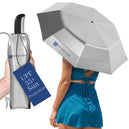
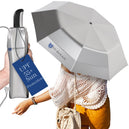
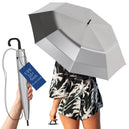
UPF 50+ fabric and portable shade. Fabric needs no reapplying, no shade-matching, and leaves no residue. UV-Blocker canopies are rated UPF 50+ and tested to AATCC TM183-2020 at 100% UV-B and 99.97% UV-A blocked, using a Solarteck® reflective silver canopy over a navy underside.
Neither the Academy nor the CDC names umbrellas specifically. Both rank shade as a first-line measure, and an umbrella is shade you can take with you. For this audience it carries one unusual advantage: it is the only protection modality where skin tone is irrelevant to the product. Nothing to match, nothing to rub in, nothing to reapply at midday.
A compact UV umbrella covers the commute, the school run and the walk home, and the full range sits in the UPF 50+ umbrella collection. For how physical shade compares with sunscreen in the research, see UV umbrellas versus sunscreen.
What about vitamin D?
Vitamin D deficiency is genuinely more common among Black Americans, but dermatology bodies are clear that unprotected UV exposure is not the right way to correct it.
The gap is well documented. National survey data covering 2011 to 2014 found 17.5% of non-Hispanic Black Americans at risk of vitamin D deficiency, against 7.6% of Asian, 5.9% of Hispanic and 2.1% of non-Hispanic white Americans.
The Academy's position statement is nonetheless unambiguous: "Vitamin D should not be obtained from unprotected exposure to ultraviolet (UV) radiation." Supplements and diet carry no skin cancer risk.
The evidence on sun protection itself is largely reassuring. Research on shade-seeking and clothing found the associations with lower vitamin D "were strongest for whites, and did not reach statistical significance among Hispanics or blacks," and that "neither wearing a hat nor using sunscreen was associated with low 25(OH)D levels or vitamin D deficiency."
One honest caveat: a 2025 randomised trial of daily SPF 50+ use over roughly a year did find a small but real reduction in vitamin D levels compared with discretionary use. Its investigators still advise people not to change their sunscreen habits, and to consider supplementation instead. The question is explored further in this guide to getting vitamin D in the shade.
Frequently asked questions
Common questions about sun protection for dark skin, answered from CDC, Academy and peer-reviewed sources.
Does dark skin need sunscreen?
Yes. Dermatologists recommend SPF 30 or higher for everyone. For deeper skin tones, a tinted mineral formula containing iron oxides adds protection against visible light that standard sunscreen does not provide.
What is dark skin's natural SPF?
Roughly SPF 13 by a widely cited calculation, but that figure is UVB-only and was estimated from epidermal tissue rather than measured on living skin. Modern in-vivo research puts melanin's real protection factor closer to 2 to 6.
Can Black people get skin cancer?
Yes. As the CDC states, skin colour does not determine whether someone can develop skin cancer. Melanoma is rarer in Black Americans but more often diagnosed late, which is what drives the difference in outcomes.
Where does skin cancer usually appear on darker skin?
Most often on sun-protected sites: soles of the feet, palms, nail beds and the legs. Checking these areas regularly is the single most useful habit, because sun protection does not reach them.
Does sunscreen prevent dark spots?
Only partly. Standard UV-only sunscreen does not block visible light, a significant driver of pigmentation in deeper skin tones. Tinted formulas containing iron oxides do, and shade blocks the full spectrum.
Is a UV umbrella better than sunscreen for dark skin?
Not better, complementary. An umbrella blocks UV and visible light with no residue, shade-matching or reapplication, removing several documented barriers at once. It works best layered with a tinted SPF 30+ sunscreen.
The bottom line
Melanin earns its reputation, just not the conclusion usually drawn from it. It is a modest, UVB-weighted filter that leaves UVA largely unaddressed and visible light entirely so.
The survival gap in melanoma is not written into anyone's skin. It is written into when the diagnosis happens, and that is something self-examination and access can change.