

TLDR Summary * Sun allergies affect up to 20% of the population, yet standard protection advice often fails because chemical sunscreens can trigger "double allergy" reactions. * Chemical UV filters like oxybenzone are the #1 reported photocontact allergen. * A specialized UV umbrella blocks 99%+ of UVA and UVB rays with zero chemical contact, making it the ideal daily barrier for PMLE and solar urticaria. * Standard protection methods have gaps: mineral sunscreens degrade in two hours, and clothing can trap heat. * This guide covers four sun allergy types, protection method comparisons, and a daily management routine.
Approximately 1 in 5 people experience some form of sun allergy, yet most protection advice ignores a critical problem: the products meant to protect them can trigger the very reactions they are trying to prevent. For the millions of individuals navigating life with Polymorphous Light Eruption (PMLE), solar urticaria, or other photosensitivity disorders, the standard recommendation to wear sunscreen is often insufficient.
Chemical sunscreens contain UV filters like oxybenzone and avobenzone, which are among the most common photocontact allergens. For patients with PMLE and solar urticaria, this creates a frustrating "double allergy" scenario: reacting to sunlight and the chemical agents designed to block it. This leaves many feeling trapped, unable to go outdoors without risking painful hives or blisters.
For many sufferers, a sun allergy is a lifestyle-altering condition. The fear of an outbreak can lead to social isolation, as individuals decline invitations to outdoor events or anxiety spikes during simple commutes. Finding a reliable protection method is about reclaiming the freedom to move through the world without fear.
This guide provides a medical-educational overview of sun allergies, compares protection methods head-to-head based on clinical efficacy, and explains why a UV umbrella addresses the unique needs that standard topical products cannot.
What Is a Sun Allergy and What Are the Different Types?
A sun allergy is an immune system overreaction to ultraviolet radiation, causing itchy rashes, hives, or blisters on sun-exposed skin. The four main types each have distinct triggers and treatment approaches.
Polymorphous Light Eruption (PMLE) PMLE is the most common form, affecting an estimated 10-20% of the population. It typically presents as itchy red bumps or patches appearing hours after UV exposure. Significantly more common in women (4:1 ratio), it is notoriously seasonal, often triggered in spring when skin has not yet "hardened" or adapted to UV radiation. This hardening process involves the skin thickening and producing melanin over time, which raises the threshold for a reaction. However, this natural protection is lost over winter, resetting the cycle each year. The immune response in PMLE is delayed, often appearing 24 to 48 hours after exposure, making it difficult for patients to immediately correlate the rash with the specific exposure event.
Solar Urticaria Solar urticaria is rare (less than 1% of urticaria cases) but acute. Hives appear within minutes of sun exposure and can fade within hours. The reaction is believed to be IgE-mediated, similar to an immediate allergy to pollen or food. In severe cases, extensive exposure can lead to anaphylaxis, making strict UV avoidance a medical necessity. Unlike PMLE, which is almost exclusively triggered by UV light, some cases of solar urticaria can be triggered by visible light, making standard sunscreens ineffective as they do not block the visible spectrum.
Actinic Prurigo This hereditary condition is most common in Indigenous American populations and often begins in childhood. It manifests as intensely itchy bumps that can persist for days, differing from the transient hives of solar urticaria. The chronic nature of this condition often leads to scarring and skin thickening, requiring long-term, consistent management strategies. Actinic prurigo is persistent and can occur even in winter, unlike the seasonal nature of PMLE.
Photoallergic Dermatitis This represents the "double allergy" phenomenon. It is triggered when UV light interacts with a chemical on the skin, including sunscreen ingredients. The UV radiation alters the chemical structure, causing the immune system to recognize it as a threat. This results in an eczema-like rash, highlighting the irony that protection products can become the source of the problem. Common culprits include fragrances, antibiotics, and specifically chemical UV filters like oxybenzone.

Why Does Standard Sun Protection Fail for Sun Allergy Sufferers?
Standard protection fails because chemical sunscreens can trigger reactions, UVA penetrates clouds and glass, and topical products degrade quickly.
Chemical Sunscreen Triggers Photoallergic Reactions Oxybenzone is the number one reported photocontact allergen. Research published in Dermatitis indicates that 70.2% of patients with sunscreen allergies tested positive for oxybenzone reactions. Avobenzone also breaks down upon UV exposure, creating phototoxic byproducts. For a sensitized patient, applying these chemicals creates a compounding inflammatory effect where the skin is fighting both the radiation and the lotion. This reaction often mimics the sun allergy itself, leading to confusion in diagnosis and management.
Mineral Sunscreens Have Limits Mineral sunscreens (zinc oxide/titanium dioxide) are safer physical blockers but have limitations. They physically degrade and wipe off due to sweat or friction, typically losing effectiveness after two hours. They also struggle to provide complete coverage; a missed patch is enough to trigger a PMLE flare. Additionally, the thick white cast of effective mineral formulas can be cosmetically difficult, leading users to apply too little product or skip application entirely. A thin application reduces the SPF significantly, often dropping a labeled SPF 50 to an effective SPF 15 or less.
UVA Penetrates Clouds and Glass PMLE sufferers are often sensitive specifically to UVA rays. Unlike UVB, UVA rays penetrate clouds, car windshields, and office windows. Up to 80% of UVA radiation passes through cloud cover, meaning a "safe" overcast day or a drive can result in a severe reaction. Relying on visual cues like "it's cloudy" is dangerous for photosensitive individuals. Standard window glass blocks UVB but allows the vast majority of UVA to pass through, creating a "greenhouse" of allergen triggers in cars and offices.
Sun Allergies Worsen Without Management Repeated unprotected exposure can intensify the immune response. For chronic conditions, each flare-up can increase skin sensitivity. Breaking this cycle requires absolute, consistent protection that does not fluctuate with reapplication habits or weather conditions. The concept of "priming" suggests that once the immune system is activated, it reacts more swiftly and severely to subsequent lower doses of UV radiation.
How Do Sun Allergy Protection Methods Compare?
UV umbrellas provide the most comprehensive chemical-free protection, blocking 99%+ of UV rays instantly with zero skin contact.

When managing conditions like solar urticaria, the margin for error is non-existent. The following table breaks down the efficacy of common strategies.
Protection Method Comparison
| Protection Method | UV Block | Chemical Contact | Coverage Area | Duration | Temperature | Sun Allergy Safe? |
|---|---|---|---|---|---|---|
| UV Umbrella (UPF 50+) | 99%+ UVA/UVB | None | Head, torso, upper body | Unlimited | 15°F cooler | Yes: ideal for all types |
| UPF 50+ Clothing | 93-98% | None | Only where worn | Unlimited | Can trap heat | Yes but uncomfortable in heat |
| Mineral Sunscreen | Up to 97% fresh | Minimal | Applied skin only | Degrades in ~2 hrs | None | Generally safe |
| Chemical Sunscreen | 95-97% fresh | Yes (oxybenzone) | Applied skin only | Degrades in ~2 hrs | None | RISK: photoallergic reaction |
| Wide-brim Hat | Varies | None | Face, neck, ears | Unlimited | Minimal cooling | Partial coverage |
UV Umbrella Advantages The UV umbrella is the only method combining high-level filtration (99%+ block) with zero chemical contact and unlimited duration. Unlike sunscreen, which requires a wait time, an umbrella provides instant protection. Specialized fabrics tested to AATCC TM183-2020 standards block 99.97% of UVA rays.
Additionally, the cooling effect is medically relevant. Heat can exacerbate itching and inflammation. A UV umbrella with a reflective coating creates a shade zone approximately 15°F cooler than direct sun. This contrasts sharply with UPF clothing, which, while effective at blocking UV, can trap body heat and humidity against the skin, potentially triggering heat rashes that complicate the sun allergy diagnosis.
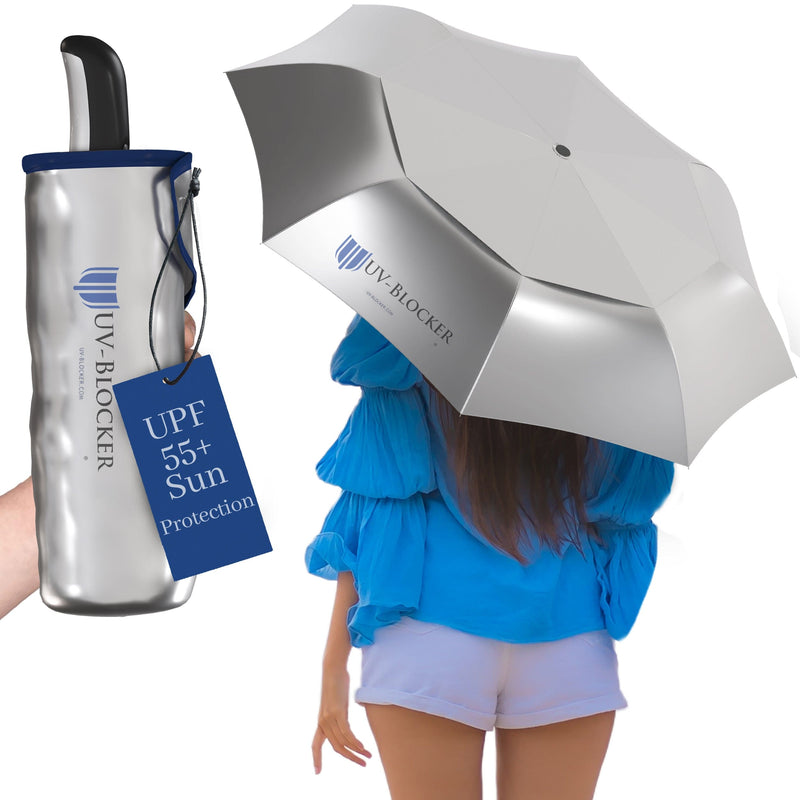
The Best Approach Is Layered Dermatologists recommend a layered approach. A UV umbrella serves as the primary mobile barrier. Mineral sunscreen should be applied to skin exposed to indirect, scattered UV light. A UPF hat serves as backup. For example, the UV protection compact umbrella fits in a purse, ensuring a high-performance barrier is always available.
Selecting the Correct UV Umbrella
Not all umbrellas provide adequate protection. To effectively manage PMLE or solar urticaria, a specific sun allergy umbrella must meet rigorous technical standards that go beyond simple shade.
Double-Layer Fabric Technology The architecture of a true protective umbrella involves two distinct layers of fabric working in unison. The outer layer must feature a high-performance reflective silver coating. This is not merely aesthetic; it serves as a mirror for electromagnetic radiation, bouncing UVA, UVB, and infrared heat away from the user. Standard black umbrellas absorb this heat, radiating it down onto the user's head, which can worsen inflammation-based conditions. The inner layer should be a dark, dense weave designed to absorb any scattered UV light that bounces off the ground (albedo effect). This dual-action approach, reflecting from above and absorbing from below, creates a "UV null zone" around the user's upper body.
Certified UPF 50+ Rating Visual opacity is not a guarantee of UV protection. A medical-grade umbrella must carry a certified UPF 50+ rating, verified by independent laboratory testing such as the AATCC TM183-2020 standard. This rating indicates that less than 1/50th (or 2%) of UV radiation penetrates the fabric. For severe photosensitivity, even higher blockage is preferred. UV-Blocker umbrellas, for instance, are tested to block 99.9% of UVA and UVB radiation, providing a level of safety that far exceeds standard "sun umbrellas" found in retail stores.
Coverage Arc and Ergonomics The physical size of the canopy determines the volume of protected space. For sun allergy sufferers, a larger arc (typically 42-62 inches) is preferable as it covers the head, shoulders, chest, and arms, which are common sites for PMLE eruptions. However, portability is also key for consistency. A compact UV umbrella that fits in a handbag allows for spontaneous protection, while a larger golf-sized unit is ideal for planned, extended outdoor events. The handle design also matters; since the user may hold the umbrella for long periods, an ergonomic grip reduces fatigue, encouraging consistent use.
What Makes UV Umbrellas Ideal for Sun Allergy Management?
UV umbrellas are ideal because they provide complete chemical-free UV blocking, address the "double allergy" problem, and offer instant portable protection.
The "Double Allergy" Solution Patients with photoallergic dermatitis often react to both sunlight and sunscreen chemicals. A UV umbrella removes the allergen entirely, providing a physical roof that blocks 99%+ of radiation without a single molecule touching the skin. This allows the skin barrier to heal without chemical challenge. For those recovering from a severe flare-up, this "contact-free" protection is often the only way to be outdoors safely.
SolarTek Reflective Coating Blocks UVA + UVB + HEVL Effective protection relies on construction. The exterior SolarTek silver reflective coating bounces UV radiation and heat away rather than absorbing it. This is critical for blocking penetrating UVA rays. The interior absorption layer captures scattered UV light. This combination also blocks High-Energy Visible Light (HEVL), which contributes to sensitivity in some skin types and is notoriously difficult to block with topical sunscreens alone.
No Degradation Over Time Chemical sunscreens break down after about two hours. A UV umbrella maintains its UPF 50+ rating indefinitely while open. Whether outside for ten minutes or four hours, the barrier remains equally effective, removing the anxiety of "reapplication math." This reliability is crucial for long days outdoors where washing hands and reapplying lotion is impractical.
Portable Shade for Spontaneous Exposure Flares often occur during brief exposures: parking lots, outdoor cafes, or waiting for transport. A compact unit that folds to 11.5 inches transforms these high-risk scenarios, providing on-demand, hospital-grade protection that can be deployed in seconds. It creates an immediate "safe zone" that travels with the user.
Daily Sun Allergy Management Routine
A rigorous daily routine is the first line of defense against outbreaks. Consistency is key, as even a single accidental exposure can trigger a weeks-long flare.

Morning Protocol The daily routine begins with checking the UV index using a reliable app, looking at the hourly forecast for the entire day rather than the current moment. Broad-spectrum mineral sunscreen (zinc oxide/titanium dioxide) should be applied to the face, neck, and hands regardless of the forecast. A compact UV umbrella should be packed in the daily bag or vehicle. This preparation must happen before stepping outside, as morning UVA rays can be intense even when temperatures are low.
Midday and Outdoor Strategy Upon exiting a building, the umbrella should be deployed immediately. The dome should be positioned to intercept the sun's angle, which changes throughout the day. For days with high UV index (6+) or extended exposure, the umbrella should be supplemented with a wide-brimmed UPF hat and long-sleeved UPF clothing. Users must be mindful of reflective surfaces like concrete, water, or sand, which can bounce UV rays under the umbrella; this is why the mineral sunscreen backup is essential for the chin and neck areas.
Transit and Commuting Protocols Commuting presents hidden dangers for sun allergy sufferers. UVA rays penetrate standard car windows, meaning a 30-minute drive can result in significant exposure to the arms and face. While driving, users should wear UV-protective sleeves or install UV-blocking window film. The transition from the car to the office or store is a critical vulnerability point. A sun allergy umbrella should be kept in the driver's side door pocket for immediate deployment when exiting the vehicle. Walking across a large parking lot without protection is a common trigger for PMLE flares.
Seasonal Vigilance For PMLE sufferers, spring is the danger zone. Vigilance must peak when skin is least adapted. "Hardening" protocols (gradual exposure) should only be done under medical supervision. During this phase, the umbrella controls the light dosage to prevent overexposure, allowing the user to precisely manage how much light their skin receives. As the season progresses and tolerance potentially builds, the protection strategy should remain strict to prevent regression.
Travel Planning Researching the destination's UV index is mandatory before travel. A UV protection travel umbrella should be packed in carry-on luggage to ensure it is available immediately upon arrival. Airports and train stations often feature large glass walls that allow UVA penetration; having a portable shade device provides security in these uncontrolled environments.
When to Seek Dermatological Care for Sun Allergy
Professional medical intervention is necessary if symptoms worsen, spread to new areas, cause blistering, or if antihistamines fail to provide relief.
Escalation Signs Medical attention should be sought if symptoms spread to unexposed areas, if blistering occurs, or if reactions happen through glass or on overcast days. Any reaction persisting for more than a week warrants evaluation. These signs suggest the condition may be progressing or that a secondary infection has occurred. Severe swelling (angioedema) or difficulty breathing requires emergency care.
Professional Treatment Options Treatments include phototherapy (controlled UV exposure), hydroxychloroquine for severe PMLE, or high-dose antihistamines/omalizumab for solar urticaria. These require specialist monitoring. Phototherapy, in particular, requires a strict schedule to be effective and is often done in the months leading up to spring to induce tolerance. Corticosteroids may be prescribed for acute, severe flares to reduce inflammation rapidly.
Polypodium Leucotomos Extract Polypodium leucotomos (fern extract) supplements can increase UV resistance. A 2025 RCT showed 8 weeks of supplementation reduced UV-induced reactions and increased the burn threshold. In PMLE studies, roughly 30% of patients stopped producing lesions. It is believed to work by providing powerful antioxidant protection that neutralizes free radicals generated by UV exposure. It is a systemic adjunct, not a replacement for physical barriers like a UV umbrella.
Frequently Asked Questions About Sun Allergy Umbrellas
Can you use an umbrella for sun allergy? Yes. A UV umbrella rated UPF 50+ blocks 99% of UVA/UVB rays, providing chemical-free protection ideal for those reacting to sunscreen. Standard rain umbrellas often lack this protection. Look for AATCC TM183-2020 testing. See Do UV Umbrellas Work?.
What is the best sun allergy umbrella? The best model has a UPF 50+ rating and a reflective coating. PMLE is triggered by UVA, which silver reflective coatings effectively bounce away. UV-Blocker's umbrellas are tested to block 99.97% of UV-A rays.
Do regular umbrellas protect against sun allergy? Generally, no. Regular umbrellas block only 50-77% of UV rays, which is insufficient for sun allergy sufferers. Without UPF certification, you risk high UV dosage. See What Color Umbrella Is Best for Sun Protection?.
Can sun allergies go away? PMLE may improve with age or "photohardening." Solar urticaria and photoallergic dermatitis typically require ongoing management. Reliable protection with a UV umbrella is essential during any tolerance-building process.
What is the best sunscreen for sun allergy? Mineral sunscreens with zinc oxide or titanium dioxide are safest, avoiding chemical reaction triggers. Avoid oxybenzone and avobenzone. Always pair sunscreen with a UV umbrella for complete protection. Consult The Complete Lupus Sun Protection Guide.
Conclusion
Sun allergies affect up to 20% of the population, presenting a complex challenge. The "double allergy" problem, where chemical sunscreens trigger reactions, highlights the need for chemical-free barriers.
A sun allergy umbrella provides the most comprehensive solution, blocking 99%+ of UVA/UVB rays without skin contact. It eliminates photoallergic risk while providing instant coverage for PMLE and solar urticaria. When integrated with mineral sunscreen and UPF clothing, it offers a sustainable path to outdoor activity.
If you suspect your current sun protection is failing or exacerbating your symptoms, check your sunscreen labels for oxybenzone and avobenzone. Consider switching to a mineral-only formula and incorporating a UV protection umbrella into your daily routine.