

Yes, umbrellas protect you from the sun, but how much depends on the fabric: ordinary umbrellas blocked 77–99% of UV in testing, while a tested UPF 50+ parasol lets less than 2% through.
That gap matters in Australia, where sun protection is needed whenever the UV Index reaches 3, and that covers much of the year. Even the best canopy only stops the UV coming from above.
So do umbrellas protect you from the sun well enough to rely on? This guide sets out the figures, each with its source: what a regular umbrella lets through, what UPF 50+ really means, why sunscreen still matters under a parasol, and how to check whether a "UPF 50+" label was ever tested.
Does an Umbrella Block UV, or Only Light?
An umbrella blocks UV as well as light, but not equally. Its fabric decides how much UV passes, and thin or light-coloured fabric lets through more than it appears.
UV is invisible, so shade that feels cool and dim can still let ultraviolet rays through the weave. Two kinds matter for skin. UVB causes sunburn. UVA reaches deeper and drives skin ageing. A canopy has to stop both.
So, do umbrellas block UV? Researchers at Emory University tested 23 handheld umbrellas in full sun at a UV Index of 8. Every one blocked some UV. The weakest, a white rain umbrella, blocked 77%. The best, a silver-coated sun umbrella, blocked more than 99%. Darker fabrics generally did better than light ones (McMichael et al., JAMA Dermatology, 2013).
The researchers also measured UV close to the face of the person holding each umbrella. Readings there ranged from 67 to 1,256 µW/cm², against roughly 6,500 to 6,900 µW/cm² with no umbrella at all, as HealthDay reported. The canopy cut exposure sharply. But what reached the skin varied with the fabric and with how the umbrella was held.
Umbrellas do block UV, then. The useful question is how much gets through.
How Much UV Gets Through a Regular Umbrella vs a UPF 50+ Parasol?
Regular umbrellas blocked anywhere from 64.5% to 99% of UV in testing. A UPF 50+ parasol lets less than 2% through; UV-Blocker's tested fabric blocks 100% of UVB.
UPF (ultraviolet protection factor) measures how much UV a fabric lets through. UPF 50 means about one fiftieth, or 2%, passes. UPF 50+ is the top rating under AS/NZS 4399, the Australian and New Zealand standard for sun-protective fabrics.
Do sun umbrellas work as labelled?
The good ones do. The catch is that a label alone proves very little.
A 2024 review of 37 umbrellas sold for sun protection found 22 carried a UPF claim, but only 6 had testing to back it. For handheld umbrellas, a UPF label was close to universal, while the chance of a validated claim was about 1 in 5.
The same review cited black nylon umbrellas blocking between 64.5% and 92.3% of UV (Gyongyosi et al., Cureus, 2024).
That's why the test matters more than the tag. A trustworthy UPF claim names the standard and the laboratory.
Do UV umbrellas work when the fabric is tested?
Yes. UV-Blocker's Solarteck® fabric was tested to AATCC TM183-2020 and blocked 100% of UVB and 99.97% of UVA. The canopy fabric is also rated UPF 50+, Excellent protection, in independent SGS testing to AS/NZS 4399:2020. Both are fabric ratings: they describe the material, not every angle a person might hold it at.
| Canopy | UV blocked by the fabric | Source |
|---|---|---|
| White rain umbrella (weakest in test) | 77% | McMichael et al., JAMA Dermatology, 2013 |
| Black nylon umbrellas | 64.5–92.3% | Gyongyosi et al., Cureus, 2024 |
| Any fabric rated UPF 50+ | more than 98% | AS/NZS 4399 rating scale |
| UV-Blocker Solarteck® fabric | 100% UVB, 99.97% UVA | AATCC TM183-2020 test |

These are fabric figures. The UV that reaches skin under any canopy is higher, because some of it arrives from below and from the sides. The guide to parasol vs umbrella covers how the two designs differ beyond the fabric.
Do You Still Need Sunscreen Under a Parasol?
Yes. A parasol blocks UV from above, but UV reflected off sand, water and concrete, and scattered from the open sky, still reaches your face, neck and legs.
Cancer Council NSW's Guidelines to Shade list how much UV common surfaces bounce back:
- Dry beach sand: 15–18%
- Sea surf and white foam: 25–30%
- Concrete: 8–12%
- Open ocean: 8%
- Lawn and grass: 2–5%
The same guidelines say good-quality shade can reduce UV exposure by up to 75%. That's a large cut, not a full stop. ARPANSA makes a similar point: someone shaded from the direct sun can still receive substantial UV from the open sky, and light-coloured concrete, white paint and metal surfaces reflect UV back towards people.
A beach trial shows what that means in practice. Of 81 adults at a lake beach, 78% of those sitting under a standard beach umbrella had sunburn somewhere on the body, compared with 25% of those using SPF 100 sunscreen. Neither method fully prevented burning (Ou-Yang et al., JAMA Dermatology, 2017). It was a standard beach umbrella rather than a UPF 50+ parasol, and a sunscreen maker part-funded the study. Its lesson still holds: combine measures.
Cancer Council Australia puts it plainly: "Shade reduces UV radiation, but it can still reach you via reflection." Its five SunSmart steps pair shade with SPF50+ broad-spectrum, water-resistant sunscreen on exposed skin.
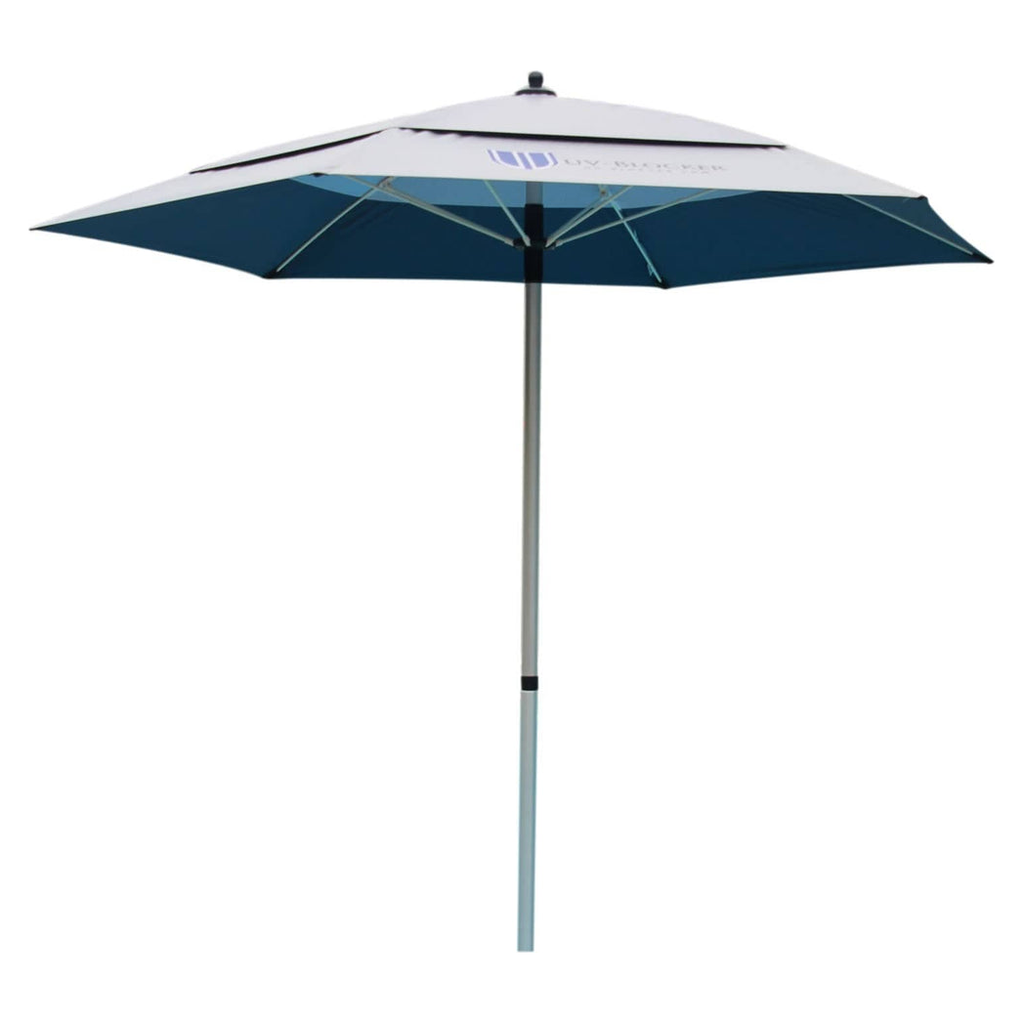
Canopy design helps a little here. UV-Blocker parasols have a navy underside, which absorbs some of the UV bouncing up from the ground instead of reflecting it onto the face. For the full picture of how people burn in the shade, see can you get sunburnt under an umbrella.
Is a Parasol Enough at UV Index 3+ in Australia?
Not on its own. At UV Index 3 and above, a parasol covers the "seek shade" step; add a hat, sunglasses, clothing and SPF50+ sunscreen on exposed skin.
The UV Index runs from low (1–2) and moderate (3–5) to high (6–7), very high (8–10) and extreme (11 and above). Cancer Council NSW describes UV Index 3 as high enough to cause permanent damage to most skin types. Cancer Council Australia advises that seeking shade should be top of mind on any day the UV Index is 3 or above, as one of five SunSmart steps:
- Slip on sun-protective clothing.
- Slop on SPF50+ sunscreen.
- Slap on a broad-brimmed hat.
- Seek shade.
- Slide on sunglasses.
A parasol is the fourth step in a form you can carry. It earns its place where there's no built shade: the walk to the station, school pick-up, the sideline at Saturday sport, the queue outside a stadium, the stroll along the beachfront.
Cloud doesn't switch the need off. Over 90% of UV can pass through light cloud, according to Cancer Council NSW, so an overcast spring morning can still reach UV 3 or higher.
Handheld sun umbrellas are still unusual in Australia, and that puts some people off. The guide to is it weird to use an umbrella in the sun looks at how that is changing.
What Makes a Sun Umbrella Actually Work?
A sun umbrella works when its fabric is tested to UPF 50+ under a named standard, its canopy covers head and shoulders, and you actually carry it.
Use this checklist before buying:
- Tested UPF 50+. The standard (AS/NZS 4399 or AATCC TM183) and the lab should be named, not just the rating.
- A reflective outer canopy and a dark underside. The outer layer turns UV away; the underside absorbs what bounces up.
- Enough coverage. The canopy should shade head and shoulders when held normally.
- Ventilation. A vented canopy lets heat escape instead of trapping it.
- Portability. It only protects if it's in the bag when the UV climbs.
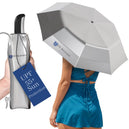
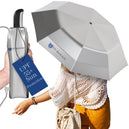
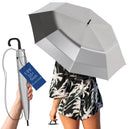
UV-Blocker's parasols are designed around that list. Founder Ron Walker started the company in 2005, two years after a Stage 1 melanoma diagnosis, to make shade people would actually take with them. The Solarteck® outer fabric is reflective silver, with the coating embedded in the fabric rather than sprayed on. The underside is navy. A patented vented canopy keeps users up to 8°C cooler than standing in direct sun, and the fabric is RPET, made from post-consumer plastic. The range is dermatologist recommended and approved by the Melanoma International Foundation.
Prices on the Australian store, checked 3 November 2026 (set at the live exchange rate, so they can move slightly):
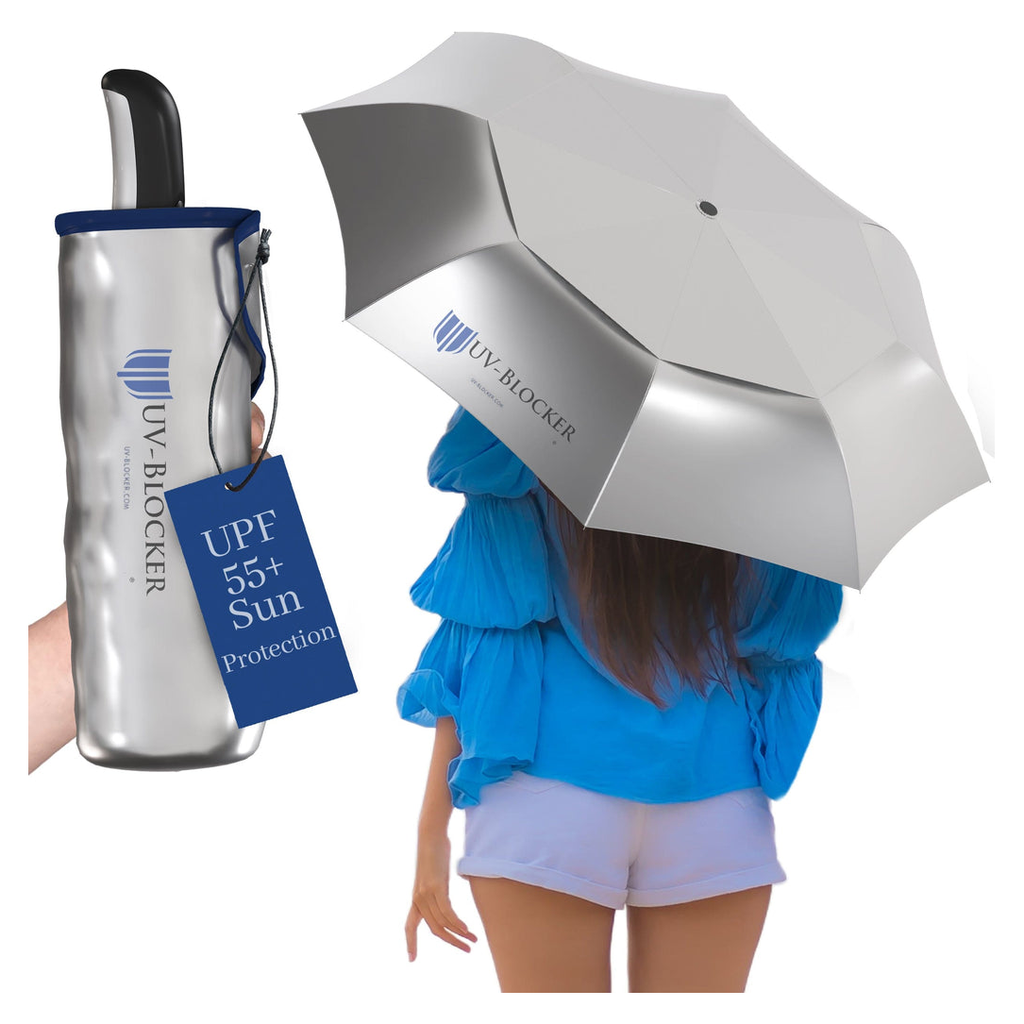
- Compact UV Parasol: about A$88, with a 107 cm arc that fits in a handbag
- UV Protection Travel Umbrella: about A$88
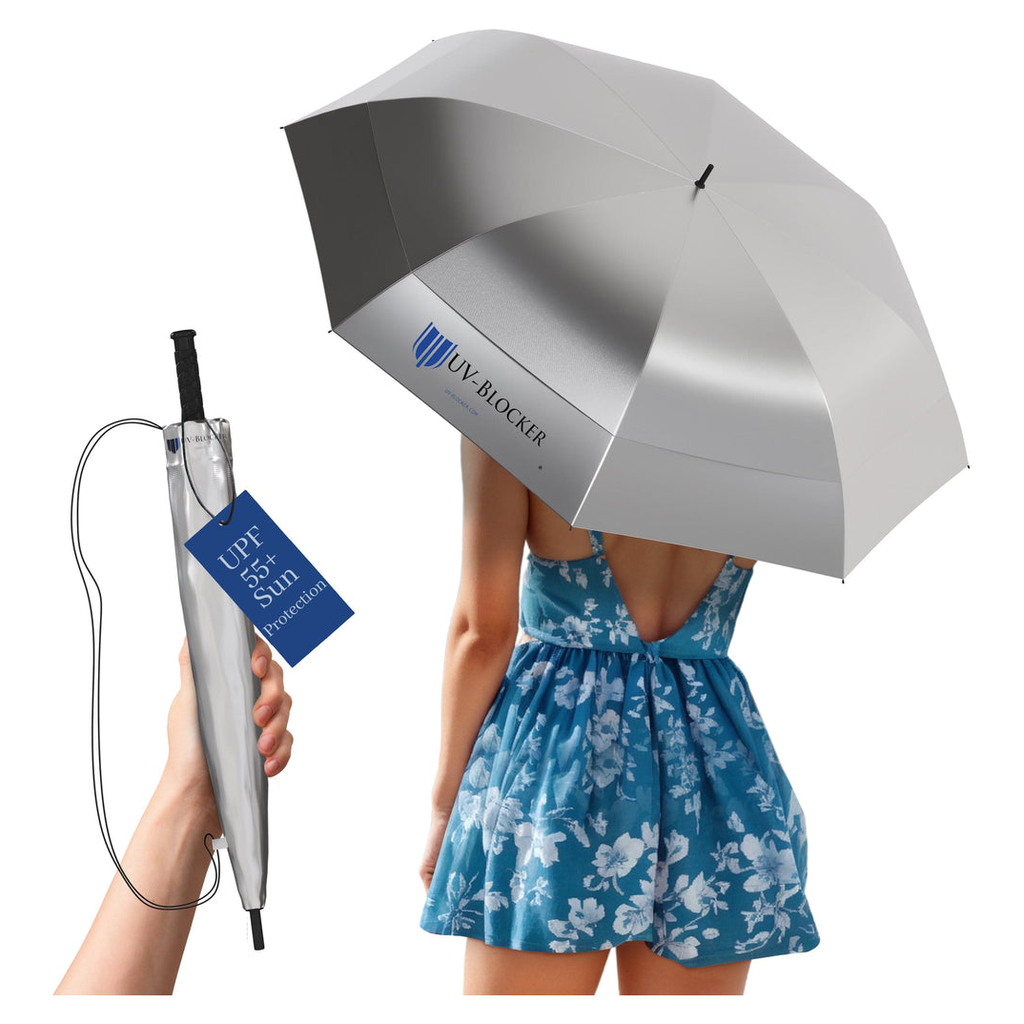
- Large Folding UV Umbrella: about A$95, with room for two
- UV Protection Golf Umbrella: about A$95, for the course and the sideline
The full range sits under UV umbrellas.
Do Umbrellas Protect You From the Sun? Frequently Asked Questions
Short answers to the questions Australians ask most about umbrellas and sun protection, from everyday rain umbrellas to UPF 50+ parasols.
Are umbrellas good for sun protection?
Yes, as one layer. A tested UPF 50+ umbrella blocks almost all direct UV; any umbrella still needs sunscreen, a hat and sunglasses alongside it.
Untested umbrellas vary widely, from about 64.5% to 99% in the studies above, so a tested rating is the safer choice.
Does an umbrella help with sun and heat?
Yes. Shade cuts the sun on your skin, and a reflective silver canopy also keeps you cooler: UV-Blocker's keeps users up to 8°C cooler than direct sun.
Can UV get through an umbrella on a cloudy day?
UV still reaches you on cloudy days, and over 90% can pass through light cloud. The umbrella still blocks what comes from above, so keep using it at UV 3+.
How can I tell if an umbrella's UPF claim is real?
Look for the test standard and the lab named on the product, such as AS/NZS 4399 or AATCC TM183. Only 6 of 37 umbrellas reviewed had validated claims.
Does a sun umbrella lose its UV protection over time?
Fabric protection can drop if the canopy is stretched, wet or worn. Keep it dry when stored and replace a canopy with tears or worn coating.
Labs rate fabric dry and relaxed, which is why everyday care matters.
Is a parasol better than sunscreen?
They do different jobs. A parasol blocks direct UV without reapplying; sunscreen protects the skin the parasol misses. Cancer Council advises using sunscreen with the other measures.
People who are photosensitive, take photosensitising medication or have a history of skin cancer should follow their doctor's advice on sun protection.
The Short Answer for Australians
Umbrellas protect you from the sun, but only a tested UPF 50+ parasol blocks nearly all direct UV, and it works best alongside sunscreen, a hat and sunglasses.
- Ordinary umbrellas blocked between 64.5% and 99% of UV across two studies, and there's no way to tell which by looking.
- A UPF claim is only as good as the test behind it: look for a named standard and lab.
- Reflected UV off sand, water and concrete means sunscreen still matters under any canopy.
- At UV Index 3 and above, a parasol is the shade step you can carry.
Before heading out today, check the UV Index in the SunSmart app or the Bureau of Meteorology's sun protection times. Then pack the shade. The Compact UV Parasol blocks direct UV with nothing to reapply, and the rest of the UV umbrellas range covers golf, travel and two-person shade.
Small price to pay. Isn't your health worth it?