

There are 319,900 diesel service technicians and mechanics working in the United States, and most of a shift happens inside a shop bay. But the Bureau of Labor Statistics is specific about the rest of the job: these technicians "occasionally repair vehicles on roadsides or at worksites." That occasional slice is where sun protection for diesel mechanics stops being optional.
TLDR: - Diesel mechanics work mostly indoors, but roadside breakdowns and worksite calls put them in full, unshaded sun with none of a shop's safety infrastructure - Loading docks and container yards fall under OSHA's warehousing heat-illness category, and California's indoor heat rule now applies to docks above 82°F - The trade already proved demand for shade-on-steel by drilling $141 permanent umbrella mounts into service trucks - Trailers, containers, dock levelers, and service-truck bodies are large flat steel panels, an ideal attachment surface for shade that most fleets never use - A magnetic-mount canopy solves shade at the point of repair without drilling, without a helper, and without giving up a hand needed for tools - A written heat-safety plan should pair OSHA's water-rest-shade framework with a shade tool assigned to each mobile vehicle, not shared equipment
Why Does Sun Protection for Diesel Mechanics Matter on Roadside and Dock Calls?
Diesel mechanics work mainly in shops, but BLS confirms they "occasionally repair vehicles on roadsides or at worksites," fully outdoors, with no shade structure at all.
This is not a rare edge case. The trade supporting these breakdowns is large and commercially active: 42,299 U.S. truck-repair businesses generated $18.1 billion in revenue in 2025, according to IBISWorld. That is not a hobbyist market. It is a workforce whose median pay sits at $60,640 per the BLS Occupational Outlook Handbook, and whose members are regularly dispatched away from the bay, tools in hand, to wherever the truck happens to have stopped running.
Sun protection for diesel mechanics also has to account for who is buying the fix. The American Trucking Associations puts the number of active U.S. motor carriers at roughly 580,000, and 91.5% of them run 10 trucks or fewer. That means most buying decisions come from an owner-operator equipping a single service truck, not a fleet safety department signing off on a program. A second, smaller buyer group exists too: shop and fleet managers outfitting a crew of mobile-repair technicians at once. Any shade solution built for this trade has to work for both.

What Heat and UV Risks Do Fleet Technicians Face Outside the Shop?
OSHA names warehousing as a heat-illness setting, and California's indoor heat rule now applies to loading docks once the temperature reaches 82°F.
That single fact surprises most fleet operators, because a loading dock does not feel like a construction site or a farm field. It is neither fully indoors nor fully outdoors, which is exactly why regulators singled it out. OSHA lists warehousing among the industries where workers have suffered heat-related illness, and Cal/OSHA's heat illness prevention rule treats indoor spaces reaching 82°F, including docks, the same way it treats an outdoor job site. Dock crews handling freight, and the technicians who service dock equipment and the trailers backed up to it, sit in that same gap: real heat exposure, with less formal safety planning than a roofing crew or a road paving job would get.
Roadside repairs add a second layer of exposure that has nothing to do with ambient air temperature. A technician kneeling beside a tractor hood or a trailer sidewall in direct sun is working next to a large flat steel panel that has spent hours absorbing solar radiation. That panel radiates heat back at the person working closest to it, on top of whatever the air temperature already reads. It is the same physics that makes a rooftop HVAC casing hot to the touch, just at ground level and on the shoulder of a highway instead of a rooftop.
The client's own vertical-market research on this trade describes the metal-surface fit for shade attachment as "outstanding," and for good reason. Trailer sidewalls, dry-van and reefer bodies, shipping containers, tractor hoods and fuel tanks, dock plates and levelers, and service-truck bodies are all large, flat, ferrous panels. It is arguably the largest connected surface area of exposed steel in the entire outdoor-worker economy, and almost none of it is currently used as an attachment point for shade.
Why Do Standard Shop Safety Habits Fail on Roadside and Dock Calls?
Hard hats and sunscreen were not built for a technician whose hands are on tools, and pop-up tents or drilled mounts solve shade but not portability.
Sunscreen reapplication assumes clean hands and a pause in the work. That assumption breaks down fast when a technician is mid-repair with grease, a multimeter, or a wrench already in hand. Stopping to wash up, reapply, and get back under a truck is not how a 20-minute roadside call actually runs.
The trade has already answered the underlying question of whether shade-on-steel makes sense; it just answered it the hard way. The Bolt-On Umbrella Mount for service trucks sells for $141 and is installed by drilling directly into the truck body. That price point and that behavior are proof that mechanics and fleet managers already want overhead shade attached to the vehicle itself. The catch is permanence: a drilled mount cannot move to a different truck, and the holes it leaves behind can complicate a paint warranty or a resale.
Smaller-scale products exist below that price, but they are not built for this job. A generic clamp umbrella runs $18.99 to $35.75, and a magnetic holder like the Trade Shade sells for $100.49, though the umbrella itself is sold separately in both cases. These are consumer products designed for bleachers, boats, and porches, not a full-canopy, hands-free shade need at a working repair bay. A pop-up canopy tent ($199 to $269) solves shade at a larger scale but requires staking or weighting and a few minutes of setup, which makes sense for a job site that will be occupied all day and makes far less sense for a 20-minute roadside call.
How Does the UV-Blocker ServiceShield Solve Shade for Fleet and Roadside Repair?
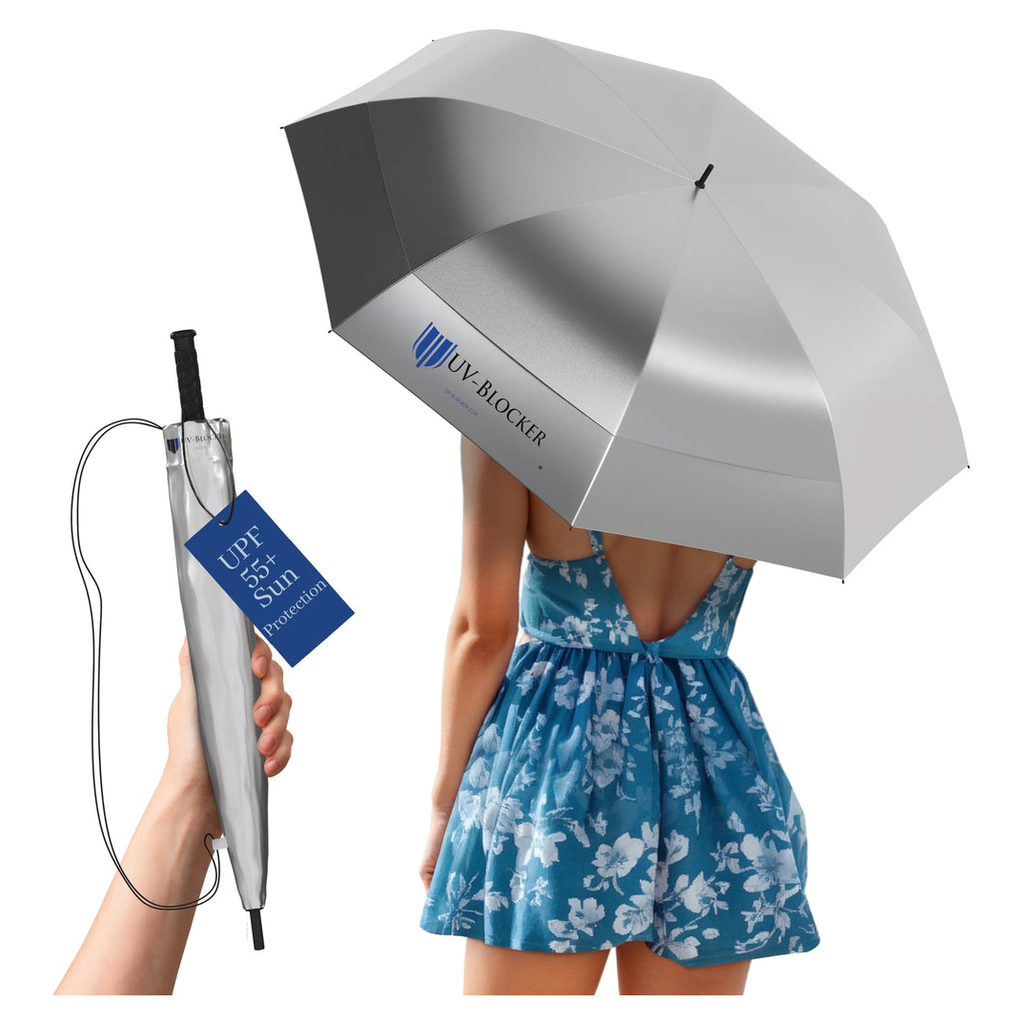
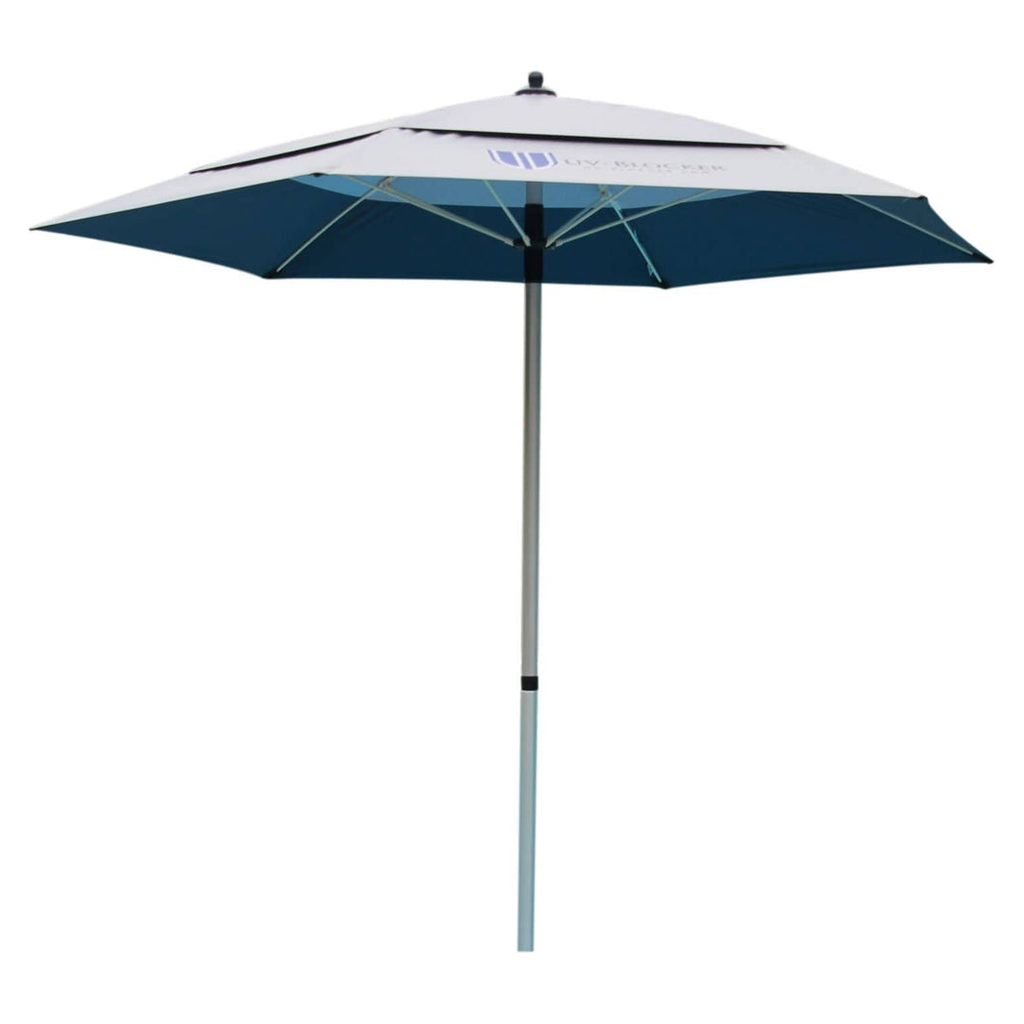
The UV-Blocker ServiceShield mounts magnetically to any flat steel surface, giving fleet and roadside technicians hands-free UPF 50+ shade with zero drilling.
Triple high-pull magnets attach the ServiceShield to a trailer sidewall, a tractor hood, a dock leveler, a service-truck body, or a steel shipping container wall in under 60 seconds, with no drilling and no permanent modification to the vehicle. That is the direct upgrade over the $141 bolt-on mount: the same idea of shade fixed to the vehicle, without the holes.
A 360-degree articulating arm lets a technician reposition the canopy as the sun moves during a longer repair call, without moving the truck or losing the shade angle. The canopy itself carries the same UPF 50+ Solarteck® fabric used across UV-Blocker's product line, independently tested to block 100% of UV-B radiation and 99.97% of UV-A radiation under AATCC TM183-2020 standards.
The ServiceShield is priced at $329.95. That sits above the $100 to $141 magnetic and bolt-on category and below a compliant pop-up tent or a full heat-stress station, while covering a use case neither of those products fits well: one technician needing hands-free overhead shade at the exact point of repair, not a shared break-area tent. It breaks down in roughly 30 seconds and stores in a service van alongside standard tools, which matters for a technician running several calls in a shift. Whether the buyer is an owner-operator equipping a single truck or a fleet manager outfitting a crew of mobile-repair technicians, the UV-Blocker ServiceShield product page has full specifications and current pricing.
How Should Fleet and Mobile-Repair Operators Build a Heat-Safety Plan?
A compliant plan pairs OSHA's water-rest-shade framework with a written heat-illness policy, acclimatization scheduling, and a shade tool assigned to each mobile unit.
Water. Cool drinking water needs to be provided at the repair site itself, whether that is the service vehicle or the roadside, not assumed to be available at a nearby gas station. OSHA's Water. Rest. Shade. campaign treats this as a baseline requirement, not a suggestion.
Rest. Break frequency should scale with heat conditions, and new hires or technicians returning from time off need an acclimatization period rather than a full workload on day one. General OSHA and NIOSH guidance recommends ramping from roughly half of normal heat exposure in the first few days to full exposure by around day eight.
Shade. This is the piece most fleet and roadside-repair operations skip entirely. A shade tool should be assigned per vehicle or per technician, not treated as shared equipment that has to be requested and coordinated between trucks before every call.
Documentation. OSHA's General Duty Clause enforcement increasingly expects a written heat-illness prevention plan on file, not a verbal policy. UV-Blocker's OSHA heat illness prevention plan for HVAC and roofing crews walks through what a documented plan should include, and the same structure generalizes cleanly to a fleet or repair-shop operation.
Dock-specific rules. Loading dock and container-yard work should be evaluated against the same heat-illness lens applied to warehousing generally. Sun protection for warehouse workers covers the loading-dock exposure pattern in more depth, including the indoor/outdoor transitions that make docks a distinct risk category.
The table below places the shade options this trade already buys side by side, so the price and mounting method are easy to compare at a glance.
| Shade Solution | Price | Mounting Method | Portable Between Vehicles? |
|---|---|---|---|
| Bolt-On Umbrella Mount (service trucks) | $141.00 | Drilled, permanent | No |
| Generic clamp umbrella | $18.99–$35.75 | Clamp | Limited |
| Magnetic umbrella holder (Trade Shade) | $100.49 | Magnetic, umbrella sold separately | Yes |
| Pop-up canopy tent | $199–$269 | Freestanding, staked or weighted | Yes, but slow setup |
| UV-Blocker ServiceShield | $329.95 | Magnetic, full canopy included | Yes |
Frequently Asked Questions About Sun Protection for Diesel Mechanics
Fleet managers, owner-operators, and technicians ask these questions most often when evaluating shade options for roadside and dock repair work.
Do diesel mechanics need sun protection if they mostly work in a shop?
Yes. BLS confirms diesel technicians occasionally repair vehicles on roadsides or at worksites, and that outdoor slice carries full, unshaded UV and heat exposure.
Even a small percentage of total work hours adds up over a career, and roadside calls tend to cluster in summer, exactly when heat and UV load are highest.
Does a loading dock count as an OSHA heat-illness risk area?
Yes. OSHA names warehousing as a heat-illness setting, and California's indoor heat rule applies to docks once the temperature reaches 82°F.
Dock crews and the technicians who service dock equipment and idling trailers both fall inside this category, even though a dock is not classified the same way as a fully outdoor job site.
Can a magnetic shade mount damage a truck's paint?
The ServiceShield uses a paint-safe magnetic base, unlike drilled bolt-on mounts that require permanent holes in the truck body.
That distinction matters most for leased trucks and any vehicle with a resale value or paint warranty to protect.
How much does the UV-Blocker ServiceShield cost?
The ServiceShield is priced at $329.95, above magnetic-holder-only products at $100.49 and below a compliant pop-up canopy tent at $199 to $269.
The price sits between those two categories because it covers a job neither one is built for: hands-free canopy shade fixed directly to the vehicle at the point of repair.
What surfaces does the ServiceShield attach to on a truck or dock?
Any large flat ferrous steel panel: trailer sidewalls, tractor hoods, dock levelers, service-truck bodies, or steel shipping container walls.
Non-magnetic surfaces, including most aluminum trailer skins and fiberglass panels, will not hold the magnetic base and are not a fit for this product.
Is the ServiceShield safe to use while the truck is being driven?
No. Like other magnetic shade mounts on the market, the ServiceShield is built for stationary use at a repair site, not while a vehicle is in motion.
Manufacturers of comparable magnetic holders warn against wind and highway-speed conditions for the same reason: a magnetic base is not a substitute for a permanent, drive-rated mount.
Conclusion
Sun protection for diesel mechanics is not about redesigning shop safety. It is about covering the roadside call, the dock repair, and the container-yard job that BLS already lists as part of the role, and that most safety programs never plan for. The trade has already shown it wants shade fixed to the vehicle, having paid $141 a unit to drill permanent mounts into service trucks for years.
A magnetic canopy removes the reason to drill. It attaches to the same trailer, hood, or dock leveler already at the job site, moves with the technician between calls, and leaves both hands free for the repair itself.
Fleet managers and owner-operators can start with one step: identify which vehicle or dock location handles the most roadside and outdoor calls, and equip that unit first. From there, expanding coverage across a crew is a matter of assigning one ServiceShield per mobile technician rather than sharing a single unit across trucks.
Frequently Asked Questions
What are the specific UV risks for Sun Protection for Diesel Mechanics?
Outdoor workers like Sun Protection for Diesel Mechanics typically accumulate 2–3× more UV exposure than indoor office workers. Chronic UV exposure increases melanoma and non-melanoma skin cancer risk significantly. OSHA recognizes UV radiation as a workplace hazard, and workers' compensation claims related to occupational UV exposure are rising. Proper sun protection is both a health and occupational safety requirement.
Does OSHA require sun protection for outdoor workers?
OSHA's General Duty Clause requires employers to protect workers from recognized hazards, including UV radiation. While no specific UV standard exists for most industries, OSHA guidance on heat illness prevention overlaps with UV protection. Several states have stronger outdoor worker heat and UV protection regulations. Employers should provide shade, schedule breaks, and supply sun protection equipment.
What sun protection equipment works best for active outdoor work?
For workers who need freedom of movement, the most effective combination is: (1) UPF 50+ work shirts and pants, (2) wide-brim hard hat or sun-protective hat, (3) SPF 50 water-resistant sunscreen on exposed skin, and (4) a portable clamp or magnetic-base UV umbrella that creates shade at a fixed workstation. UV-Blocker's ServiceShield umbrella was specifically designed for rooftop and outdoor workstation use.
How often should outdoor workers apply sunscreen during a shift?
Sunscreen should be reapplied every 2 hours, and immediately after heavy sweating or toweling off. Most outdoor workers underapply — dermatologists recommend 1 oz (shot glass amount) for full body coverage. Water-resistant SPF 50+ formulas last longer during sweating. Physical (mineral) sunscreens tend to be more stable under direct sun than chemical formulas.
What long-term skin damage should outdoor workers watch for?
Watch for actinic keratoses (rough, scaly patches), unusual moles or growths that change in size, shape, or color, and persistent sores that don't heal. Annual skin cancer screenings with a dermatologist are strongly recommended for outdoor workers with 10+ years of occupational sun exposure. Early detection dramatically improves outcomes.
Professional Sun Safety Protocol for Sun Protection for Diesel Mechanics
- Schedule intensive UV work (roof work, outdoor inspections) before 10am or after 4pm when UV index is lowest
- Use UV-blocking umbrella attachments at fixed workstations — they eliminate ambient UV exposure during breaks
- Establish a buddy system: coworkers check each other for missed sunscreen areas and early sunburn signs
- Keep sunscreen in the work vehicle or tool bag — accessibility increases compliance
- Document sun protection training in safety briefings — it creates legal compliance records and reinforces habits
- Consider UV-protective safety eyewear — eyes are often neglected in outdoor worker sun protection protocols
Frequently Asked Questions
What are the specific UV risks for Sun Protection for Diesel Mechanics?
Outdoor workers like Sun Protection for Diesel Mechanics typically accumulate 2–3× more UV exposure than indoor office workers. Chronic UV exposure increases melanoma and non-melanoma skin cancer risk significantly. OSHA recognizes UV radiation as a workplace hazard, and workers' compensation claims related to occupational UV exposure are rising. Proper sun protection is both a health and occupational safety requirement.
Does OSHA require sun protection for outdoor workers?
OSHA's General Duty Clause requires employers to protect workers from recognized hazards, including UV radiation. While no specific UV standard exists for most industries, OSHA guidance on heat illness prevention overlaps with UV protection. Several states have stronger outdoor worker heat and UV protection regulations. Employers should provide shade, schedule breaks, and supply sun protection equipment.
What sun protection equipment works best for active outdoor work?
For workers who need freedom of movement, the most effective combination is: (1) UPF 50+ work shirts and pants, (2) wide-brim hard hat or sun-protective hat, (3) SPF 50 water-resistant sunscreen on exposed skin, and (4) a portable clamp or magnetic-base UV umbrella that creates shade at a fixed workstation. UV-Blocker's ServiceShield umbrella was specifically designed for rooftop and outdoor workstation use.
How often should outdoor workers apply sunscreen during a shift?
Sunscreen should be reapplied every 2 hours, and immediately after heavy sweating or toweling off. Most outdoor workers underapply — dermatologists recommend 1 oz (shot glass amount) for full body coverage. Water-resistant SPF 50+ formulas last longer during sweating. Physical (mineral) sunscreens tend to be more stable under direct sun than chemical formulas.
What long-term skin damage should outdoor workers watch for?
Watch for actinic keratoses (rough, scaly patches), unusual moles or growths that change in size, shape, or color, and persistent sores that don't heal. Annual skin cancer screenings with a dermatologist are strongly recommended for outdoor workers with 10+ years of occupational sun exposure. Early detection dramatically improves outcomes.
Professional Sun Safety Protocol for Sun Protection for Diesel Mechanics
- Schedule intensive UV work (roof work, outdoor inspections) before 10am or after 4pm when UV index is lowest
- Use UV-blocking umbrella attachments at fixed workstations — they eliminate ambient UV exposure during breaks
- Establish a buddy system: coworkers check each other for missed sunscreen areas and early sunburn signs
- Keep sunscreen in the work vehicle or tool bag — accessibility increases compliance
- Document sun protection training in safety briefings — it creates legal compliance records and reinforces habits
- Consider UV-protective safety eyewear — eyes are often neglected in outdoor worker sun protection protocols