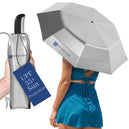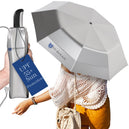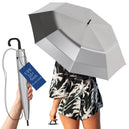


TLDR:
- Solo beachgoers need 6 feet of canopy minimum; couples need 7 feet; families of four need 7.5 feet or larger
- Coverage diameter (the shade circle on the ground) matters more than arc size printed on the label
- Standard umbrella fabric lets through up to 84% of UV rays; only UPF 50+ rated fabric blocks 98%+
- A 7.5-foot UPF 50+ umbrella at under 8 lbs hits the sweet spot for family coverage and portability
A 6-foot beach umbrella covers roughly 24 square feet of sand. A family of four with two chairs and a cooler needs at least 40.
That gap is where sunburns happen. Most buyers pick beach umbrellas by price or portability without checking whether the canopy actually covers their group.
This beach umbrella size guide breaks down coverage area by diameter, explains the measurements that actually matter, and identifies the minimum size for solo, couple, and family setups. Size is only half the equation, though. Fabric quality determines whether shade protects or just casts a shadow.
How Big Should a Beach Umbrella Be?
A solo beachgoer needs a 6-foot umbrella minimum, couples should choose 7 feet, and families of four or more need 7.5 feet or larger for full coverage.
The math here is straightforward. Umbrella diameter translates directly to shade area on the ground, and most people underestimate how much space their beach setup actually occupies.
Solo (1 person): A 5-6 foot diameter umbrella provides 20-24 square feet of shade. That covers one chair and a bag, with a small buffer as the sun shifts angles throughout the afternoon.
Couples (2 people): A 7-foot diameter umbrella delivers approximately 38 square feet of coverage. Two standard beach chairs placed side by side fit comfortably, with enough margin that both people stay shaded even as the sun tracks westward after noon.
Families (3-4 people): A 7.5-foot diameter umbrella provides roughly 44 square feet of shade. That covers two adult chairs, a children's play area, and a cooler. The UV-Blocker 7.5ft Large Beach Umbrella delivers an 88-inch coverage diameter at this size, which translates to over 42 square feet of usable shade.
Large groups (5+): Groups of five or more should consider an 8-9 foot umbrella or a pair of 7.5-foot umbrellas spaced to overlap shade coverage.

| Group Size | Minimum Diameter | Coverage Area | Example Setup |
|---|---|---|---|
| 1 person | 6 ft | ~24 sq ft | One chair + bag |
| 2 people | 7 ft | ~38 sq ft | Two chairs side by side |
| 3-4 people | 7.5 ft | ~44 sq ft | Two chairs + kids + cooler |
| 5+ people | 8-9 ft | 50-63 sq ft | Multiple chairs + gear |
One practical rule: size for one more person than your actual count. The sun's angle changes throughout the day, and what feels like full shade at 11 a.m. can leave someone fully exposed by 2 p.m. Buying one size up costs a few extra dollars but eliminates the midday shade shuffle.
What Do Beach Umbrella Measurements Actually Mean?
Arc size measures the curved canopy from edge to edge, while coverage diameter measures the flat shade circle on the ground. Coverage diameter determines how much sand stays shaded.
These two measurements confuse nearly every buyer, and manufacturers don't make it easier. A product labeled "7.5-foot beach umbrella" might be referencing arc size, canopy diameter, or coverage diameter, and the actual shade footprint changes significantly depending on which one.
Arc Size vs. Coverage Diameter
Arc size traces the curve of the canopy from one edge up over the top and down to the opposite edge. Because the fabric curves, arc size always reads larger than the shade it casts. A 7.5-foot arc umbrella doesn't produce 7.5 feet of shade on the ground.
Coverage diameter measures the flat circle of shade the canopy throws onto the sand. This is the number that matters for planning a seating layout. The UV-Blocker 7.5ft model, for example, has a 90-inch arc but an 88-inch coverage diameter, meaning the shade footprint nearly matches the arc measurement because of the canopy's wide, flat profile.
Pole Height
Taller poles cast wider shade at high noon when the sun is directly overhead, but the shade narrows and shifts faster during morning and late afternoon hours. Most beach umbrellas use poles between 6 and 7 feet, which strikes a reasonable balance for all-day use.
The Comparison Trap
When comparing two "7.5-foot" umbrellas from different brands, always check which measurement the manufacturer used. One brand's 7.5-foot arc might deliver 70 inches of coverage diameter, while another's 7.5-foot coverage diameter delivers a full 88 inches of ground shade. Comparing by coverage diameter puts every product on the same playing field.
Does Beach Umbrella Fabric Affect UV Protection?
Standard beach umbrella fabric blocks as little as 55% of UV rays, while UPF 50+ rated fabric blocks over 98%, making fabric the true divider between shade and sun protection.
This is the part of the beach umbrella size guide most articles skip entirely. A large umbrella that casts 60 square feet of shade sounds impressive, but if the fabric lets UV radiation pass through, everyone underneath is still accumulating sun damage.
The JAMA Sunburn Study
A 2017 randomized clinical trial published in JAMA Dermatology put this to the test. Researchers split 81 participants into two groups at a beach near Dallas, Texas: one group sat under a standard beach umbrella for 3.5 hours during peak sun (10 a.m. to 2 p.m.), and the other applied SPF 100 sunscreen.
The results were stark. 78% of participants under the umbrella got sunburned, compared to 25% of the sunscreen group. The umbrella shade alone failed to protect the majority of users.
Why Standard Shade Falls Short
UV radiation doesn't only come from directly overhead. It scatters through clouds, bounces off sand and water, and reaches skin from angles the canopy doesn't cover. Earlier UV transmission studies found that standard beach umbrella fabric offers the equivalent of SPF 3-10, meaning up to 84% of UV radiation can still reach the skin underneath.
UPF 50+ Changes the Equation
Fabric rated UPF 50+ blocks a fundamentally different percentage of radiation. UV-Blocker's Solarteck fabric, for example, is independently tested to block 100% of UV-B and 99.97% of UV-A radiation per the AATCC TM183-2020 standard. The silver reflective exterior bounces both UV and infrared heat away from the canopy instead of absorbing it, resulting in temperatures roughly 15 degrees Fahrenheit cooler underneath compared to direct sunlight.
That reflective design matters for comfort as much as protection. Dark-colored absorptive fabrics trap heat underneath the canopy, turning the shade into a warm pocket. A silver reflective canopy with a dark navy underside (to reduce glare from below) provides genuine cooling alongside UV protection.

| Umbrella Type | UV Blocked | Equivalent SPF | Temperature Under Shade |
|---|---|---|---|
| Standard (untested) | 55-66% | SPF 3-10 | Minimal cooling |
| UPF 30 rated | 96.7% | ~SPF 30 | Moderate cooling |
| UPF 50+ (Solarteck) | 99.97% | ~SPF 2000 | 15F cooler |
How to Pick the Right Beach Umbrella for Your Setup
Match umbrella diameter to your group size, confirm UPF 50+ fabric rating, then check weight and pole diameter for the wind conditions at your beach.
Choosing the right beach umbrella comes down to four factors in order of importance:
1. Size for your group plus one. Count the people who'll share the shade, then size up by one. If three people are coming, buy for four. The sun's angle shifts throughout the day, and that extra coverage prevents the 2 p.m. scramble where someone ends up sitting in full sun.
2. Check the UPF rating on the label. If a beach umbrella has no UPF rating printed on the product or packaging, assume it offers SPF 3-10 protection at best. UPF 50+ is the gold standard. Anything rated UPF 30+ provides reasonable protection, but UPF 50+ blocks 98%+ of harmful UV.
3. Weigh portability against coverage. A 7.5-foot umbrella doesn't have to be a burden. The UV-Blocker 7.5ft weighs 7 lb 8 oz, light enough for one person to carry from the car to the waterline. As a general rule, anything under 8 pounds stays manageable for a solo carry. Over 12 pounds typically needs two people.
4. Check pole diameter for stability. A 1.5-inch pole resists wind better than a 1.25-inch pole and fits most aftermarket sand anchors. For windy beaches, a thicker pole combined with a vented canopy (which lets gusts pass through instead of catching them) prevents the umbrella from becoming a flying hazard.
One more thing: always use a sand anchor. Even large, heavy umbrellas can blow away or become projectiles in a sudden gust. The sand-lock anchoring technique takes 60 seconds and can prevent a trip to the ER. Carry bags typically come included; sand anchors are usually sold separately.
Frequently Asked Questions About Beach Umbrella Sizes
These are the most common beach umbrella sizing questions, each answered with specific measurements and practical recommendations to help match the right canopy to any beach setup.
Is a 6-Foot Beach Umbrella Big Enough for Two People?
A 6-foot umbrella provides roughly 24 square feet of shade, which is tight for two adults with chairs. A 7-foot umbrella adds approximately 14 more square feet and comfortably fits two people side by side with room for bags and a cooler between them. For couples, 7 feet is the practical minimum.
What Size Beach Umbrella Do I Need for a Family of Four?
A family of four needs at least a 7.5-foot umbrella, which provides approximately 44 square feet of shade. That covers two adult chairs, a play area for kids, and a cooler. Anything smaller forces the group to rotate in and out of shade as the sun moves.
Does a Bigger Beach Umbrella Protect Better From UV?
A bigger umbrella casts more shade, but UV protection depends on fabric quality. An untested 9-foot umbrella can let through more UV than a UPF 50+ rated 7-foot umbrella. Size determines how many people fit under the shade. Fabric determines whether that shade actually blocks radiation.
How Much Does a Large Beach Umbrella Weigh?
Most 7-7.5 foot beach umbrellas weigh between 5 and 10 pounds. The UV-Blocker 7.5ft weighs 7 lb 8 oz with its carry bag. As a reference point, anything under 8 pounds is manageable for a single person to carry from the parking lot to the beach, even with other gear.
Can Wind Blow Over a Large Beach Umbrella?
Any beach umbrella can blow over without proper anchoring, regardless of size or weight. Screw-in sand anchors rated for the umbrella's pole diameter provide the most secure hold. Vented canopy designs let wind pass through instead of catching it like a sail, further reducing blowover risk. The combination of a proper anchor and a vented canopy keeps most umbrellas stable in moderate coastal winds.
Conclusion
The right beach umbrella isn't the biggest or the cheapest. It's the one sized for the group and built with fabric that actually blocks UV.
- Match diameter to group: 6 feet for solo, 7 feet for couples, 7.5 feet or larger for families
- Compare by coverage diameter, not arc size. Coverage diameter is the shade footprint on the ground, and it's the only measurement that tells the truth about how much sand stays shaded
- Demand UPF 50+ fabric. Standard beach umbrella shade lets through up to 84% of UV radiation. UPF 50+ blocks 98%+. The difference is sunburn vs. actual protection
- Keep weight under 8 lbs to ensure a family-size umbrella stays portable enough for one person to carry
Before the next beach trip, measure the typical setup: count chairs, add a cooler footprint, and check that measurement against the sizing table above. If it doesn't fit under the current umbrella's coverage diameter, it's time to size up.
The UV-Blocker 7.5ft Large Beach Umbrella delivers 88 inches of UPF 50+ coverage at 7 lb 8 oz. Sized for a family of four, light enough for one person to carry, and built with Solarteck reflective fabric that keeps the shaded area 15 degrees cooler than direct sunlight. Carry bag included; Long Sand Anchor recommended, sold separately.
How Beach Umbrella Size Affects UV Protection: The Data You Need
Size and UV protection are directly linked — but not in the way most people assume. A larger canopy doesn't automatically mean better UV blocking; the fabric's UPF rating and coating matter far more than raw diameter. Here's what the research actually shows:
- Standard 6-foot beach umbrellas block only 77% of UV rays on average, according to a 2017 JAMA Dermatology study. That's equivalent to SPF 3.5 — far below the SPF 15 minimum dermatologists recommend.
- Angle matters as much as size. A 7-foot umbrella tilted at 45° can leave your legs fully exposed if you're not positioned correctly. Studies show that without tilt capability and a low sit height, up to 34% of reflected ground UV still reaches skin under the canopy.
- For two adults sitting in standard beach chairs, a 6.5-foot canopy is the practical minimum. For a family of four, 7.5 feet or larger is needed to keep everyone in shade when the sun is low on the horizon.
Choosing Size by Activity
| Use Case | Recommended Canopy Size | Key Requirement |
|---|---|---|
| Solo beachgoer | 5–6 ft | UPF 50+ rating + tilt |
| Couple in beach chairs | 6.5–7 ft | UPF 50+ + wind vents |
| Family (3–4 people) | 7.5–8 ft | Sand anchor + UPF 50+ |
| Sports sideline shade | 7.5–9 ft | Pole stability + UPF 50+ |
The key insight: a UV-blocking coating is non-negotiable regardless of size. UV-Blocker's umbrellas use Solarteck® silver-reflective technology that blocks 99.97% of UV-A and 100% of UV-B — tested under AATCC TM183-2020 — making them effective even at compact 6-foot sizes that standard umbrellas can't match at 8 feet.