

TLDR:
- No single method covers the whole face. Every option has a site where it measurably fails.
- Sunscreen reaches the most facial territory, including eyelids and lips, but most people apply only 20-50% of the tested dose, and protection falls as the square root of that shortfall.
- A baseball cap gives the chin roughly 19.5% protection and the lips roughly 30%, measured on a mannequin in Peru. A wide brim still leaves the chin near 71.8%.
- In a UV-camera study of 57 people, 44 failed to fully cover the inner corner of the eye. Being told about eyelid cancer did not fix it.
- Handheld umbrellas blocked 77% to 99% of UV beneath the canopy, but in a beach trial 78% of umbrella-only users still burned, because UV arrives from the side and off the ground.
- Shade first, then a 3-inch brim, then wraparound sunglasses, then a properly dosed broad-spectrum SPF 30 or higher. The stack works; no single layer does.
Most skin cancers show up on the head and neck. The nose alone accounts for up to a quarter of those cases.
That is a small amount of real estate carrying a large share of the risk. It is also the part of the body hardest to cover, because the face is not a flat surface and nothing worn on it covers all of it.
This guide ranks the six realistic options by what has actually been measured, site by site, from the nose to the jaw.
Why is the face the hardest part of the body to protect?
The face concentrates risk into a small, uneven, permanently exposed area, and no single product covers every part of it at once.
Nonmelanoma skin cancers are the most common malignancies worldwide, and the majority of cases affect the head and neck. Within that group, the nose is affected in up to 25% of cases, according to a 2024 review in Current Opinion in Otolaryngology. The Skin Cancer Foundation puts the share of nonmelanoma skin cancers associated with UV exposure at about 90%.
Cosmetic damage follows the same pattern. In a study of 298 Caucasian women aged 30 to 78 living in southern France, roughly 80% of visible facial aging signs were sun-associated. The figure is a ratio of catalogued signs rather than proof of cause, and the researchers were affiliated with L'Oreal and Biotherm, so it is best read as one cohort's observation rather than a universal law.
The five sites where face protection breaks down
Protection does not fail evenly. It fails in five specific places:
- The nose, which projects forward and catches sun from almost every angle.
- The ears, which sit outside the shadow of most headwear and get forgotten entirely.
- The lips, which have almost no melanin and rarely get a dedicated product.
- The eyelids, and especially the inner corner beside the nose.
- The area under the chin and along the jaw, which is reached mainly by UV bouncing up off the ground.
Sunscreen and fabric are measured on different scales, which trips people up. The short version is that SPF describes a lotion and UPF describes a fabric, and the full UPF versus SPF explainer covers the rest.
What is the best sun protection for the face? Six methods, ranked
Sunscreen ranks first on raw coverage, wide-brim hats second, sunglasses third for the eyelids, and UV umbrellas first among the hands-free physical barriers.
The table below scores each method against the five problem sites. Figures come from published measurements, and the sources are named underneath.
| Method | Measured face protection | Nose | Ears | Lips | Eyelids | Under-chin / jaw | Real-world compliance | Reapply? |
|---|---|---|---|---|---|---|---|---|
| Broad-spectrum SPF 30+ sunscreen | Up to the label SPF at the tested 2 mg/cm2 dose; most people apply 20-50% of it | Covered | Covered | Covered only with a dedicated lip product | Covered, but 44 of 57 people missed the inner corner | Covered | 42.6% of women and 18.1% of men use it regularly on the face | Yes, roughly every 2 hours |
| Baseball cap | 44.5% median across the face | 67.0% | Best-protected site, but hat types did not differ significantly | 30.0% | None | 19.5% | High, worn without thinking | No |
| Wide-brim hat, 3in or more | 83.1% median across the face | 92.9% | Best-protected site, but hat types did not differ significantly | 87.6% | Partial, via shadow only | 71.8% | Moderate, often left at home | No |
| Wraparound UV sunglasses | Not quantified as a share of the face | None | Partial, at the temples | None | The only real barrier for this site | None | High once bought and worn | No |
| Sun visor | Not measured separately | Similar to a cap | None | Minimal | None | None | High | No |
| UV umbrella, verified UPF 50+ | 77% to 99% of UV blocked beneath the canopy across 23 umbrellas tested | Covered while beneath it | Covered | Covered | Covered | Covered | Must be carried and held | No |
| Seeking shade | UPF 1.5 to 5.4 for fixed public shade canopies measured in winter | Varies | Varies | Varies | Varies | Varies | Free, but depends entirely on the structure | No |

The ranking follows a simple rule: coverage first, then whether people actually do it. Sunscreen wins on coverage and loses on compliance. Hats win on compliance and lose on the lower face. Nothing wins on both.
Does sunscreen really protect your whole face?
Sunscreen reaches more of the face than any other method, including eyelids and lips, but the dose people apply is usually far below the amount the label was tested at.
Sunscreen deserves its top ranking on coverage. It is the only option that reaches the eyelid margin, the vermilion of the lips and the shadow under the nostrils. Fabric and shade cannot follow those contours.
The problem is arithmetic. SPF is measured in the lab at a film of 2 milligrams per square centimetre, a figure written into FDA regulation 21 CFR 201.327. The American Academy of Dermatology notes that many individuals apply only about 20-50% of the amount needed to reach the SPF on the label.
That gap does not scale politely. Research in the British Journal of Dermatology found that SPF falls as the square root of the labelled value at half the tested dose. A bottle marked SPF 50, applied at half thickness, is delivering something closer to SPF 7.
How much sunscreen the face actually needs
The AAD's own measure is concrete: at least one teaspoon for the face, which is roughly the amount needed to cover the length of the index and middle fingers. That is considerably more than most people squeeze out.
Then there is whether it goes on at all. In a CDC analysis of the 2013 Summer ConsumerStyles survey of US adults, 42.6% of women and 18.1% of men reported regularly using sunscreen on the face, where regularly meant always or most of the time when outside for more than an hour on a warm, sunny day.
The AAD states the conclusion plainly: sunscreen alone cannot fully protect you. Use it, dose it properly, reapply it roughly every two hours, and stop treating it as the complete answer.
Is a hat enough to protect your face from the sun?
No. A hat is a roof with no walls, so it protects the upper face well and leaves the lower face exposed to UV arriving from the side and from below.
The most useful numbers here come from an experimental letter published in 2026 in Peru's national public health journal. Researchers placed 20 pieces of headwear on a mannequin in Ica, Peru, and logged UV at five facial sites hourly from 09:00 to 15:00 with a radiometer. Median protection came out at 44.5% for caps, 62.0% for walking hats and 83.1% for wide-brim hats.
The site-by-site breakdown is where it gets interesting.
| Facial site | Cap | Walking hat | Wide-brim hat |
|---|---|---|---|
| Nose | 67.0% | 82.9% | 92.9% |
| Lips | 30.0% | 55.5% | 87.6% |
| Neck | 38.7% | 47.3% | 75.6% |
| Chin | 19.5% | 32.7% | 71.8% |
The chin is the standout, and it is also the only site where all three headwear types differed significantly from each other. A baseball cap leaves the chin at roughly 19.5% protection and the lips at 30%. Even the wide brim only pulls the chin up to 71.8%.
Two honest caveats belong with those figures. The measurements come from a single stationary mannequin, and the authors say plainly that the values probably overestimate protection in real use, because people move and turn their heads. The ear results, often the most flattering, were not statistically significant.
Brim width is the lever that matters. Diffey and Cheeseman established in 1992 that hats need a brim wider than 7.5 cm, close to 3 inches, to deliver a protection factor above 3 around the nose and cheeks. Their work also found that peaked baseball-style caps protect the nose reasonably well but are relatively ineffective elsewhere on the face, which is exactly the pattern the Peru data reproduced 34 years later.
Buy the 3-inch brim. Just know its floor. The coverage math behind hats and umbrellas goes deeper on the geometry.
Do sunglasses protect the eyelids people keep missing?
Yes, and this is the one site where a physical barrier clearly beats sunscreen, because people demonstrably fail to apply sunscreen to the eyelid region.
Researchers at the University of Liverpool photographed 57 people with a UV camera after they applied sunscreen. The results, published in PLOS ONE, found a median 14% of the eyelid region missed against 7% for the rest of the face.
The medial canthus, the inner corner of the eye beside the nose, fared worst. Of the 57 participants, 44 failed to fully cover it, meaning the imaging detected at least some uncovered skin there.
Then the researchers tried to fix it. Participants returned two weeks later, this time given written information about eyelid cancer first. Eyelid misses improved slightly to a median 10%, but 37 of 57 still could not cover the medial canthus, and that change was not statistically significant. Being told did not work.
Participants explained why: stinging, assuming their sunglasses already handled it, awkwardness, and makeup. Which is the argument for the sunglasses doing it properly. The AAD warns that lenses that appear dark do not necessarily offer UV protection, and that large-framed or wraparound sunglasses offer more sun protection than aviators.
Where do visors and face shields fit?
Visors protect the forehead and part of the nose and leave everything else open, which makes them a partial upgrade on nothing rather than a real face protection method.
A visor is a brim without a crown. It shades the forehead and casts a limited shadow over the nose, and offers effectively nothing to the ears, lips, chin or jaw. The scalp is left fully exposed as well.
Clear plastic face shields, the kind sold for glare, are not UV products unless the material is specifically rated, and most are not. Neither belongs above a hat in the ranking. Both are listed here because leaving them out would make the table look more flattering to the alternatives than the evidence supports.
How well do UV umbrellas protect the face?
An umbrella shades the entire face at once, including the lower face that hats miss, but it only works while it is overhead and it does not stop UV bouncing in from the side.
The CDC lists shade first among sun protection methods, ahead of clothing, hats, sunglasses and sunscreen, advising people to stay in the shade under an umbrella, tree, or other shelter.
The measurements back that ordering. A JAMA Dermatology research letter tested 23 handheld umbrellas at UV index 8 and found they blocked between 77% and 99% of UV beneath the canopy. Black rain umbrellas all blocked at least 90%, and most blocked more than 95%. A silver, sun-specific model topped the range at 99%.
Two findings the category would rather not publish
The first concerns claims. A 2024 study in Cureus looked at 37 sun-protection umbrellas from the 13 most-searched brands. All 10 handheld umbrellas claimed UPF 50+. Only 2 of those 10 could produce supporting test data when asked. It is worth being precise about what that study did: no umbrella was independently tested in a lab. The authors emailed the brands and gave them a week to supply documentation, and a non-reply counted the same as a false claim.
The second concerns geometry. A randomised trial of 81 people spending 3.5 hours at midday by a Texas lake found that 32 of 41 people in the umbrella-only group developed sunburn at one or more sites, against 10 of 40 in the sunscreen-only group. The conclusion was blunt: neither method alone completely prevented sunburn.
The detail that matters is why. The umbrella fabric itself showed no detectable UV transmittance on a spectrophotometer. The burns came from UV scattering in from the sides and reflecting off the ground, and from people drifting out from under the canopy. That trial also warrants a disclosure: it was part-funded by Johnson & Johnson, which owns the maker of the sunscreen tested, and all six authors had ties to the company.
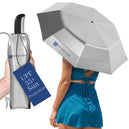
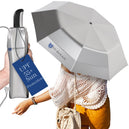
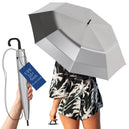
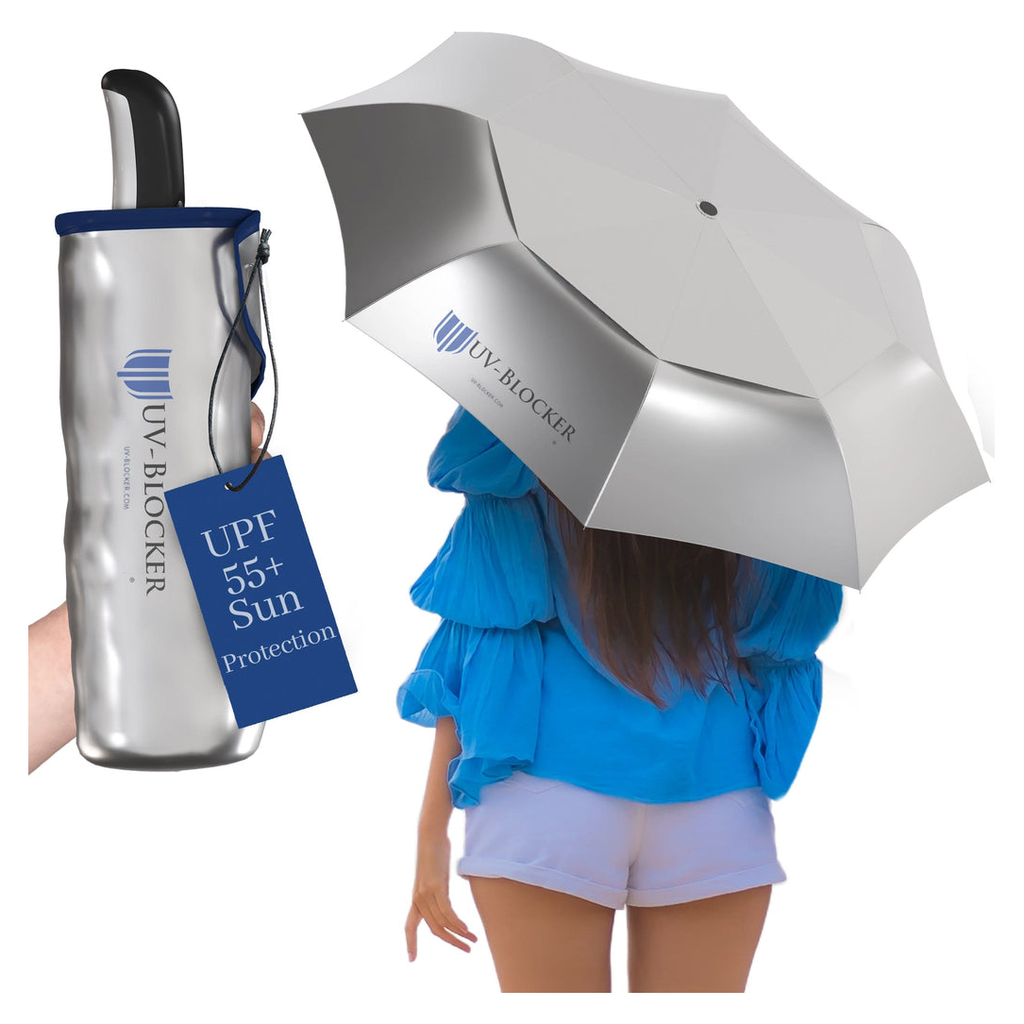
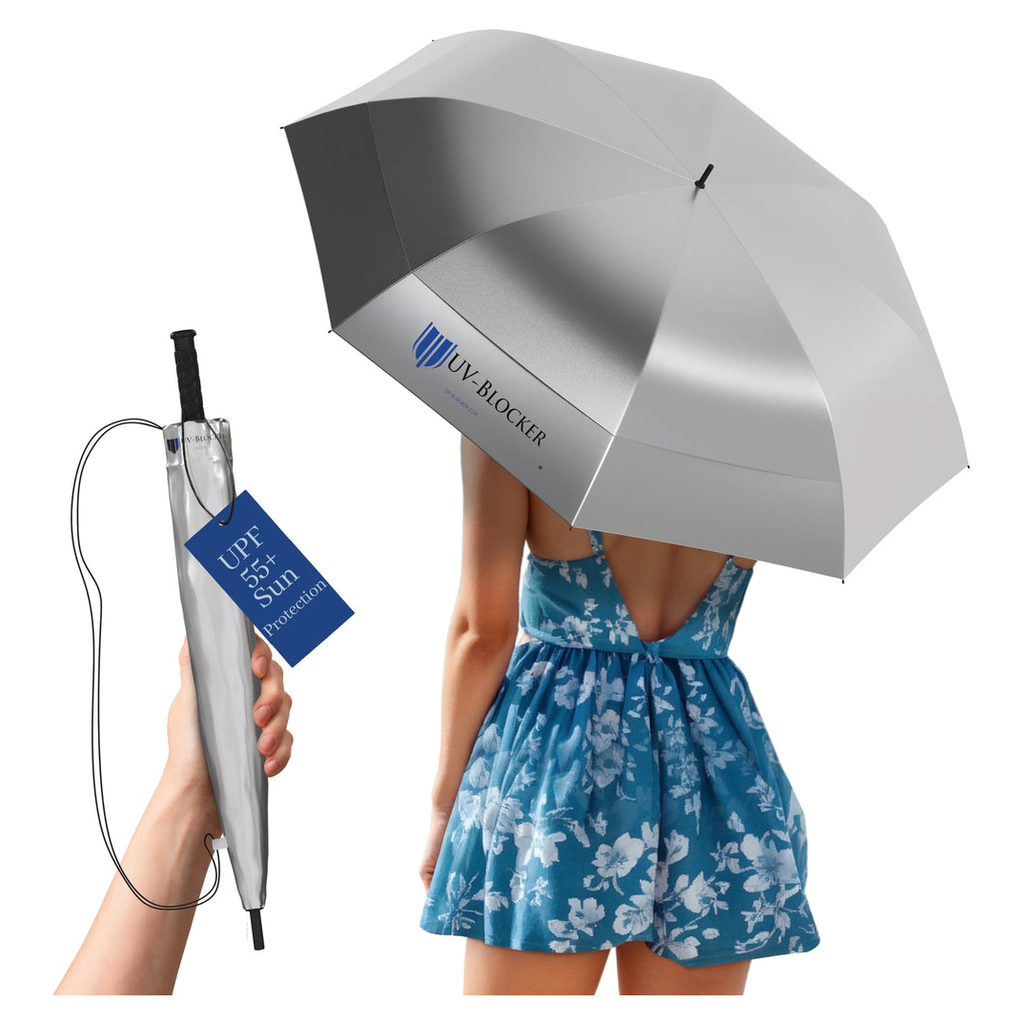
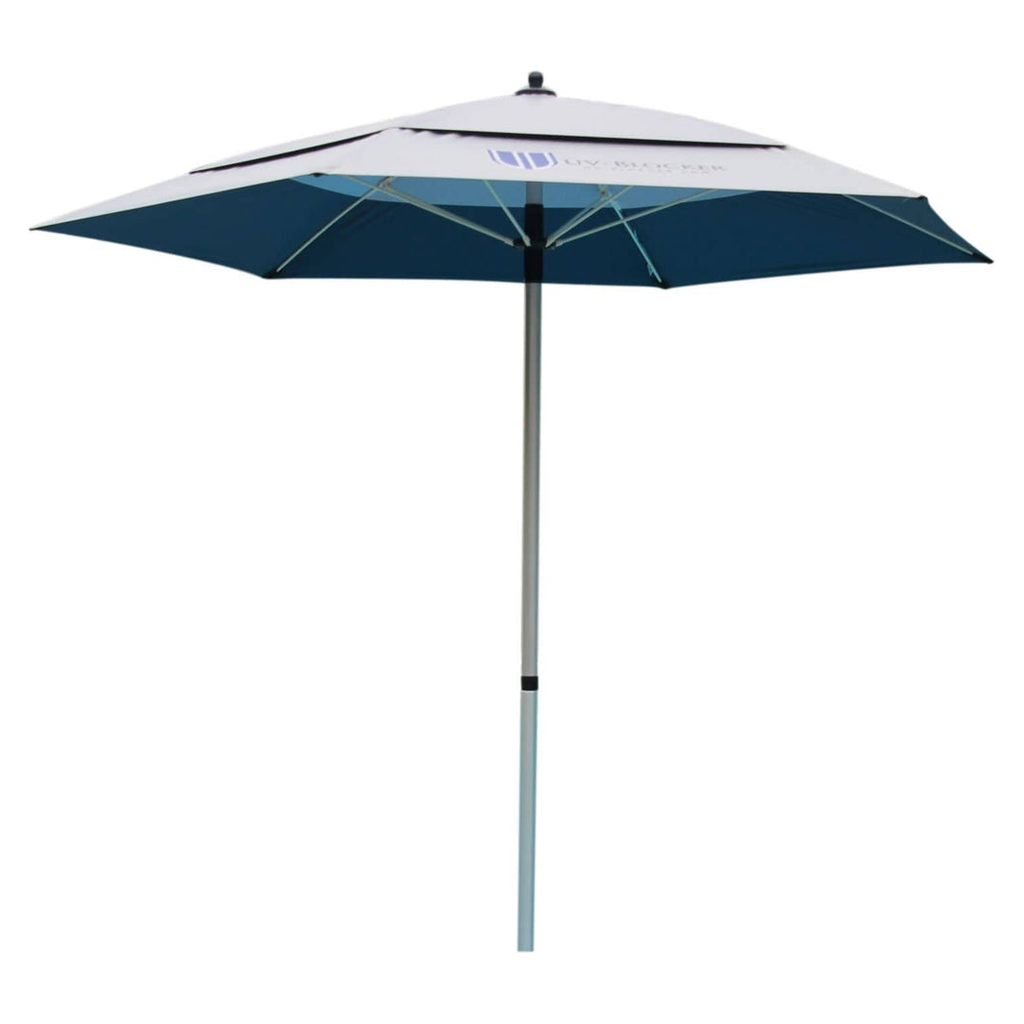
UV-Blocker's own answer to the documentation problem is to publish the test: AATCC TM183-2020 tested, 100% UV-B and 99.97% UV-A blocked, on a Solarteck® silver reflective canopy. The Compact UV Umbrella is the everyday-carry version at $59.95, and the wider UPF 50+ umbrella range covers golf, beach and travel sizes. The research comparison is set out in more detail in what the umbrella studies actually show.
How much protection does shade actually give?
Less than people assume. Fixed shade structures have been measured at protection factors low enough that a person sitting under one can still burn.
Australian researchers measured three public shade structures and found ultraviolet protection factors ranging from 1.5 to 5.4. Those readings were taken in winter under clear skies in Queensland, so they are not a summer beach number, but they make the point: shade is a range, not a guarantee.
The reason is that UV does not travel only downward. The World Health Organization notes that snow can reflect as much as 80% of UV radiation, dry beach sand about 15% and sea foam about 25%, while grass, soil and water reflect less than 10%. Sky-scattered UV adds to that from every direction.
This is why the CDC pairs its shade advice with a second sentence that often gets dropped: the best protection is to use sunscreen and wear protective clothing even while in the shade.
What does a face protection stack look like?
Layer by failure point: shade or an umbrella overhead, a 3-inch brim for the nose, wraparound sunglasses for the eyelids, and properly dosed sunscreen for everything fabric cannot follow.
The order below is built from where each method breaks down rather than from product categories:
- Start with overhead shade. A tree, a structure or a UPF 50+ umbrella removes most of the direct overhead UV before anything else has to work.
- Add a brim of 3 inches or more. It handles the nose and upper face and travels better than shade does.
- Wear wraparound sunglasses. This is the eyelid layer, and it is the one that sunscreen reliably fails to cover.
- Apply broad-spectrum SPF 30 or higher at the full dose. One teaspoon for the face, two fingers' length, reapplied roughly every two hours.
- Use a dedicated lip product with SPF. In a Spanish study of patients with actinic cheilitis, more than 90% had never used lip photoprotection at all.
- Check the under-chin and jaw. This is the ground-reflection zone, and it is the site every hat in the Peru data protected worst.
Worth stating plainly: UV-Blocker sells umbrellas and holders, not sunscreen, hats or sunglasses. The recommendations above for those three categories carry no commercial interest. Readers looking specifically to reduce their reliance on lotion will find more detail in the sunscreen alternative guide.
Frequently asked questions
Short answers to the questions people ask most often about protecting the face from the sun, drawn from the measurements above.
What is the best sun protection for your face?
A layered combination. On raw coverage sunscreen ranks first, because it is the only method that reaches eyelids, lips and the shadow under the nose. On real-world reliability it slips, because most people underapply it. The best sun protection for the face in practice is overhead shade plus a wide brim plus wraparound sunglasses plus properly dosed broad-spectrum sunscreen.
How can I protect my face from the sun without sunscreen?
Use physical barriers and stack them. An umbrella with a verified UPF 50+ rating shades the whole face including the lower half, a brim of 3 inches or more handles the nose, and wraparound sunglasses cover the eyelids. The gap left behind is the lips, so a lip product with SPF is worth keeping even in a sunscreen-free routine.
Is a hat enough to protect your face from the sun?
No. In the Peru measurements a baseball cap gave the chin about 19.5% protection and the lips about 30%. A wide-brim hat improved that considerably but still left the chin near 71.8% and the neck near 75.6%, because a brim does nothing about UV arriving from the side or reflecting off the ground.
How much sunscreen do I actually need on my face?
At least one teaspoon, which the AAD describes as roughly the amount needed to cover the length of the index and middle fingers. Applying half of that does not halve the protection. Because SPF falls as the square root of the labelled value at half dose, an SPF 50 product applied thinly behaves closer to SPF 7.
Which parts of the face do people miss most when applying sunscreen?
The eyelids, and above all the inner corner of the eye. In a UV-camera study of 57 people, a median 14% of the eyelid region was missed against 7% for the rest of the face, and 44 of the 57 failed to fully cover the medial canthus. Handing participants information about eyelid cancer did not produce a significant improvement.
Do I still need sunscreen if I'm in the shade or under an umbrella?
Yes. Measured public shade structures delivered protection factors as low as 1.5 to 5.4, and in a beach trial 78% of people using only an umbrella still developed sunburn, because UV reflects off sand and scatters in from the sky. The CDC advises using sunscreen and protective clothing even while in the shade.
The bottom line
The face is not one surface and it does not have one answer. Sunscreen covers the most ground and is applied at a fraction of the dose it was tested at. Hats protect the upper face well and abandon the chin. Sunglasses are the only reliable eyelid barrier. Umbrellas and shade handle the whole face at once and lose to UV coming in sideways.
Ranked honestly, the best sun protection for the face is the stack, ordered by where each layer fails.