Free Shipping on US Orders!
 Dermatologist Approved
 Designed for Maximum Sun Protection


Between 1992 and 2022, 986 workers died from environmental heat exposure on the job. Construction trades account for a third of those deaths despite employing only 6% of the American workforce. HVAC technicians working on commercial rooftops sit squarely in the highest-risk category.
Most HVAC companies believe their heat safety program works. They provide water, sunscreen, and break time. But their crews still end up in emergency rooms. The issue is not a lack of effort. The issue is that common approaches miss how rooftop heat actually works.
TLDR:
- Sunscreen prevents sunburn but does nothing to prevent heat stroke, which is a thermal problem, not a UV problem
- Weather apps underestimate rooftop heat by 15-30F because they measure shaded air temperature, not radiant surface heat
- OSHA requires water, rest, AND shade, but most rooftop HVAC work provides zero shade infrastructure
- Over 70% of heat fatalities happen in a worker's first week of heat exposure, including experienced veterans returning from time off
- Heat safety triggers start at 80F heat index, which hits in April across the southern U.S., not just summer months

What Critical Mistakes Break Down Rooftop Heat Safety HVAC Programs?
Most HVAC heat safety programs fail because they address compliance checkboxes rather than the actual thermal physics of commercial rooftop work environments.
OSHA conducted approximately 2,400 heat-related inspections annually between 2022 and 2025, including around 50 fatality investigations each year. Even with active enforcement, heat-related deaths persist across the construction industry. The gap between "having a program" and having an effective program continues to widen.
The numbers tell a stark story. Construction workers make up roughly 6% of the U.S. workforce but account for 34% of all occupational heat deaths over the past three decades. That ratio suggests a systemic failure in how the industry approaches heat, not just isolated incidents.
And these figures likely undercount the problem. A California workers' compensation study found that heat-related injuries were three to six times higher in state workers' comp data compared to what employers reported to BLS. The real numbers across the country could be far worse.
The five mistakes below explain where rooftop heat safety HVAC programs break down. Each one is common, each one is fixable, and each one is still sending techs to the hospital.
Is Sunscreen Enough to Prevent Rooftop Heat Illness?
Sunscreen prevents sunburn but does nothing to prevent heat stroke. Most rooftop heat illness is thermal, not UV-related, making sunscreen an incomplete safety measure.
There is a critical distinction that many safety programs overlook. Sunburn is UV damage to skin cells. Heat stroke is a failure of the body's thermoregulation system when core temperature exceeds 104F. These are separate physiological mechanisms. Sunscreen addresses the first problem. It has no effect on the second.
A technician wearing SPF 50 sunscreen on a 160F commercial rooftop is protected from UV radiation. That same technician can still collapse from heat exhaustion because nothing about sunscreen reduces their core body temperature, improves evaporative cooling, or blocks radiant thermal load from the roof surface.
This matters because checking the "sunscreen provided" box on a safety form gives companies a false sense of security. Sunscreen belongs in every outdoor safety program for skin cancer prevention. But counting it as a heat illness control is like counting a hard hat as fall protection.
The correction: Treat sunscreen as one layer in a multi-layer approach. Pair it with thermal mitigation strategies including shade, cooling periods, acclimatization schedules, and WBGT monitoring.
Why Is Weather App Temperature Wrong for Rooftop Work?

Weather app temperatures measure air conditions at shaded weather stations, not the radiant heat on commercial rooftops that can reach 150-180F and significantly increase heat stress risk.
A weather app reading of 95F comes from a thermometer mounted inside a ventilated shelter at a weather station, typically over grass, at about five feet above ground. A technician standing on a dark commercial roof membrane is working in a completely different thermal environment.
Commercial rooftop surface temperatures reach 150-190F on dark membrane roofs, even when the air temperature reads 95F. That radiant heat reflects upward from the surface, creating a thermal envelope that surrounds anyone working on the roof from below and above simultaneously.
Wet Bulb Globe Temperature (WBGT) is the metric designed for exactly this scenario. Unlike standard thermometers, WBGT combines three measurements: dry-bulb air temperature, wet-bulb temperature (accounting for humidity and evaporative cooling), and globe temperature (capturing radiant heat from surfaces, sun, and equipment).
| Condition | Weather App | Estimated Rooftop WBGT | OSHA Action Level |
|---|---|---|---|
| Moderate day | 85F | 90-95F WBGT | Precautions required |
| Hot day | 95F | 100-110F WBGT | High risk: mandatory rest cycles |
| Extreme day | 105F | 115F+ WBGT | Work stoppage likely warranted |
Most HVAC companies do not own a WBGT instrument. Devices like the Kestrel 5400 Heat Stress Tracker cost around $300 and measure all three WBGT components. A $300 instrument that provides accurate rooftop heat data is a fraction of the cost of a single workers' comp claim.
The correction: Replace weather app checks with WBGT readings taken on the actual rooftop before dispatching crews. If WBGT is not available, add at least 15-20F to the weather app reading for a rough estimate of rooftop conditions on dark membrane roofs.
What Happens When Your Heat Safety Plan Has No Shade?
OSHA's heat framework requires three elements: water, rest, AND shade. Most HVAC companies deliver the first two and skip shade entirely because commercial rooftops lack attachment points for traditional structures.
This is a real infrastructure problem, not a compliance shortcut. There are no trees on a rooftop. No overhangs. No walls to anchor a canopy to. Pop-up tents require staking or weighting that flat commercial roofs cannot accommodate safely. The result: technicians take "breaks" standing next to the RTU in direct sunlight on a surface radiating 150F+ of heat.
Rest without shade does not effectively lower core body temperature. A tech sitting in direct sun on a rooftop is not recovering. That break is doing minimal good.
Solving the Rooftop Shade Problem
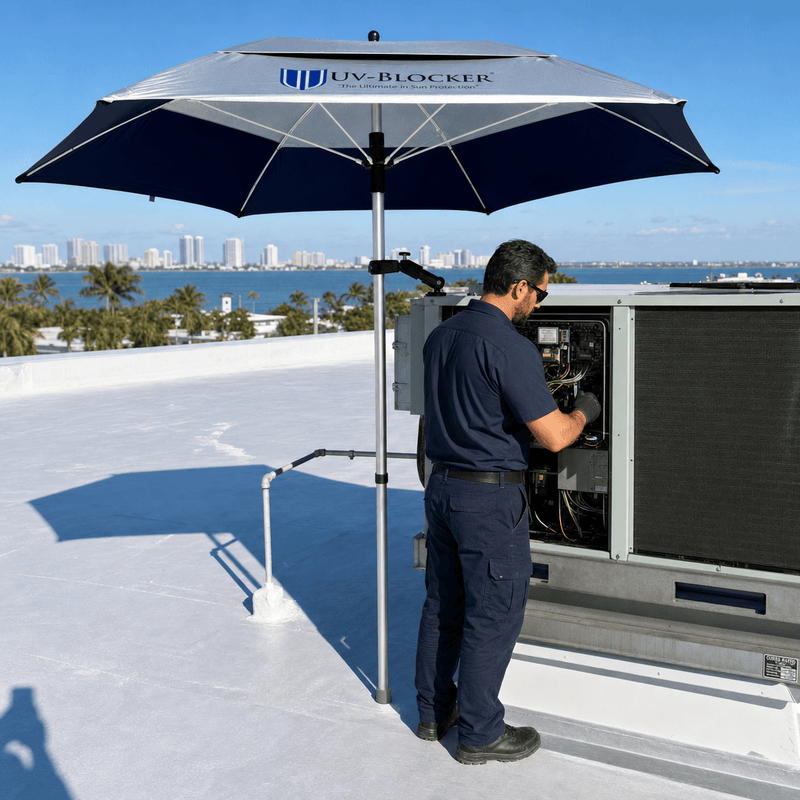
The UV-Blocker Service Shield addresses this specific infrastructure gap. It uses a magnetic mount system that attaches directly to the side of an HVAC rooftop unit casing, creating immediate UPF 50+ shade without permanent installation, drilling, or rooftop penetration. The pole-mounted shade structure with Solarteck reflective canopy deploys in seconds and moves from unit to unit as the crew works across a rooftop.
For a comparison of portable shade options for contractors, including pop-up canopies, hard-mount solutions, and magnetic systems, see the full breakdown.
The correction: Budget shade infrastructure as a line item in fleet safety equipment, not as an afterthought. If your crews cannot access shade within two minutes of stopping work on a rooftop, the rooftop heat safety HVAC program has a structural gap.
Why Do Experienced HVAC Technicians Have Higher Heat Risk?
Experienced technicians face higher heat risk because companies skip acclimatization protocols for veterans returning from time off, cool weather periods, or seasonal breaks.
The assumption runs deep: a 10-year veteran can handle anything a rooftop throws at them. But acclimatization is physiological, not psychological. A veteran who spent a week on vacation, worked indoor jobs through a cool spring, or took sick leave loses meaningful heat tolerance within 7-14 days.
The data on this is striking. According to OSHA, more than 70% of workers who die from heat do so within their first week on the job. That statistic includes experienced workers returning to heat exposure after an absence. "First week" does not mean first week of employment. It means first week back in the heat.
OSHA Acclimatization Schedules
OSHA provides separate acclimatization protocols:
- New workers: No more than 20% heat exposure on day one, increasing by 20% each additional day
- Experienced workers returning to heat: 50% on day one, 60% on day two, 80% on day three, 100% on day four
Most HVAC companies apply zero acclimatization schedule to returning veterans. A tech returning from a two-week vacation in June goes straight to a full eight-hour rooftop shift in July. This is the highest-risk scenario in the industry, and most companies treat it as routine.
The correction: Apply the returning-worker acclimatization schedule to every technician after any absence of seven or more days during heat season, regardless of years of experience.
Does Heat Safety Only Matter in Summer?
OSHA's heat illness prevention triggers begin at 80F heat index, a threshold reached by April across most of the southern United States, making heat safety a year-round operational requirement.
Companies that frame heat safety as a "summer program" miss two to three months of exposure on each end of the season. In Florida, Texas, and Arizona, 80F heat index days start in April and persist through October. Humidity is the hidden accelerant. An air temperature of 82F with 80% relative humidity produces a heat index above OSHA trigger thresholds.
NOAA's June 2026 forecast projects a 62-80% probability of El Nino forming this summer, with forecasters indicating potential for a historically strong event. El Nino years load the dice toward above-normal temperatures globally, extending and intensifying the heat season.
If your fleet operates in Texas, your rooftop heat safety HVAC season started two months before the summer safety briefing.
The correction: Replace calendar-based "summer safety programs" with year-round WBGT monitoring and automatic protocol triggers tied to measured conditions, not dates on a calendar.
What Does a Real Rooftop Heat Safety Program Look Like?

An effective rooftop heat safety program combines WBGT monitoring, portable shade infrastructure, acclimatization protocols for all workers, a buddy system, and documented procedures.
Each of the five mistakes above has a corresponding fix. A complete program addresses all five:
- WBGT monitoring at every rooftop worksite before dispatching crews. Measure conditions on the actual roof, not from a weather app.
- Shade infrastructure as standard fleet equipment. Every crew should have access to portable rooftop shade at every job site.
- Acclimatization protocol applied to all workers, not just new hires. The returning-worker schedule triggers after any absence of seven or more days during heat season.
- Buddy system for all rooftop work above 90F WBGT. No technician works alone on a rooftop in high-heat conditions.
- Written documentation covering all four elements above, plus training records and incident reporting. See OSHA Heat Illness Prevention Plan for HVAC and Roofing for a full compliance template.
For a complete prescriptive guide to staying cool on a roof during HVAC work, including cooling strategies, PPE selection, and scheduling tactics, the full guide covers each step in detail.
Companies that treat rooftop heat safety as an engineering problem rather than a paperwork exercise see fewer incidents and lower workers' comp costs. The investment is modest: a WBGT instrument, portable shade equipment, a written acclimatization schedule, and crew training. The cost of not investing is measured in ER visits, OSHA citations, and lost workdays.
Frequently Asked Questions About Rooftop Heat Safety for HVAC
These questions come up frequently from HVAC company owners and safety managers evaluating their rooftop heat safety HVAC programs.
At what temperature should HVAC techs stop working on rooftops?
OSHA does not set a specific stop-work temperature, but WBGT readings above 90F require mandatory rest cycles and readings above 100F typically warrant work stoppage.
The answer depends on WBGT, not air temperature. A 95F day with high humidity and a dark roof can produce WBGT readings well above 100F. Decisions about continuing rooftop work should be based on measured WBGT at the actual work location, not on the number displayed in a weather app.
Is shade legally required for outdoor workers?
California and Washington already have state-level shade requirements for outdoor workers. OSHA's proposed federal heat standard requires employers to provide shade or equivalent cooling when temperatures exceed the initial heat trigger of 80F heat index.
Regardless of current legal requirements in a given state, shade demonstrably reduces core body temperature during rest breaks, making it a practical necessity even where not yet mandated.
What is the cheapest way to add rooftop shade?
Magnetic-mount shade systems like Service Shield attach directly to HVAC rooftop unit casings without permanent installation, making them the most practical option for commercial rooftop environments.
Traditional pop-up canopies require anchoring that is impractical on flat commercial roofs. Magnetic-mount solutions solve the attachment problem. For a detailed comparison, see the portable shade for contractors comparison guide.
How can an HVAC company verify its heat safety program is OSHA-compliant?
A compliant program requires written protocols covering water access, rest breaks, shade, acclimatization, training, and emergency response. Most companies address only the first two elements.
A full compliance checklist and template are available in the OSHA Heat Illness Prevention Plan guide. The key test: if a program cannot document all six elements, it has gaps that an OSHA inspector will find.
OSHA's Rooftop Heat Safety Requirements: What HVAC Contractors Must Document
Following OSHA's finalized Indoor and Outdoor Heat Illness Prevention rule (2024), rooftop HVAC contractors now face specific documentation requirements that many companies are unprepared for. Here's what your safety program must include:
Required Documentation Elements (29 CFR 1910.147 and Proposed 1926.1101)
- Written Heat Illness Prevention Plan (HIPP) — Must include site-specific shade provisions. Generic "seek shade when available" language is no longer sufficient; the plan must specify the shade infrastructure available at each job type.
- Heat Index Monitoring Log — Daily wet-bulb globe temperature (WBGT) or heat index readings must be recorded. OSHA compliance officers increasingly request 90-day historical logs during inspections.
- Shade Adequacy Documentation — For rooftop work, the plan must demonstrate how shade requirements are met when the structure itself provides none. Portable UV-blocking umbrellas with measured UPF ratings qualify as compliant shade.
- Employee Acclimatization Schedule — New employees must follow a 7-day acclimatization protocol; returning employees after 14+ days of absence require a modified 4-day schedule.
Shade Compliance on Rooftops
The most common rooftop OSHA violation is "failure to provide accessible shade." Compliant shade must be within 2 minutes of any work station, provide at least 4 square feet of shade per worker, and block direct sunlight. UV-Blocker's ServiceShield — a 7.5-foot commercial umbrella with magnetic rooftop base — is specifically designed to meet these OSHA proximity and coverage requirements.