


TL;DR
- Best Ultralight: Six Moon Designs Rain Walker SUL (about 156 g, UPF 50+, premium price band)
- Best Value: Gossamer Gear Lightrek (about 164 g, UPF 50+, budget price band)
- Best Wind Resistance: Hyperlite Mountain Gear Essential (195 g, UPF 50+, premium price band)
- Best Premium Sun Protection: UV-Blocker Compact (about 425 g, UPF 50+, mid-range price band)
- UPF 50 lets through about 1/50th of UV (it blocks 98%); UPF 50+ is the top rating category
- A reflective silver canopy can feel up to about 8°C cooler than standing in direct sun
- Gram-counters should aim for roughly 140–200 g; day walkers can put UV protection ahead of weight
- In Australia, use an umbrella as your "seek shade" step whenever the UV Index is 3 or above, alongside clothing, a hat, sunscreen and sunglasses
The best hiking umbrella for Australian conditions is a light sun umbrella rated UPF 50+ with a reflective silver canopy. Australia has some of the highest UV levels in the world, and on a summer day the UV Index stays at 3 or above, the level at which Cancer Council recommends sun protection, for hours at a time. A parasol you can carry gives you shade where the track gives you none.
Long-distance hikers worked this out on desert trails first. On the Pacific Crest Trail in the US, thru-hikers who've baked through the Mojave Desert section treat an umbrella as essential gear for roughly 1,600 km of the route. Australian walkers face the same problem on the open ridges of the Larapinta Trail, the farmland and range country of the Heysen Trail and the alpine sections of the Australian Alps.
Yet here's the problem: many hikers carry an umbrella that blocks only about 75% of UV rays. Ordinary rain umbrellas and budget options leave you exposed through eight or more hours of daily sun on exposed tracks. The difference between a standard umbrella and a purpose-built hiking umbrella with UPF 50+ isn't subtle: it's 75% of UV blocked versus 98% or more.
I've compared 7 of the best hiking umbrellas across the weight range, ranking them by UV protection, weight, durability and value. Whether you're a gram-counting thru-hiker or a day walker in the Blue Mountains who needs maximum sun protection, you'll find the right hiking umbrella here.
Most "best hiking umbrellas" lists rank by weight alone. That's a mistake. Eight hours a day under a UPF 25 umbrella still adds up to significant UV exposure over a multi-month walk.

What Makes a Hiking Umbrella Worth the Weight?
A hiking umbrella is worth carrying when it is rated UPF 50 or higher (blocking at least 98% of UV) and has a canopy of about 94 cm or more. How much weight you accept depends on your trip length and how sun-sensitive your skin is.

The weight vs. protection trade-off isn't one-size-fits-all:
For thru-hikers covering 3,000+ km: Every gram matters. A 140–200 g umbrella with UPF 50+ is the sweet spot. You save real pack weight without giving up meaningful UV protection.
For day walks or short overnight hikes: Heavier umbrellas (roughly 280–425 g) with bigger canopies become practical. The extra grams matter less on a weekend in the Grampians or the Blue Mountains.
For hikers with medical UV sensitivity: Weight becomes secondary to protection. Melanoma survivors, people with lupus and anyone taking a photosensitising medicine need the highest-rated protection available, used with the rest of their sun protection.
The UPF ratings matter more than most hikers realise. Under the Australian standard for sun-protective clothing, Cancer Council explains that UPF 15 is minimum protection, UPF 30 is good and UPF 50 and 50+ are excellent protection. Here's what the numbers mean:
| UPF Rating | UV Blocked | What It Means |
|---|---|---|
| UPF 25 | 96% | 4% gets through—adds up over months |
| UPF 40 | 97.5% | Better, but not the top tier |
| UPF 50 | 98% | About 1/50th of UV gets through; excellent protection |
| UPF 50+ | More than 98% | Top rating category; standard for serious sun protection |
The gap between UPF 40 and UPF 50+ might sound trivial: 2.5% of UV getting through versus 2% or less. It isn't. That's at least a quarter more UV reaching your skin, and over 1,200 hours of sun (five months at eight hours a day on a long thru-hike) it adds up. For a deeper look at what these ratings mean, see UPF 50 Explained: What the Rating Means for Sun Protection.
Canopy material matters too. Silver-coated canopies reflect heat and can make it feel up to about 8°C cooler under the umbrella. Black canopies absorb heat. If you're walking in the Red Centre or other hot, dry country, a silver or reflective coating makes a noticeable difference to comfort.
Canopy size determines coverage: you want at least 94 cm of arc to shade your head, neck and shoulders from direct sun.
How Do We Rank the Best Hiking Umbrellas?
We rank hiking umbrellas by UV protection first, then weight, canopy size, wind resistance, and price to find the best option for different hiking styles.
Here's the scoring methodology:
| Factor | Weight | Why It Matters |
|---|---|---|
| UV Protection (UPF) | 30% | Primary purpose for sun protection |
| Weight | 25% | Critical for thru-hikers |
| Canopy Size | 20% | Coverage determines effectiveness |
| Wind Resistance | 15% | Alpine ridges and open desert country are windy |
| Price | 10% | Value for multi-use gear |
Most hiking gear lists rank umbrellas by weight alone. That makes sense if pack weight is your only concern. But if you're carrying an umbrella for UV protection on exposed tracks, which is the whole point of a sun umbrella, the UPF rating matters just as much.
The best hiking umbrella depends on how you'll use it. A gram-counting thru-hiker on the Heysen Trail has different needs from a day walker with a history of skin cancer.
Which Hiking Umbrellas Offer the Best UV Protection?
Six Moon Designs Rain Walker SUL leads for ultralight thru-hiking at about 156 g with UPF 50+, while the UV-Blocker Compact offers premium UPF 50+ protection for day walkers who put maximum sun blocking first.
Here's the full breakdown. Weights and canopy sizes are converted to metric from each maker's published figures, and the price bands (budget, mid-range, premium) compare these umbrellas with each other. Check current availability and pricing in Australia with each maker before you buy.
1. Six Moon Designs Rain Walker SUL — Best Ultralight with Full Protection
- UPF: 50+
- Weight: about 156 g
- Canopy: about 95 cm
- Price band: premium
The Rain Walker SUL is the lightest hiking umbrella in this list that still delivers UPF 50+ protection. At about 156 g, you're carrying almost nothing for real sun protection.
Pros: Lightest full UPF 50+ option, collapsible design Cons: Higher price than most of the ultralight field, smaller canopy than some competitors Best for: Long-distance walkers who count every gram
2. Gossamer Gear Lightrek — Best Value for Thru-Hikers
- UPF: 50+
- Weight: about 164 g
- Canopy: about 94 cm
- Price band: budget
The Lightrek has logged thousands of kilometres on the Pacific Crest Trail. Gossamer Gear claims it can make it up to about 8°C cooler under the canopy, a claim I've seen backed up by thru-hikers who've carried it through the Mojave Desert.
Pros: Great price-to-weight ratio, proven track record on long trails Cons: Non-collapsible design (stays at full length) Best for: Budget-conscious thru-hikers who want proven gear
3. Montbell Sun Block Umbrella — Best for Mountaineers
- UPF: 50+ (blocks 99.7% UV per manufacturer)
- Weight: about 201 g
- Canopy: about 98 cm
- Price band: mid-range
Montbell's offering is beloved by the ultralight community for good reason. The silver reflective coating is excellent, and the collapsible design makes it packable. One catch: it's often sold out.
Pros: Excellent UV blocking, collapsible, great build quality Cons: Availability issues—frequently out of stock Best for: Alpine walks and overseas trips where packability matters
4. Hyperlite Mountain Gear Essential — Best Wind Resistance
- UPF: 50+
- Weight: 195 g
- Canopy: about 97 cm
- Price band: premium
The Hyperlite Essential stands out for its dual canopy design that handles wind better than most competitors. The company claims it can handle strong gusts without inverting.
Pros: Wind-resistant dual canopy, solid UPF 50+ rating Cons: Premium price point Best for: Exposed ridgelines, alpine sections and windy desert country, such as the high ridges of the Larapinta Trail
5. Zpacks Lotus Ultralight — Best for Gram Counters Accepting Lower UPF
- UPF: 40
- Weight: about 193 g
- Canopy: about 97 cm
- Price band: mid-range
The Zpacks Lotus has excellent build quality and a proven reputation. The trade-off: UPF 40 instead of 50+. That's 97.5% UV blocked vs 98%+—a meaningful difference over months of exposure.
Pros: Excellent durability, trusted brand Cons: Lower UPF rating than competitors at similar weight Best for: Hikers who prioritise brand reputation and accept slightly lower UV protection
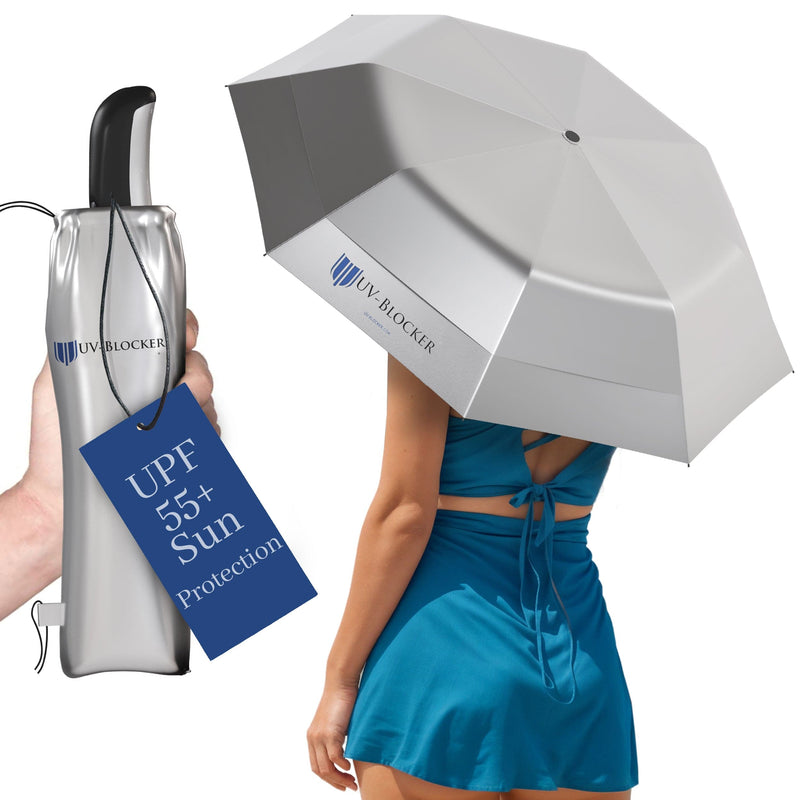
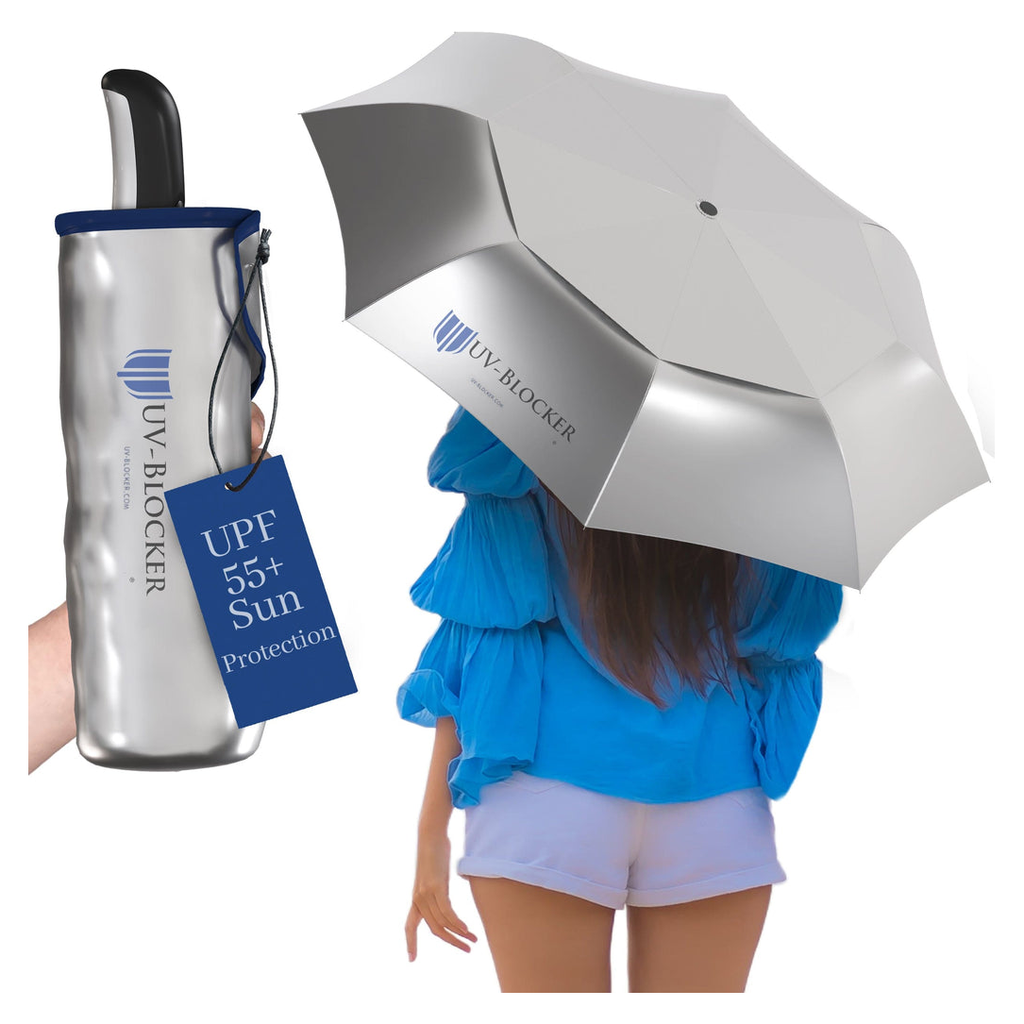
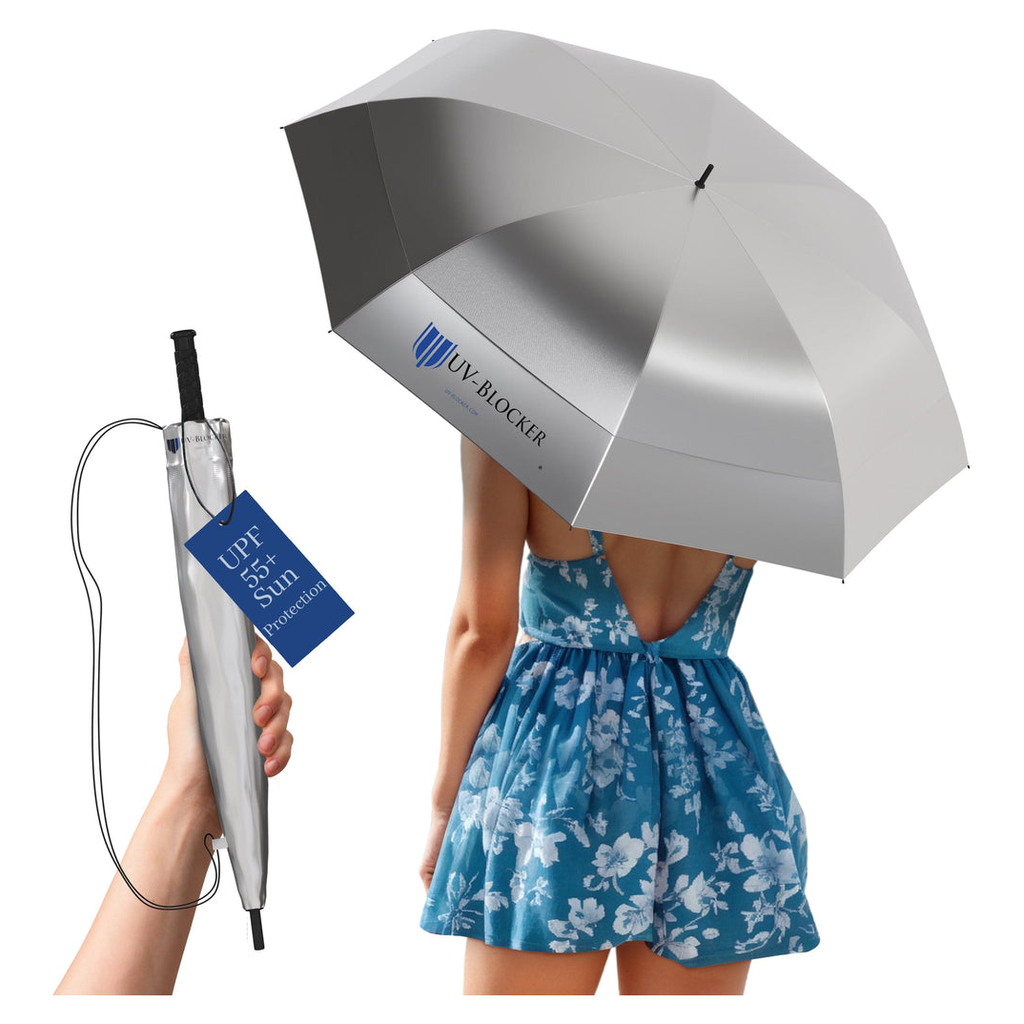
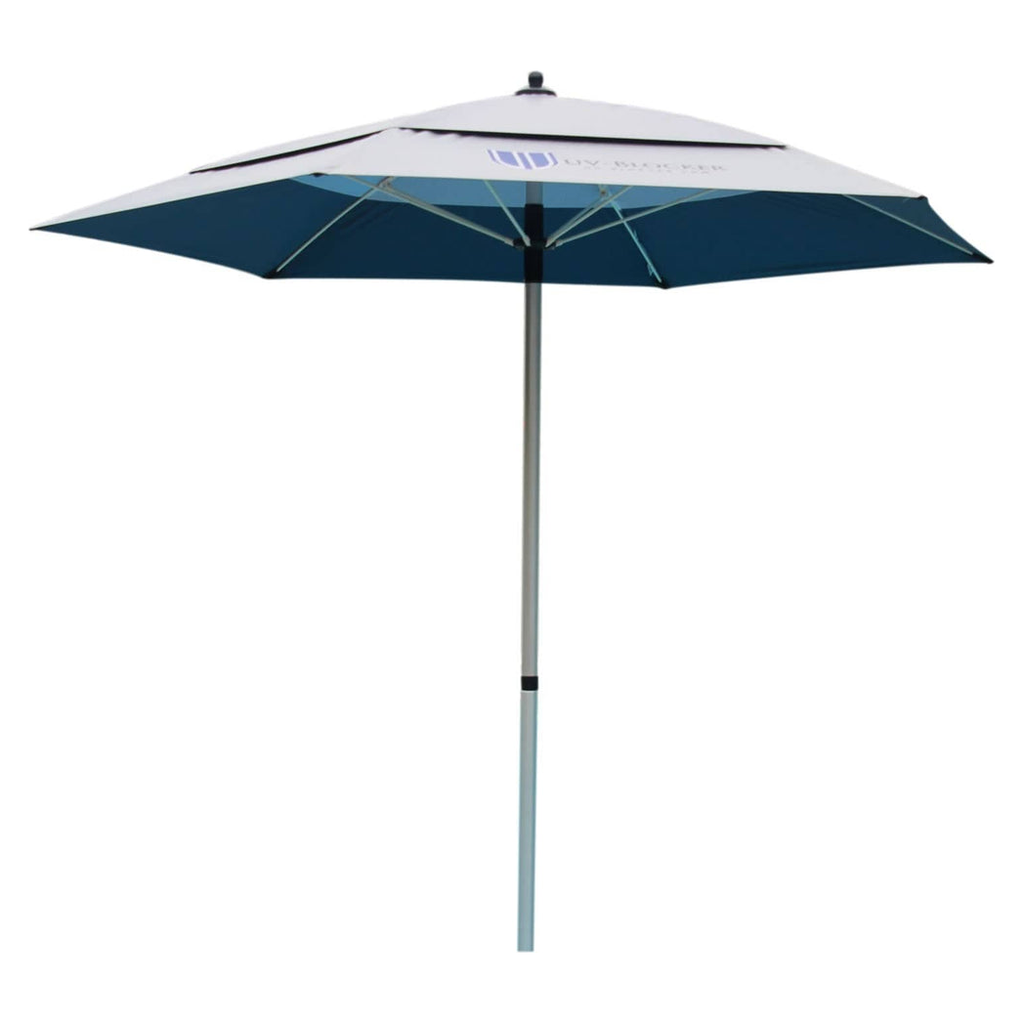
6. UV-Blocker Compact — Best Premium Sun Protection
- UPF: 50+ (lab-tested to AATCC TM183-2020: blocks 100% of UVB and 99.97% of UVA)
- Weight: about 425 g
- Canopy: about 107 cm arc (largest coverage here)
- Opening: automatic open and close
- Price band: mid-range
Here's where I need to be honest: the UV-Blocker Compact is not an ultralight option. At about 425 g, it's nearly three times heavier than the ultralight competition. For gram-counting thru-hikers, that rules it out.
But its Solarteck® fabric has been tested by SGS to AS/NZS 4399 (UPF 50+, Excellent), it has the largest canopy here (about 107 cm arc), and it's approved by the Melanoma International Foundation. The silver Solarteck® outer layer, with a navy blue underside, keeps you up to 8°C cooler than standing in direct sun.
Pros: UPF 50+, MIF approved, largest coverage, up to 8°C cooler underneath, opens and closes automatically, works in rain too Cons: Nearly three times heavier than ultralight options Best for: Day walkers, melanoma survivors, people with lupus, anyone who puts maximum UV protection ahead of weight
7. Snow Peak Ultra-Light — Absolute Lightest (Rain Priority)
- UPF: Not rated
- Weight: about 133 g
- Canopy: about 84 cm
- Price band: budget
The Snow Peak is the lightest hiking umbrella in this list. But there's no UPF rating, and the small 84 cm canopy provides minimal coverage. This is a rain umbrella, not a sun umbrella.
Pros: Lightest option available Cons: No UPF rating, small canopy, rain-only protection Best for: Hikers who need rain protection and don't prioritise UV blocking
Quick Comparison Table
| Umbrella | UPF | Weight | Canopy | Price band | Best For |
|---|---|---|---|---|---|
| Six Moon Designs Rain Walker | 50+ | ~156 g | ~95 cm | Premium | Ultralight thru-hiking |
| Gossamer Gear Lightrek | 50+ | ~164 g | ~94 cm | Budget | Budget thru-hiking |
| Montbell Sun Block | 50+ | ~201 g | ~98 cm | Mid-range | Mountaineering |
| Hyperlite Essential | 50+ | 195 g | ~97 cm | Premium | Wind resistance |
| Zpacks Lotus | 40 | ~193 g | ~97 cm | Mid-range | Weight priority |
| UV-Blocker Compact | 50+ | ~425 g | ~107 cm | Mid-range | Premium sun protection |
| Snow Peak Ultra-Light | N/R | ~133 g | ~84 cm | Budget | Rain only |
Why Does UPF Rating Matter for Thru-Hikers?
Thru-hikers face 8-12 hours of daily sun exposure for 4-6 months, making cumulative UV damage a serious health risk that basic umbrellas don't adequately address.

Let's do the maths. A five-month thru-hike such as the Pacific Crest Trail, at eight to ten hours of walking a day, adds up to 1,200+ hours of sun exposure.
The PCT's desert section alone covers more than 1,100 km of exposed terrain with little tree cover. Altitude adds to the load: UV levels rise as you climb because thinner air absorbs less of it, as the World Health Organization explains, and a commonly used estimate is roughly 10–12% more UV for every 1,000 metres of elevation gain.
Traditional umbrellas only block about 75% of UV rays. Over 1,200 hours, that 25% getting through adds up to significant cumulative damage.
UPF 50+ umbrellas block 98% or more of UV rays. That extra 23% of protection compounds over a multi-month hike.
For Hikers with Medical UV Sensitivity
Some hikers can't afford to compromise on UV protection:
- Melanoma survivors need maximum protection to prevent recurrence
- People with lupus can experience flares triggered by UV exposure—see The Complete Lupus Sun Protection Guide
- Retinol/tretinoin users have heightened sun sensitivity
- Fair-skinned hikers burn faster and accumulate damage quicker
- Anyone on a photosensitising medicine should check the Consumer Medicine Information (CMI) leaflet or ask a pharmacist before a long walk in the sun
For these hikers, the UV-Blocker Compact's UPF 50+ rating and Melanoma International Foundation approval matter more than carrying an extra 250 g or so. When your health depends on it, protection isn't negotiable, and the umbrella is one layer of it, used with clothing, a hat, sunscreen and sunglasses.
Hiking Umbrellas in Australia: Shade for Australian Tracks
In Australia, a hiking umbrella is the "seek shade" step you can carry. Cancer Council notes that Australia has some of the highest UV levels in the world, and that just 15 minutes of unprotected exposure when the UV Index is 3 or above is enough to start damaging your skin. On a full day on an open track, that adds up quickly. UV can also be high on cool and overcast days, so a mild morning in the mountains is no reason to skip sun protection.
Check the UV before you go. The Bureau of Meteorology issues sun protection times whenever the UV Index is forecast to reach 3 or above, and you can see them for your walk's location on the free SunSmart app or the Bureau's website.
Use the parasol with the other four steps. Cancer Council's SunSmart advice is that shade reduces UV but some still reaches you by reflection, so use shade together with covering clothing, SPF 50 or higher broad-spectrum, water-resistant sunscreen (reapplied every two hours and after heavy sweating), a broad-brimmed hat and sunglasses.
Where a sun umbrella earns its place on Australian tracks:
- Red Centre and outback walks such as the Larapinta Trail in the West MacDonnell Ranges, with long stretches of open ridgeline and little tree cover
- Alpine walks on the Main Range near Mt Kosciuszko and in the Victorian Alps, where you're above the tree line and UV is stronger with altitude
- Coastal walks such as the Great Ocean Walk in Victoria or the Coast Track in Sydney's Royal National Park, where sand and water reflect UV back at you
- Open farmland and range country on long trails such as the Heysen Trail in South Australia
Look for a rated fabric. In Australia and New Zealand, sun-protective fabrics are rated under AS/NZS 4399, and Cancer Council's guide describes UPF 50 and 50+ as excellent protection. An umbrella with no UPF rating, like the Snow Peak in this list, tells you nothing about how much UV gets through. For reference, UV-Blocker umbrellas use Solarteck® fabric tested by SGS to AS/NZS 4399 (UPF 50+, Excellent).
Heat is the other half of the job. A reflective silver canopy keeps radiant heat off your head and shoulders; UV-Blocker measures up to 8°C cooler under its umbrellas than in direct sun. That makes a hot afternoon easier, but it is no substitute for carrying enough water and planning hot-country walks for the cooler part of the day and year.
Can Hiking Umbrellas Handle Wind and Rain?
Modern hiking umbrellas handle gusts of roughly 30–65 km/h through vented canopy designs and carbon fibre construction, unlike cheap umbrellas that turn inside out in light wind.
How wind-resistant designs work:
- Vented canopies allow wind to pass through instead of catching like a sail
- Dual canopy designs create airflow that reduces blowouts (Hyperlite)
- Carbon fibre/fibreglass shafts flex without snapping under stress
The Hyperlite Essential's dual canopy is specifically designed for windy conditions. Vented canopies on other umbrellas serve the same purpose, letting wind pass through while keeping you covered. When the wind picks up on an exposed ridge, angle the canopy into it and be ready to close it.
Realistic limitations:
Hiking umbrellas aren't invincible. Be realistic about when they work:
- Heavy storms: Use a rain jacket instead. Umbrellas are supplemental.
- Dense vegetation: Closed forest, rainforest and thick scrub make umbrellas impractical because branches catch the canopy constantly. US thru-hikers say the same about the Appalachian Trail's green tunnel.
- Extreme winds: Above about 65 km/h, even wind-resistant designs struggle. Consider hands-free attachment systems that secure the umbrella to your pack.
Umbrellas work best on exposed, open terrain—exactly where you need sun protection most.
How Should You Choose Your Hiking Umbrella?
Choose based on trip length and priorities: ultralight UPF 50+ for thru-hikes, a larger premium UPF 50+ canopy for day walks or medical UV sensitivity.
Here's a decision matrix:
| If You're... | Prioritise... | Best Choice |
|---|---|---|
| Thru-hiking a long trail | Weight + UPF 50+ | Six Moon Designs or Gossamer Gear |
| Day walking in high UV | Maximum UV protection | UV-Blocker Compact (UPF 50+) |
| Melanoma survivor or living with lupus | Maximum protection | UV-Blocker (MIF Approved) |
| Hiking alpine or windy country | Wind resistance | Hyperlite Essential |
| Budget-conscious | Value | Gossamer Gear Lightrek |
| Overseas travel | Packability + protection | Montbell Sun Block |
Budget Considerations
- Budget: The Gossamer Gear Lightrek delivers excellent value; the Snow Peak is cheap but has no UPF rating
- Mid-range: Most options sit here; choose based on your priority (weight vs. protection)
- Premium: Hyperlite's wind resistance for exposed conditions, and Six Moon Designs' ultralight build
What's the Bottom Line on Hiking Umbrellas?
The best hiking umbrella depends on your priorities: ultralight thru-hikers need options of roughly 140–200 g, while day walkers and medically UV-sensitive hikers benefit from a bigger, premium canopy.
Our picks for the best hiking umbrellas:
- Best Ultralight: Six Moon Designs Rain Walker SUL (premium, about 156 g, UPF 50+)
- Best Value: Gossamer Gear Lightrek (budget, about 164 g, UPF 50+)
- Best Wind Resistance: Hyperlite Mountain Gear Essential (premium, 195 g, UPF 50+)
- Best Premium Sun Protection: UV-Blocker Compact (mid-range, about 425 g, UPF 50+)
The honest take:
For gram-counting thru-hikers, the Six Moon Designs or Gossamer Gear options make more sense: they're among the best hiking umbrellas for long trails, whether that's the PCT or the Heysen. You save 250 g or more over the UV-Blocker without giving up UPF 50+ protection. Over 3,000 km, that weight adds up.
But for day walkers, people with medical UV sensitivity, or anyone who puts the best possible sun protection ahead of weight, the UV-Blocker Compact is the best hiking umbrella here for maximum UV blocking. Its UPF 50+ Solarteck® fabric, MIF approval and up to 8°C cooler shade justify the extra weight. When you're not carrying it for months at a time, about 425 g for maximum protection is a fair trade, especially under Australian UV.
For more on choosing the right UV umbrella for your needs, see The Complete Travel UV Umbrella Buying Guide.
If maximum sun protection is your priority, explore UV-Blocker's full range of MIF-approved umbrellas.
Frequently Asked Questions
What UPF rating do I need for the best hiking umbrellas?
For serious sun protection under Australian UV, aim for UPF 50 or 50+, which Cancer Council's guide to the Australian standard describes as excellent protection. Most of the best hiking umbrellas here are UPF 50+, blocking 98% or more of UV rays. UV-Blocker's Solarteck® fabric was lab-tested to AATCC TM183-2020 at 100% of UVB and 99.97% of UVA blocked. For hikers with medical UV sensitivity (melanoma survivors, people with lupus), choose UPF 50+ and use it with the other SunSmart steps.
Are the best hiking umbrellas worth the weight?
For exposed tracks such as the Larapinta Trail or the Main Range near Mt Kosciuszko, yes. The best hiking umbrellas can make it feel up to about 8°C cooler and block 98% or more of UV with a proper UPF rating. On densely forested tracks they're less useful because branches get in the way.
Can I use a regular umbrella instead of the best hiking umbrellas?
You can, but regular umbrellas only block about 75% of UV rays. The best hiking umbrellas with UPF 50+ block 98% or more of UV rays and typically weigh less while being more wind-resistant than standard umbrellas.
How do I carry a hiking umbrella hands-free?
Most ultralight hiking umbrellas can be secured to pack straps using foam handles or dedicated attachment systems. Some hikers use shock cord or hook-and-loop straps to secure the umbrella shaft to their pack's shoulder straps.
What's the difference between UPF 50 and UPF 50+?
UPF 50 blocks approximately 98% of UV rays (1/50th passes through). UPF 50+ is the top rating category, for fabrics that test above UPF 50; Cancer Council's guide to the Australian standard classes both as excellent protection. UV-Blocker's UPF 50+ Solarteck® fabric, for example, was lab-tested to AATCC TM183-2020 at 100% of UVB and 99.97% of UVA blocked.
Do black or silver umbrella canopies work better for sun protection?
Silver or reflective canopies are better for sun protection. They reflect UV rays and heat away from you, making it feel up to about 8°C cooler. Black canopies absorb UV (blocking it from reaching you) but also absorb heat, making it warmer underneath. Learn more about umbrella colours for sun protection.
Are hiking umbrellas waterproof?
Most hiking umbrellas have water-resistant coatings that handle light to moderate rain. However, they're not designed to replace rain jackets in heavy downpours. Treat them as extra rain protection for lighter conditions, which is handy given how quickly the weather can turn in the Australian Alps or Tasmania.
How long do hiking umbrellas last?
Quality hiking umbrellas from brands like Gossamer Gear, Six Moon Designs, and UV-Blocker typically last several seasons with proper care. Fibreglass and carbon fibre frames resist corrosion better than metal frames. Avoid leaving your umbrella in direct sun when not in use, and store it dry to prevent mold.
7 Best Hiking Umbrellas for UV Protection in 2026: Questions From Australian Hikers
What is the primary difference between a standard rain umbrella and a specialised UV hiking umbrella?
Standard umbrellas typically only block about 75% of UV radiation. A UV umbrella uses a rated sun-protective fabric instead: UV-Blocker's Solarteck® fabric, with a reflective silver outer layer and a navy blue underside, was lab-tested to AATCC TM183-2020 to block 100% of UVB and 99.97% of UVA, and was tested by SGS to AS/NZS 4399 (UPF 50+, Excellent). That difference matters for walkers on exposed Australian tracks, who face direct sun plus UV reflected off rock, sand and water for hours at a time.
Can using a UV-protected umbrella actually reduce the temperature for a hiker?
Yes. A reflective silver canopy bounces sunlight away from your body, and UV-Blocker measures up to 8°C cooler under its umbrellas than in direct sun. Less radiant heat on your head and shoulders makes strenuous climbs on hot days more comfortable. It doesn't replace water, rest breaks and timing your walk for the cooler part of the day, which still matter on hot Australian tracks.
Is a UPF 50+ rating sufficient for high-altitude trekking where UV intensity is higher?
A UPF 50+ rating is the top rating category, blocking 98% or more of UV radiation. That matters at altitude because UV increases as you climb, by roughly 10–12% for every 1,000 metres of elevation gain on a commonly used estimate. In alpine areas, use the umbrella with sunscreen, a hat and sunglasses, and reapply sunscreen every two hours as Cancer Council recommends, because sunscreen can be sweated off on a long climb.
What does the Melanoma International Foundation seal of approval signify for hiking gear?
The Melanoma International Foundation (MIF) is a melanoma organisation, and UV-Blocker umbrellas are approved by it. For hikers, it's a useful signal that the umbrella is designed as sun protection rather than as a rain umbrella. In Australia, also check the fabric's rating: UV-Blocker uses Solarteck® fabric tested by SGS to AS/NZS 4399 (UPF 50+, Excellent). Either way, an umbrella is one part of sun protection, used alongside clothing, a hat, sunscreen and sunglasses.