

Here's something most people get wrong about sun safety: a cold, cloudy mountain summit at 14,000 feet hits skin with 50%+ more UV than a sunny beach at sea level. Nobody expects that. The burn shows up hours later and the math doesn't click until it's too late.
The problem? Every warning sign that normally screams "put on sunscreen" disappears at altitude and in unfamiliar latitudes. No blazing heat, no visible sweat, no bright glare. Instead, cold wind and grey clouds signal safety while UV does its damage unnoticed.
This guide covers the physics of altitude and latitude UV exposure, breaks down risk by trip type, and explains why a certified travel UV umbrella belongs in every travel bag regardless of destination.
How Does Altitude Increase UV Radiation?
UV radiation increases 10-12% for every 1,000 meters of elevation gain because thinner atmosphere filters fewer UV photons before they reach exposed skin.
Think of it like a stack of coffee filters. At sea level, UV passes through the full stack before reaching skin. Climb to 4,000 meters and about 40% of those filters are gone (atmospheric pressure drops from 1,013 hPa to roughly 600 hPa). The UV that used to get caught? It sails right through to exposed skin.
The WHO puts it at roughly 10% more UV per 1,000 meters gained. Research in the Swiss Alps measured it closer to 12% in certain conditions. Either way, the math is clear: elevation isn't just scenic, it's a UV multiplier.

Consider what happens at actual destinations people fly to every week:
| Elevation | UV Increase vs Sea Level | Example Destination |
|---|---|---|
| 1,000m (3,280 ft) | +10-12% | Denver, Colorado |
| 2,640m (8,660 ft) | +26-32% | Bogota, Colombia |
| 3,400m (11,150 ft) | +34-41% | Cusco, Peru |
| 4,267m (14,000 ft) | +43-51% | Mt. Elbert, Colorado |
| 5,364m (17,600 ft) | +54-64% | Everest Base Camp |
A hiker summiting a Colorado 14er gets roughly 50% more UV than someone at sea level under identical sky conditions. The Colorado Sun Protection guide breaks down what that 50% increase looks like in practice for anyone hiking the Front Range or skiing the Rockies.
Why Is UV Radiation Stronger Near the Equator?
Equatorial UV hits 12-14 year-round because the sun's near-vertical angle sends radiation through less atmosphere than at higher latitudes.
Near the equator, the sun hits Earth at close to 90 degrees regardless of season. That steep angle means UV indexes of 12-14 are normal, while cities at the 50th parallel barely crack 6-8 even in July.
Here's why that matters for travelers. In London or Seattle, sunlight arrives at a shallow angle and has to punch through a thick slice of atmosphere. Near Quito or Bogota? The sun's path to ground level is almost vertical, cutting through far less air. Less air means less filtering, and that translates to brutal UV intensity.
Put it in numbers anyone can feel. London and Vancouver? They barely crack UV index 7 on the hottest July afternoon. Bogota sits at 4 degrees north of the equator and regularly hits UV index 10-12. In January. In June. In October. It doesn't matter what month the flight lands.
Now here's where travel planning gets tricky. Bogota isn't just near the equator (extreme baseline UV). It's also at 2,640 meters (26-32% altitude boost on top). Travelers flying into Quito (2,850m) or Cusco (3,400m) face the same double whammy. Equatorial sun PLUS thin mountain air. It's the worst of both worlds hitting skin at once.
Someone flying from Portland or Edinburgh to Bogota has literally never felt this kind of UV. Their SPF 30 weekend routine was built for UV index 5-7. Dropping into UV index 12 means that same sunscreen runs out of protection time in half the hours they're used to.
Why Do Travelers Underestimate UV Exposure?
Four factors conspire against travelers: altitude feels cold, clouds look protective, new environments steal attention, and nobody remembers to reapply sunscreen when they're exploring a new city.
Wind chill masks the damage. A 40-degree summit wind makes sunscreen feel irrelevant. Skin stays cold while UV photons cause identical cellular damage regardless of temperature. That's how people end up with blistering burns after a cold, windy hike where they never once felt hot.
Clouds create false security. Overcast skies block visible light and heat but transmit up to 80% of UV radiation. A cloudy day at 3,000 meters can deliver a higher cumulative UV dose than a sunny afternoon at sea level. Travelers relax under grey skies and skip reapplication entirely.
Vacation brain takes over. Figuring out transit maps, ordering food in a second language, coordinating with travel partners, photographing everything in sight. "Reapply sunscreen at 2 hours" doesn't stand a chance against that mental load. The result? Six straight hours of unprotected exposure that'd never happen during a regular Tuesday at home.
Reflection from surfaces hits from unexpected angles. Fresh snow bounces 80-90% of UV radiation straight back up into faces, chins, and under-eye skin that nobody thinks to protect. Sand kicks back about 15%, water 10-25%. Stand on a glacier and UV arrives from every direction at once, like standing inside a UV oven.
Stack all four together and it gets ugly. Picture a hiker above treeline on a cloudy afternoon at 4,000 meters, crossing a snowfield, with cold wind on their face. Every single sense says "you're fine." Meanwhile UV is hammering exposed skin from above and below at 50%+ above sea-level intensity.
How a Travel UV Umbrella Solves These Problems
A UPF 50+ travel UV umbrella provides instant shade without reapplication, chemicals, or reef-safety concerns at any altitude or latitude.
It fixes all four problems listed above: instant shade, no reapplication clock, zero chemicals touching skin or coral reefs, and it weighs less than a water bottle.
Open it and done. Sunscreen needs 15-20 minutes to absorb before it actually works. A travel UV umbrella pops open in two seconds flat. Step off the bus at Machu Picchu? Protected before feet hit the ground.
No two-hour countdown. Sunscreen starts failing after 2 hours, faster when altitude wind and sweat strip it off skin. An umbrella canopy doesn't degrade, doesn't sweat off, doesn't need a reminder app. It blocks UV for as long as it stays open.
No chemical worries at reef destinations. Hawaii, Palau, Aruba, the US Virgin Islands, and Key West all banned oxybenzone and octinoxate to protect coral. Packing a UV umbrella sidesteps that whole headache. No googling ingredient lists, no paying $28 for "reef-safe" formulas at the hotel shop.
Packs once, works everywhere. Mountain trail on Monday, tropical city on Wednesday, beach on Friday. Instead of packing three different sunscreen formulas (altitude sport, reef-safe, daily wear), one umbrella handles the lot.
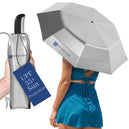
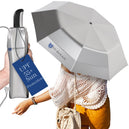
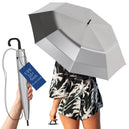
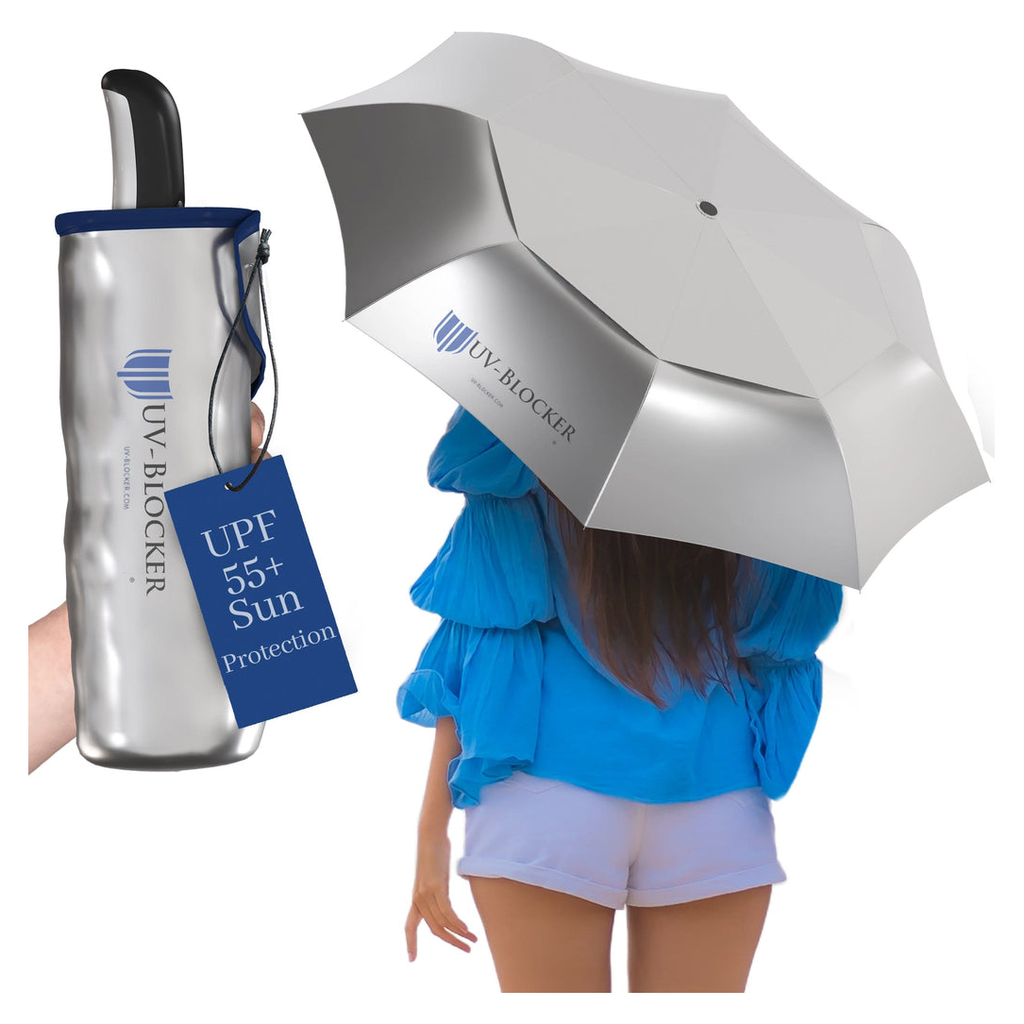
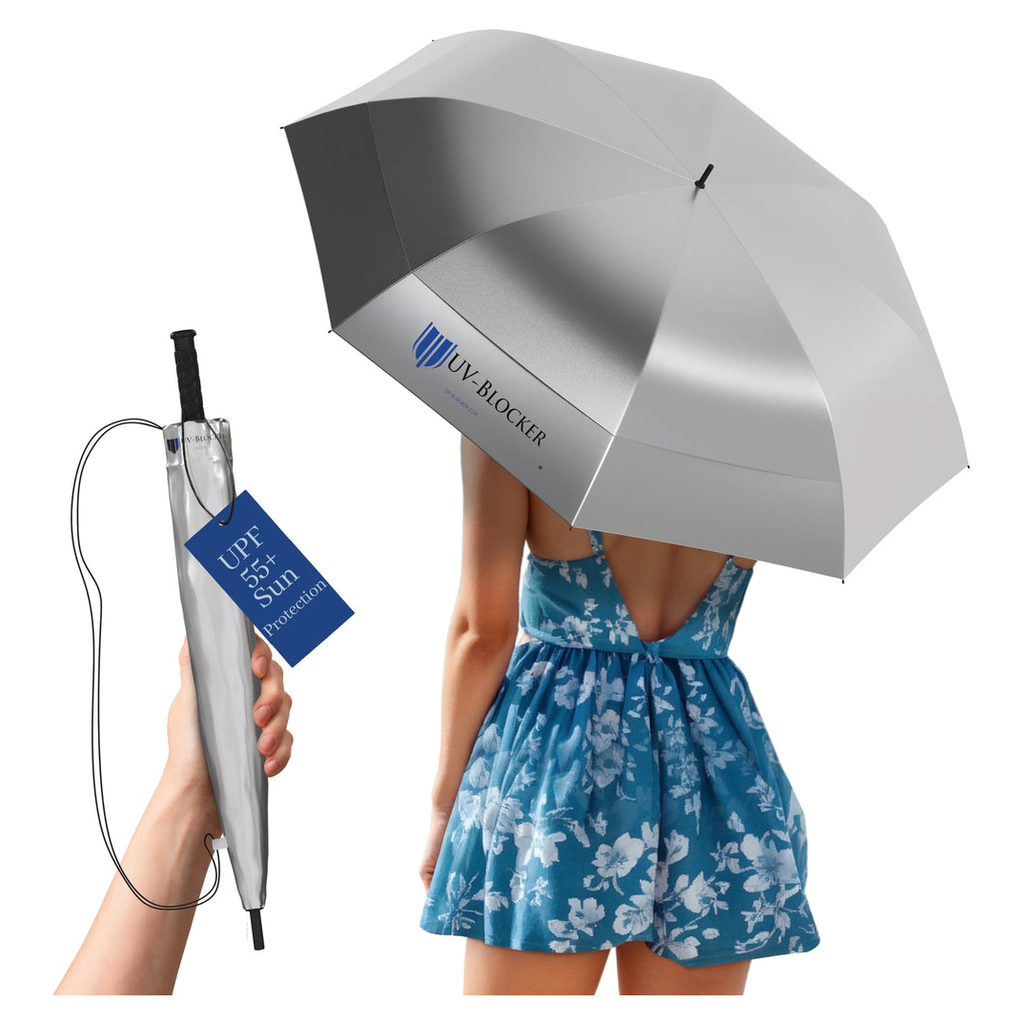
The UV-Blocker Travel UV Umbrella weighs 1 lb 5 oz, folds to 17.5 inches with a shoulder strap carry case, and is UPF 50+ certified via AATCC TM183-2020 testing (100% UV-B block, 99.97% UV-A block). For those preferring maximum portability, the Compact UV Umbrella folds to just 11.5 inches. The physics behind why a silver-exterior canopy outperforms other designs is covered in the Black vs Silver heat physics breakdown.
UV Protection by Trip Type
Every trip type throws different UV curveballs. Here's what to expect and where an umbrella fits into each scenario.
Mountain Hiking
Above treeline means zero natural shade combined with altitude UV amplification. Wind chill masks burning, which is the most common cause of unexpected altitude sunburns. Snow reflection above snowline adds up to 80% reflected UV from below. A UV umbrella for hiking provides shade where no trees exist.
Tropical Beach
Equatorial intensity combines with sand reflection (15%) and water reflection (10-25%). All-day beach exposure often stretches 6-8 hours versus a typical 1-2 hour outdoor block. Sunscreen reapplication fails reliably with swimming and sweating. A UV umbrella provides shade between water sessions without chemical reapplication.
Ski and Snowboard
Altitude UV amplification stacks with fresh snow reflection (80-90%) for extreme exposure. Cold temperatures eliminate all burn awareness until goggles come off. The "goggle tan line" visible on every skier's face is accumulated UV damage to exposed lower-face skin. UV umbrellas prove useful at base lodges, lift lines, and lunch spots.
City Walking in Hot Destinations
Extended sightseeing means 4-8 hours of continuous exposure per day. Concrete and glass reflect UV from multiple angles that overhead shade doesn't block. No structured shade breaks exist in urban environments the way resort pools and beach cabanas provide. Anyone who's walked through Tokyo, Bangkok, or Seoul in summer has seen it: half the pedestrians carrying sun umbrellas as naturally as they carry phones.
| Trip Type | Primary UV Risk | UV Amplifier | Umbrella Use Case |
|---|---|---|---|
| Mountain Hiking | Altitude (+10-12%/1000m) | No tree shade, snow reflection | Shade above treeline |
| Tropical Beach | Equatorial intensity (UV 12-14) | Sand + water reflection | Between-swim shade |
| Ski/Snowboard | Altitude + snow (80-90% reflection) | Cold masks burn | Lift lines, base lodge |
| City Walking | Extended hours (4-8h) | Concrete reflection | Walking companion |
For product comparisons across these use cases, the best compact UV umbrella for travel roundup tests multiple options head-to-head.
Frequently Asked Questions About Travel UV Umbrellas
Altitude UV exposure, umbrella UPF ratings, airline packing rules, and sunscreen limitations are the most common travel UV questions asked in forums and clinics.
These come up constantly in travel forums and dermatologist offices alike.
Does altitude affect sunscreen effectiveness?
Not technically, but practically? Yes. The SPF number doesn't change at elevation, but the UV hitting skin per minute jumps 40-50% at 4,000 meters.
Same SPF 30 bottle, but way more UV energy per hour. That 2-hour reapplication window shrinks to maybe 60-90 minutes. Add wind stripping cream off exposed skin and altitude sweat washing it down the forehead, and real-world protection time drops even further.
Can you get UV damage on a cloudy mountain day?
Absolutely. Clouds block heat and visible light, but up to 80% of UV sails right through them. Grey sky ≠ safe skin.
Dermatologists see this pattern constantly: someone hikes at 3,000 meters under overcast skies, feels cold the whole time, then shows up two days later with a second-degree burn. The grey sky told their brain "no danger" while UV did identical damage to a sunny beach day at lower elevation.
What UPF rating works for high altitude travel?
UPF 50+ blocks 98%+ of UV and doesn't care whether someone's at sea level or at 5,000 meters. It's the rating to look for.
Products tested to AATCC TM183-2020 standards hold that rating regardless of altitude or conditions. Lower ratings like UPF 15 or 30 leave gaps that get wider with elevation. At a location with 40-50% more UV than home, those gaps aren't trivial.
Is a UV umbrella allowed in carry-on luggage?
Yes. Folding UV umbrellas under 18 inches are permitted in carry-on bags by all major airlines, including TSA-regulated US flights.
The UV-Blocker Travel folds to 17.5 inches and includes a shoulder strap case for hands-free transit through airports. No lithium batteries, no liquids, nothing that'll trigger a bag check.
Why do people in Asia carry umbrellas in the sun?
Across Japan, Korea, and Southeast Asia, carrying a sun umbrella on a hot day is as normal as wearing shoes. People there figured out decades ago that instant shade beats reapplying lotion every two hours.
It's not a fashion statement. It reflects generations of practical knowledge that shade overhead beats any cream on skin. Western travelers adopting this approach for hot-climate city walking find it resolves the reapplication problem that sunscreen creates during 6-8 hour sightseeing days.
Conclusion
Travel UV plays by different rules than the backyard. Here's what to remember before booking:
- Elevation = UV multiplier. Every 1,000 meters adds 10-12% more UV. A Colorado 14er? That's 50%+ more UV than back home at the beach. Everest Base Camp hits 64% above sea level.
- The equator doesn't take seasons off. Bogota and Cusco serve up UV indexes of 10-14 in January and July alike. Northern-latitude sunscreen habits won't cut it there.
- Cold, wind, and clouds mask burn awareness. Every sensory cue says "safe" while UV damage accumulates at the same rate as a blazing beach day.
- One umbrella handles every environment. Pack it for the mountain, use it at the beach, pull it out at the ski lodge, carry it through Bogota. No chemicals, no reapplication timer, no reef-safety worries.
Before the next trip, check the UV index at the destination using the WHO Global Solar UV Index database. If the destination is above 2,000 meters, near the equator, or both, pack accordingly.
Ron Walker built the UV-Blocker Travel UV Umbrella after his own melanoma diagnosis, and it's become the go-to for altitude and tropical travelers: UPF 50+, 1 lb 5 oz, fits in any carry-on.
Ready for Real UV Protection?
UV-Blocker umbrellas block 99%+ of UV rays, keep you up to 15°F cooler, and carry the only Melanoma International Foundation approval of any umbrella. Dermatologist-recommended. Loved by melanoma survivors, outdoor workers, and sun-sensitive individuals worldwide.
Shop UV-Blocker Umbrellas →Sun Safety in Australia
Australia has some of the highest UV radiation levels in the world, with the UV Index regularly reaching extreme levels (11 or above) in cities such as Sydney, Melbourne, Brisbane, Perth, and Adelaide for much of the year — including on overcast days. The Cancer Council Australia reports that approximately two in three Australians will be diagnosed with some form of skin cancer by age 70, making sun protection a national health priority.
Key resources and guidelines for Australian sun safety:
- SunSmart Program (Cancer Council Australia): The SunSmart UV Alert is broadcast daily and recommends sun protection whenever the UV Index reaches 3 or above. In most Australian cities, this threshold is met every day of the year, including winter months in northern regions.
- ARPANSA (Australian Radiation Protection and Nuclear Safety Agency): Provides real-time UV monitoring at stations across all states and territories. Australians can access current UV levels at arpansa.gov.au.
- Safe Work Australia — UV Radiation as an Occupational Hazard: Australian workplace health and safety legislation requires employers to assess and manage UV radiation exposure for outdoor workers. Physical shade, including umbrellas rated UPF 50+, is recognised as a primary engineering control under these regulations.
A UPF 50+ UV-blocking umbrella provides the consistent, continuous shade protection that is essential under Australia's intense sun. The UV-Blocker umbrella, with its patented Solarteck® reflective coating, blocks 99% of UV rays and reduces perceived temperature by up to 15°F — a meaningful advantage for outdoor activities in Australia's climate. It is the only umbrella of its kind approved by the Melanoma International Foundation.
Sun Safety in Canada
Canada experiences meaningful UV exposure throughout the year, with UV Index levels regularly reaching 8–10 or higher during summer months in cities such as Vancouver, Calgary, Toronto, and Ottawa. Health Canada and Environment and Climate Change Canada publish daily UV Index forecasts and recommend protective measures whenever the index exceeds 3 — a threshold reached on most clear days between May and August across the country.
Key resources for Canadian sun safety:
- Health Canada UV Index: Published daily via the Environment and Climate Change Canada weather portal (weather.gc.ca). Canadians can track UV levels by city and receive alerts when protection is recommended.
- Canadian Cancer Society: Recommends UPF 50+ clothing, hats, sunscreen, and shade-seeking as primary sun protection strategies. Physical UV barriers — such as UPF 50+ umbrellas — are emphasized for prolonged outdoor exposure.
- Canadian Dermatology Association: Endorses broad-spectrum sun protection strategies, including shade structures and UV-blocking accessories, especially for individuals with fair skin or a personal or family history of skin cancer.
For Canadians spending extended time outdoors — whether working, playing sports, or enjoying recreational activities — a UV-blocking umbrella rated UPF 50+ provides continuous, reapplication-free protection. The UV-Blocker umbrella, independently tested and approved by the Melanoma International Foundation, blocks 99% of UV rays and keeps users up to 15°F cooler — making it a practical and reliable companion for Canadian summers.
Key Takeaways
- UPF (Ultraviolet Protection Factor) 50+ means the fabric blocks at least 98% of UV radiation.
- Regular umbrellas are made from polyester or nylon without UV-blocking treatment and provide only 40–60% UV protection.
- Yes.
- Umbrellas block direct overhead UV effectively but don't fully replace sunscreen because UV reflects from surrounding surfaces (water, sand, paveme...
Frequently Asked Questions
What does UPF 50+ actually mean for an umbrella?
UPF (Ultraviolet Protection Factor) 50+ means the fabric blocks at least 98% of UV radiation. An umbrella rated UPF 50+ allows only 1/50th of UV rays to pass through compared to no protection. UV-Blocker umbrellas are independently certified to block 99% of UVA and 100% of UVB, earning the Melanoma International Foundation's approval — one of the highest certifications in the industry.
How is a UV-blocking umbrella different from a regular rain umbrella?
Regular umbrellas are made from polyester or nylon without UV-blocking treatment and provide only 40–60% UV protection. UV-blocking umbrellas like those from UV-Blocker use specialized fabrics with Solarteck® silver reflective coating that reflects UV rays rather than absorbing them. This also keeps you up to 15°F cooler than standing in direct sun — a dramatic difference on hot days.
Is a UV-blocking umbrella effective for all skin types?
Yes. UV-blocking umbrellas provide objective, physical UV barrier protection that works regardless of skin type, medication use, or skin condition. They're especially recommended for: people taking photosensitizing medications, post-cancer patients undergoing radiation therapy, people with conditions like lupus or vitiligo, and anyone who needs reliable sun protection without relying on topical products.
Can a UV umbrella fully replace sunscreen?
Umbrellas block direct overhead UV effectively but don't fully replace sunscreen because UV reflects from surrounding surfaces (water, sand, pavement, snow). For maximum protection, use both: SPF 30+ sunscreen on all exposed skin PLUS a UPF 50+ umbrella for overhead shade. This combination reduces total UV exposure by 95–99%.
How do I maintain and store a UV-blocking umbrella to preserve its protection?
Rinse with fresh water after beach or salt air exposure. Air dry before closing — storing wet promotes mildew. Avoid storing in extreme heat (e.g., car trunks in summer) which can degrade fabric coatings. UV-Blocker umbrellas maintain their UPF 50+ rating for years of normal use. The silver reflective coating is embedded in the fabric, not a surface treatment that washes off.
Expert Guide to Choosing and Using UV-Blocking Umbrellas
- Look for third-party UPF certification, not just manufacturer claims — independent testing matters
- Canopy diameter matters: 40" covers one person, 60"+ covers two adults — choose based on your typical use
- Wind resistance rating is important for outdoor sports and beach use — look for umbrellas rated for 30+ mph winds
- A magnetic or clamp base lets you use a UV umbrella hands-free at a fixed workstation, patio, or sports sideline
- The silver side of a UV-Blocker umbrella should face up — this maximizes UV reflection away from you
- Pair with UPF 50+ clothing and SPF 50 sunscreen for comprehensive protection in high UV environments
Key Takeaways
- UPF (Ultraviolet Protection Factor) 50+ means the fabric blocks at least 98% of UV radiation.
- Regular umbrellas are made from polyester or nylon without UV-blocking treatment and provide only 40–60% UV protection.
- Yes.
- Umbrellas block direct overhead UV effectively but don't fully replace sunscreen because UV reflects from surrounding surfaces (water, sand, paveme...
Frequently Asked Questions
What does UPF 50+ actually mean for an umbrella?
UPF (Ultraviolet Protection Factor) 50+ means the fabric blocks at least 98% of UV radiation. An umbrella rated UPF 50+ allows only 1/50th of UV rays to pass through compared to no protection. UV-Blocker umbrellas are independently certified to block 99% of UVA and 100% of UVB, earning the Melanoma International Foundation's approval — one of the highest certifications in the industry.
How is a UV-blocking umbrella different from a regular rain umbrella?
Regular umbrellas are made from polyester or nylon without UV-blocking treatment and provide only 40–60% UV protection. UV-blocking umbrellas like those from UV-Blocker use specialized fabrics with Solarteck® silver reflective coating that reflects UV rays rather than absorbing them. This also keeps you up to 15°F cooler than standing in direct sun — a dramatic difference on hot days.
Is a UV-blocking umbrella effective for all skin types?
Yes. UV-blocking umbrellas provide objective, physical UV barrier protection that works regardless of skin type, medication use, or skin condition. They're especially recommended for: people taking photosensitizing medications, post-cancer patients undergoing radiation therapy, people with conditions like lupus or vitiligo, and anyone who needs reliable sun protection without relying on topical products.
Can a UV umbrella fully replace sunscreen?
Umbrellas block direct overhead UV effectively but don't fully replace sunscreen because UV reflects from surrounding surfaces (water, sand, pavement, snow). For maximum protection, use both: SPF 30+ sunscreen on all exposed skin PLUS a UPF 50+ umbrella for overhead shade. This combination reduces total UV exposure by 95–99%.
How do I maintain and store a UV-blocking umbrella to preserve its protection?
Rinse with fresh water after beach or salt air exposure. Air dry before closing — storing wet promotes mildew. Avoid storing in extreme heat (e.g., car trunks in summer) which can degrade fabric coatings. UV-Blocker umbrellas maintain their UPF 50+ rating for years of normal use. The silver reflective coating is embedded in the fabric, not a surface treatment that washes off.
Expert Guide to Choosing and Using UV-Blocking Umbrellas
- Look for third-party UPF certification, not just manufacturer claims — independent testing matters
- Canopy diameter matters: 40" covers one person, 60"+ covers two adults — choose based on your typical use
- Wind resistance rating is important for outdoor sports and beach use — look for umbrellas rated for 30+ mph winds
- A magnetic or clamp base lets you use a UV umbrella hands-free at a fixed workstation, patio, or sports sideline
- The silver side of a UV-Blocker umbrella should face up — this maximizes UV reflection away from you
- Pair with UPF 50+ clothing and SPF 50 sunscreen for comprehensive protection in high UV environments