

TL;DR:
- 53% of Americans often forget to apply sunscreen, and 48% would wear it more but forget to bring it
- 44% do not know that shade protects skin from UV rays
- Shade is technique-independent: nothing to apply, nothing to remember, nothing to reapply
- A UPF 50+ canopy blocks 100% of UV-B and 99.97% of UV-A under AATCC TM183-2020 testing
- Shade does not stop UV reflected off snow or sand, and the AAD still recommends sunscreen
The short answer: For people who have stopped using sunscreen, the most reliable protection is a physical barrier overhead. It works regardless of whether anyone remembers to apply anything.
Most sun protection advice assumes the reader forgot why sunscreen matters. Usually they have not. The bottle is in a drawer, or in the car, or it ran out in June.
The numbers back that up. One-third of Americans (33%) were sunburned in 2025, which is 8 percentage points higher than in 2020, even though 90% of them already know sunscreen prevents burns. Awareness was never the missing piece.
UV-Blocker was founded in 2005 by Ron Walker, two years after a Stage 1 melanoma diagnosis, because he needed protection that did not depend on remembering. This article does not argue about sunscreen chemistry. It covers what physically works for someone who is not going to apply it.
How Many People Actually Skip Sunscreen, and Why?
Most sunscreen avoidance is logistical, not ideological. AAD data shows 53% forget to apply it, 48% forget to bring it, and 28% never reapply it at all.
Those figures come from the American Academy of Dermatology's 2026 Practice Sun Safety Survey. Versta Research surveyed 1,132 U.S. adults online between January 19 and February 2, 2026, with a margin of error of plus or minus 3%.

| Behaviour | Share of U.S. adults | Notable split |
|---|---|---|
| Often forget to apply sunscreen | 53% | |
| Would wear it more but forget to bring it | 48% | |
| Do not reapply at all | 28% | 34% of men vs 23% of women |
| Only use it when nagged by someone | 23% | 30% of men, 32% of Gen Z |
| Reapply every two hours as directed | 38% |
Read that table honestly and something stands out. Not one of those is a chemical objection.
They are memory failures, packing failures, and follow-through failures. Only 38% of sunscreen users reapply every two hours the way the label instructs, which means the majority are getting a fraction of the protection printed on the bottle. The reapplication gap is one of the most common sun protection mistakes even among people who consider themselves careful.
Readers who do want the ingredient-by-ingredient debate will find it in a detailed comparison of sunscreen alternatives. This article stays on a different question.
Why Does Sunscreen Feel Bad in the First Place?
Sunscreen has to be spread, absorbed, and reapplied every two hours. That mechanical cycle, not the chemistry, is what most people quietly abandon by midday.
The friction is physical and specific. It has to go on before clothes, then again over them. It stings when it mixes with sweat. Sand sticks to it, and reapplying at hour two means reapplying over makeup, or onto a child who has already decided the day is about something else.
None of that is an argument against sunscreen, and it should not be read as one. The American Academy of Dermatology continues to recommend sunscreen as part of a complete sun protection strategy. The CDC is blunter still, advising that "your best bet to protect your skin is to use sunscreen and wear protective clothing even when you're in the shade."
That guidance is correct. It also assumes compliance, and roughly half the country has already demonstrated it will not comply. If you are not going to wear it, the question stops being which sunscreen is best and becomes what physically works instead.
What Does the Data Say About Shade, and Why Do 44% of People Get It Wrong?
Shade blocks UV by physically intercepting it before it reaches skin. Yet 44% of Americans are unaware that shade protects them at all, according to the AAD survey.
That is the single most consequential gap in the data. More than two out of five people do not count shade as protection, which means they treat it as a comfort measure and make no attempt to seek it out.
An overhead barrier removes direct UV, which accounts for the largest share of exposure during ordinary daytime activity. Walking, standing on a sideline, sitting at a patio table: in each case the sun is above, and something above intercepts it.
Why a barrier survives the behaviour that defeats lotion
Here is the part that matters for anyone in that 53% who keeps forgetting. A canopy is technique-independent.
There is nothing to spread evenly, nothing to remember to pack, and nothing to reapply at hour two. Sunscreen's protection is a function of user behaviour, and every statistic in the table above describes that behaviour failing. A physical barrier's protection is not.
The evidence base for how umbrellas perform against topical products is covered in what the research actually shows on UV umbrellas versus sunscreen. On the common objection about vitamin D, the short version is that shade does not eliminate synthesis, and the detail is worth reading.
Does Clothing Alone Cover You?
Not entirely. The AAD found 24% of Americans do not realise UV penetrates clothing, and ordinary fabric leaves the face, neck, ears and hands exposed.
That first number deserves attention because so much sun protection advice defaults to "just wear a shirt." One quarter of the country does not know that a standard cotton t-shirt is not a UV barrier. A loose weave lets a meaningful amount through, and it lets more through when wet.
Purpose-made UPF apparel is a genuine exception and works well. It is the right tool for hiking, paddling, and any activity where hands need to be free.
The honest gap is what it does not reach. A shirt does not cover the face, neck, ears or backs of hands, which are exactly the sites that accumulate the most lifetime sun. And nobody keeps a long sleeve layer on at 95°F, which means the protection tends to come off at the precise hour UV is strongest. The trade-offs against a sun hoodie come down to that: coverage you keep versus coverage you shed.
What Does a UPF 50+ Umbrella Actually Block?
A UPF 50+ canopy blocks at least 98% of UV. UV-Blocker's Solarteck® fabric tested at 100% of UV-B and 99.97% of UV-A under AATCC TM183-2020.
UPF measures how much ultraviolet radiation a fabric allows through to skin. UPF 50+ is the highest rating available, and it is a laboratory measurement of the material rather than a claim about how well someone applied it.
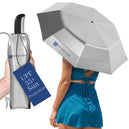
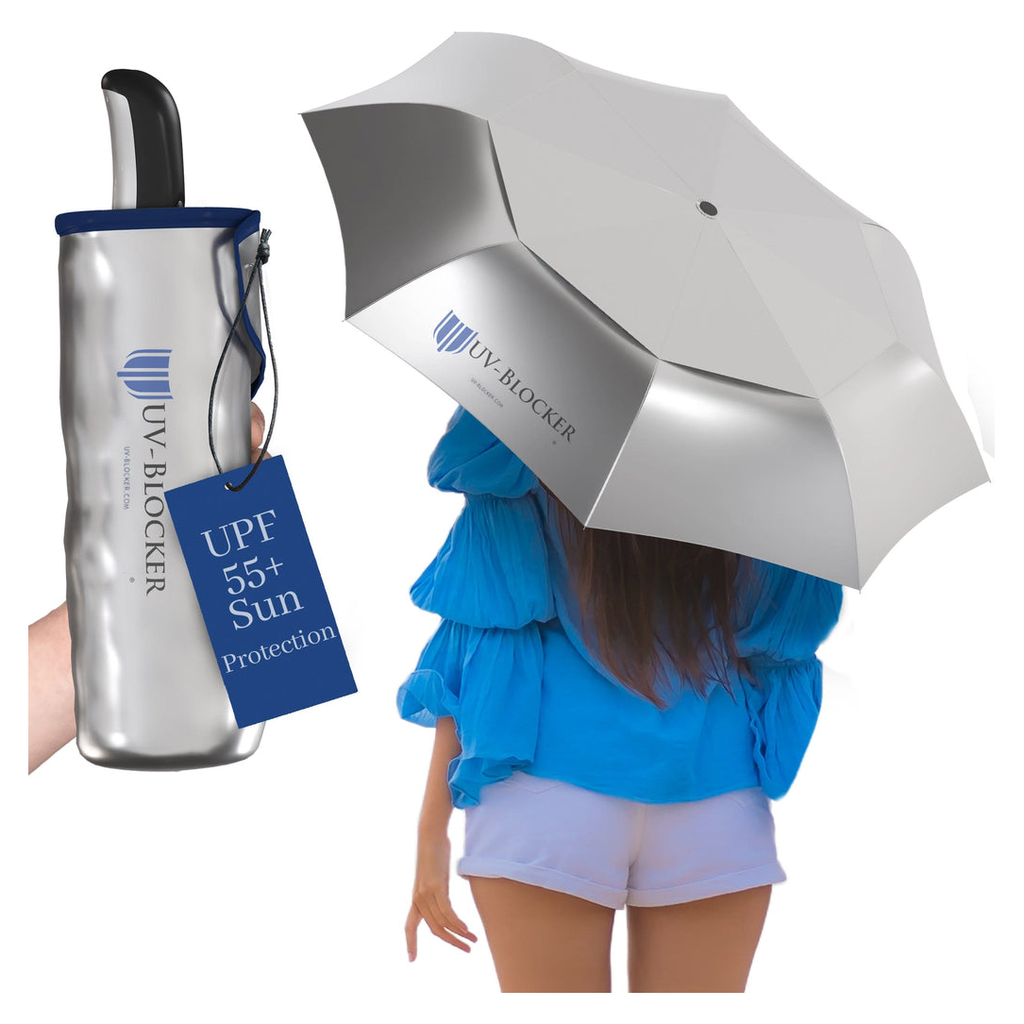
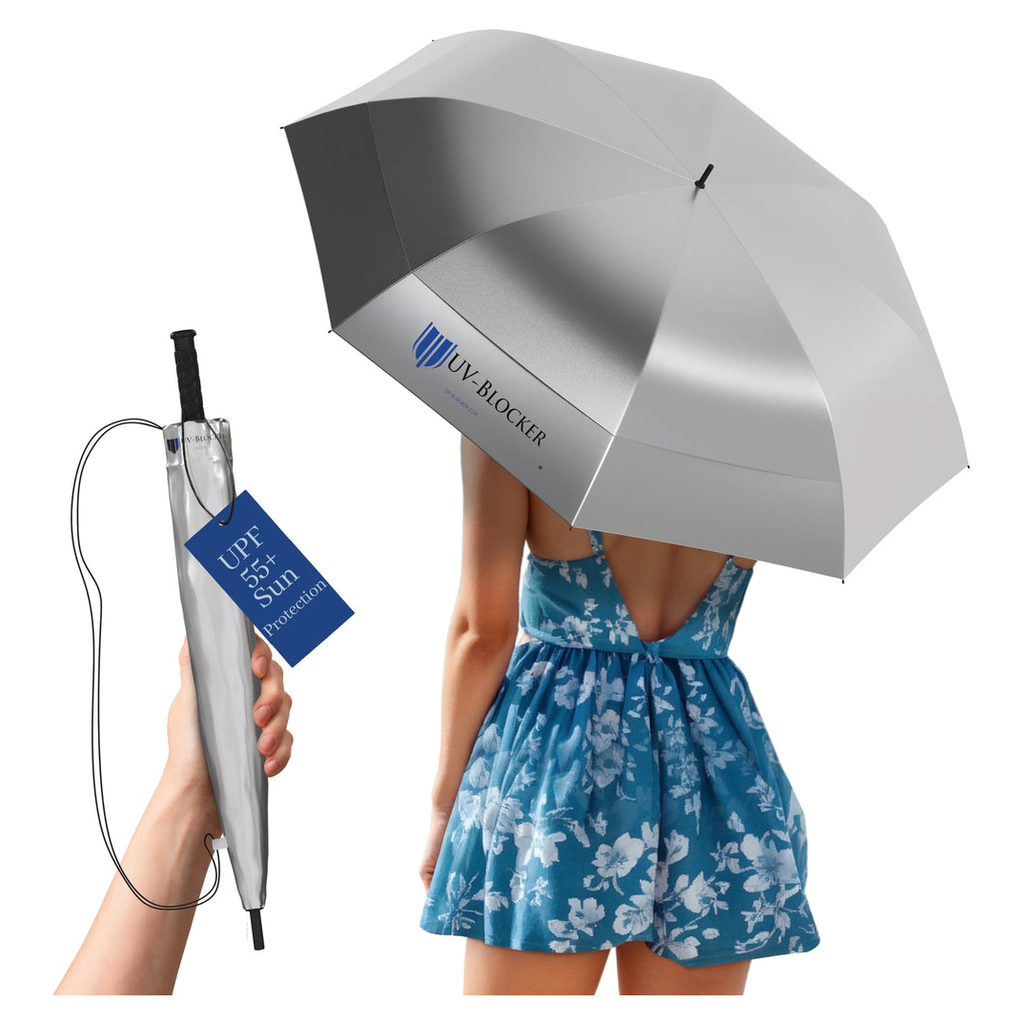
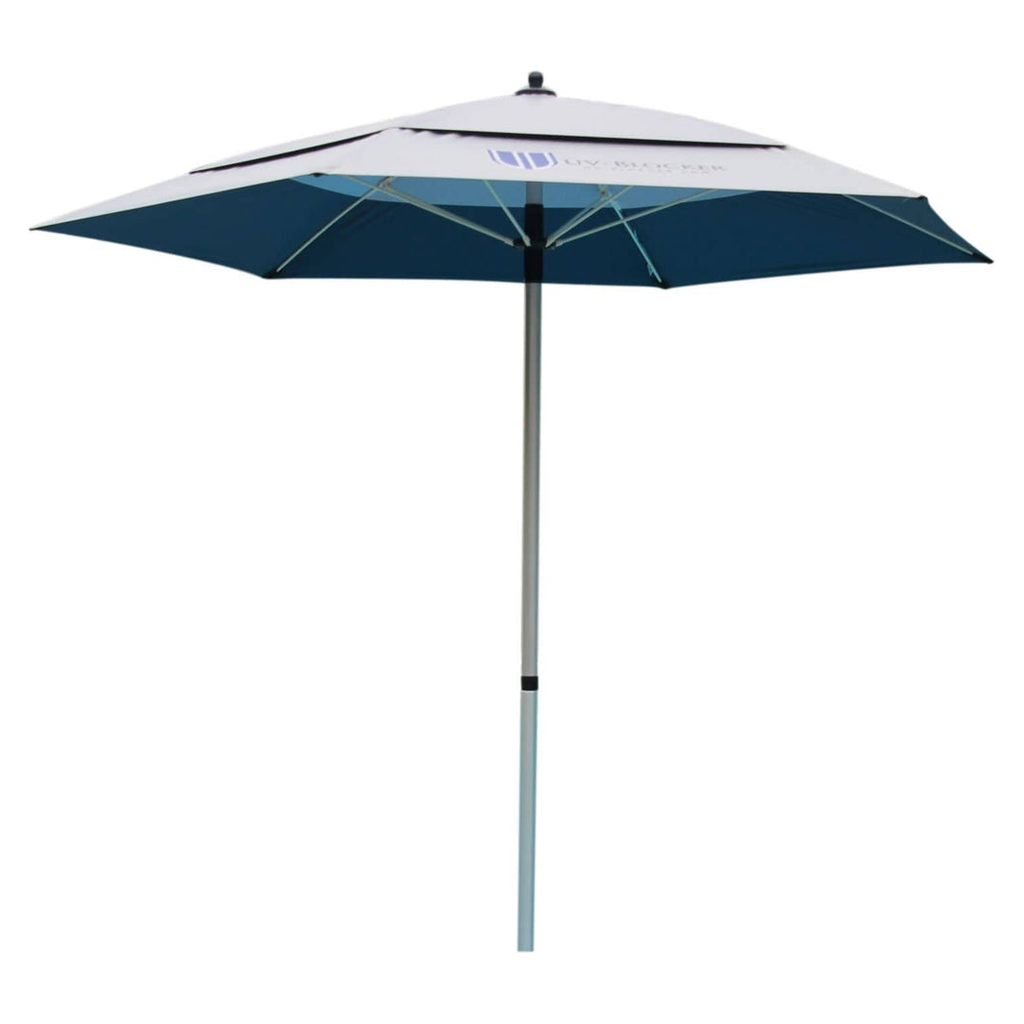
The Solarteck® canopy is silver on the outside and navy blue underneath. The reflective outer layer bounces UV and infrared away rather than absorbing it, which is why the area beneath measures roughly 15°F cooler than direct sun. The darker underside limits glare reflecting back up into the eyes.
The distinction worth insisting on is between a rating and a test. Plenty of umbrellas claim UV protection with nothing behind the claim. The full testing methodology is published for anyone who wants to see how those figures were produced.
What About Reflected UV From Sand, Water and Snow?
Shade cannot stop UV bouncing up from the ground. Fresh snow reflects as much as 80% of UV, and dry sand around 15%. An umbrella does not solve this.
That limitation is real and worth stating before any product claim. An overhead canopy intercepts UV travelling down. It does nothing about UV travelling up.
According to the World Health Organization, fresh snow is the worst offender, reflecting up to 80% of UV and almost doubling a person's total exposure. Sea foam reflects about 25%, and dry beach sand about 15%.
One widely repeated claim is worth correcting. Water reflects less than 10% of UV, which is less than sand. The risk at the water is not mirror-like reflection; it is UV penetrating the surface and the sheer number of hours people spend exposed. The AAD found that 16% of Americans are unaware UV reflects off snow, water and sand at all.
The practical conclusion is unglamorous. On fresh snow and open sand, shade alone is not enough, and the areas lit from below (chin, nose, underside of the arms) still need a topical layer or covered clothing. Any brand that tells you otherwise is selling.
What Does Sun Protection for People Who Don't Wear Sunscreen Look Like Day to Day?
Match the barrier to the setting. Commutes need something pocketable, sidelines need two-person coverage, and snow or open sand need shade plus a topical layer.
- Commute or city walk. Exposure is short but daily, and daily is what accumulates. A compact canopy that opens and closes at the touch of a button and lives in a bag removes the decision entirely. The UV Protection Compact Umbrella ($59.95) is 15 oz with a 39-inch coverage diameter.
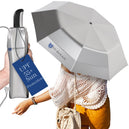
- Kids' sports sideline. This is the highest-risk slot on the list: two or three hours, static, usually midday, usually with no shade on the field. The Large Folding UV Umbrella ($64.95) has a 48-inch coverage diameter and covers two people.
- Patio lunch. Existing shade is often partial. Check whether the awning actually blocks the sun's current angle rather than just shading the table.
- Beach. Shade plus a topical layer on the areas lit from below, because of the roughly 15% reflection off dry sand.
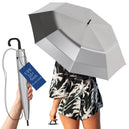
- Travel. The UV Protection Travel Umbrella ($59.95) opens automatically and packs flat, which matters when the alternative is buying nothing at the destination.
Frequently Asked Questions
Common questions from readers who have already stopped using sunscreen and want to know what shade does and does not replace.
Can I stop wearing sunscreen if I use a UV umbrella?
No. The American Academy of Dermatology continues to recommend sunscreen, and the CDC advises using sunscreen and protective clothing even in the shade. A UPF 50+ umbrella is not permission to stop. It is what still protects you on the days sunscreen was realistically never going to happen, which for roughly half of American adults is most days.
Does shade really protect from UV rays?
Yes. Shade physically intercepts direct UV before it reaches skin, and 44% of Americans do not know this. The caveat is that shade is partial rather than total, because UV also arrives scattered through the atmosphere and reflected off the ground.
Is an umbrella better than a hat?
They cover different areas. A wide brim shades the face and scalp, while a canopy covers the shoulders, arms and whoever is standing next to you. A hat is easier to wear hands-free; an umbrella covers considerably more surface area. The coverage math is worth seeing side by side.
Do I still need protection on cloudy days?
Yes. UV penetrates cloud cover, and cloud does little to reduce UV-A. Regular sunscreen use drops from 57% of Americans to just 21% on cloudy days, according to the AAD survey, which is one reason burns happen on days that never felt hot.
What UPF should I look for?
UPF 50+, which blocks at least 98% of UV and is the highest rating issued. The more useful question is which test standard produced the number. Ask for the standard, not just the claim. What UPF 50+ actually means covers how the rating is assigned.
Compare UV-Blocker Umbrellas
All three models use the same Solarteck® fabric and the same AATCC TM183-2020 test result. The difference is coverage and how they pack.
| Model | Coverage diameter | Weight | Opening | Best for | Price |
|---|---|---|---|---|---|
| Compact 42" | 39" | 15 oz | Auto open and close | Daily carry, commutes | $59.95 |
| Travel 44" | 37" | 1 lb 5 oz | Auto open | Packing, trips | $59.95 |
| Large Folding 58" | 48" | 1 lb 11 oz | Manual | Sidelines, two people | $64.95 |
Every model is UPF 50+, blocks 100% of UV-B and 99.97% of UV-A, and runs roughly 15°F cooler underneath. The full UPF 50+ range includes golf and beach sizes for longer static exposure.
The point is not that shade replaces sunscreen. It is that shade keeps working on the days sunscreen does not get used, and for a large share of people, that is most of them.
Frequently Asked Questions
What is the difference between UVA and UVB rays, and why does it matter?
UVA rays (320–400nm) are longer waves that penetrate deep into the skin, causing photoaging, wrinkles, and contributing to melanoma. They pass through glass and clouds and are relatively constant year-round. UVB rays (290–320nm) are shorter, cause sunburn, and are the primary driver of skin cancer. They're most intense midday (10am–4pm) and in summer. Effective sun protection must block both.
How effective is a UPF 50+ umbrella compared to sunscreen alone?
A UPF 50+ umbrella blocks 99%+ of direct overhead UV — more reliable than sunscreen because it doesn't require reapplication, doesn't wash off with sweat, and provides consistent protection. However, reflected UV from surfaces still reaches skin under an umbrella. The ideal combination is SPF 50+ sunscreen + UPF 50+ umbrella for 95–99% total UV reduction. UV-Blocker's umbrellas are dermatologist-recommended for this purpose.
What time of day poses the highest UV risk?
UV radiation is highest between 10am and 4pm, peaking around noon in most locations. The UV Index is the most accurate measure — when it reaches 6 or above, unprotected skin can begin to burn in as little as 15 minutes. Cloud cover reduces UV intensity but doesn't eliminate it: 80% of UV penetrates light cloud cover.
Does skin tone affect UV damage risk?
All skin tones are affected by UV radiation, but the risk and presentation differ. People with lighter skin (Fitzpatrick types I–III) burn faster and have higher non-melanoma skin cancer rates. People with darker skin (types IV–VI) are more prone to hyperpigmentation and have a higher risk of melanoma being diagnosed at later stages. Sun protection is essential for every skin tone.
What are early warning signs of skin cancer I should watch for?
Use the ABCDE rule for moles: Asymmetry, Border irregularity, Color variation, Diameter larger than 6mm, and Evolving (any change over time). Also watch for sores that don't heal, new pink or pearly bumps, and flat red or pink patches. Annual dermatologist screenings are recommended for anyone with significant sun exposure history or a family history of skin cancer.
Expert Sun Protection Recommendations
- Check the daily UV Index at weather.gov or a UV app before any extended outdoor activity
- Apply SPF 30+ broad-spectrum sunscreen 30 minutes before going outdoors, not right before sun exposure
- Reapply sunscreen every 2 hours and after swimming or heavy sweating
- Use a UPF 50+ umbrella for hands-free shade during outdoor dining, sports, or work
- Wear UV-blocking sunglasses that block 99–100% of UVA and UVB — eyes are vulnerable to UV-related damage
- Annual skin screenings with a board-certified dermatologist can catch early-stage skin cancers when highly treatable
Frequently Asked Questions
What is the difference between UVA and UVB rays, and why does it matter?
UVA rays (320–400nm) are longer waves that penetrate deep into the skin, causing photoaging, wrinkles, and contributing to melanoma. They pass through glass and clouds and are relatively constant year-round. UVB rays (290–320nm) are shorter, cause sunburn, and are the primary driver of skin cancer. They're most intense midday (10am–4pm) and in summer. Effective sun protection must block both.
How effective is a UPF 50+ umbrella compared to sunscreen alone?
A UPF 50+ umbrella blocks 99%+ of direct overhead UV — more reliable than sunscreen because it doesn't require reapplication, doesn't wash off with sweat, and provides consistent protection. However, reflected UV from surfaces still reaches skin under an umbrella. The ideal combination is SPF 50+ sunscreen + UPF 50+ umbrella for 95–99% total UV reduction. UV-Blocker's umbrellas are dermatologist-recommended for this purpose.
What time of day poses the highest UV risk?
UV radiation is highest between 10am and 4pm, peaking around noon in most locations. The UV Index is the most accurate measure — when it reaches 6 or above, unprotected skin can begin to burn in as little as 15 minutes. Cloud cover reduces UV intensity but doesn't eliminate it: 80% of UV penetrates light cloud cover.
Does skin tone affect UV damage risk?
All skin tones are affected by UV radiation, but the risk and presentation differ. People with lighter skin (Fitzpatrick types I–III) burn faster and have higher non-melanoma skin cancer rates. People with darker skin (types IV–VI) are more prone to hyperpigmentation and have a higher risk of melanoma being diagnosed at later stages. Sun protection is essential for every skin tone.
What are early warning signs of skin cancer I should watch for?
Use the ABCDE rule for moles: Asymmetry, Border irregularity, Color variation, Diameter larger than 6mm, and Evolving (any change over time). Also watch for sores that don't heal, new pink or pearly bumps, and flat red or pink patches. Annual dermatologist screenings are recommended for anyone with significant sun exposure history or a family history of skin cancer.
Expert Sun Protection Recommendations
- Check the daily UV Index at weather.gov or a UV app before any extended outdoor activity
- Apply SPF 30+ broad-spectrum sunscreen 30 minutes before going outdoors, not right before sun exposure
- Reapply sunscreen every 2 hours and after swimming or heavy sweating
- Use a UPF 50+ umbrella for hands-free shade during outdoor dining, sports, or work
- Wear UV-blocking sunglasses that block 99–100% of UVA and UVB — eyes are vulnerable to UV-related damage
- Annual skin screenings with a board-certified dermatologist can catch early-stage skin cancers when highly treatable